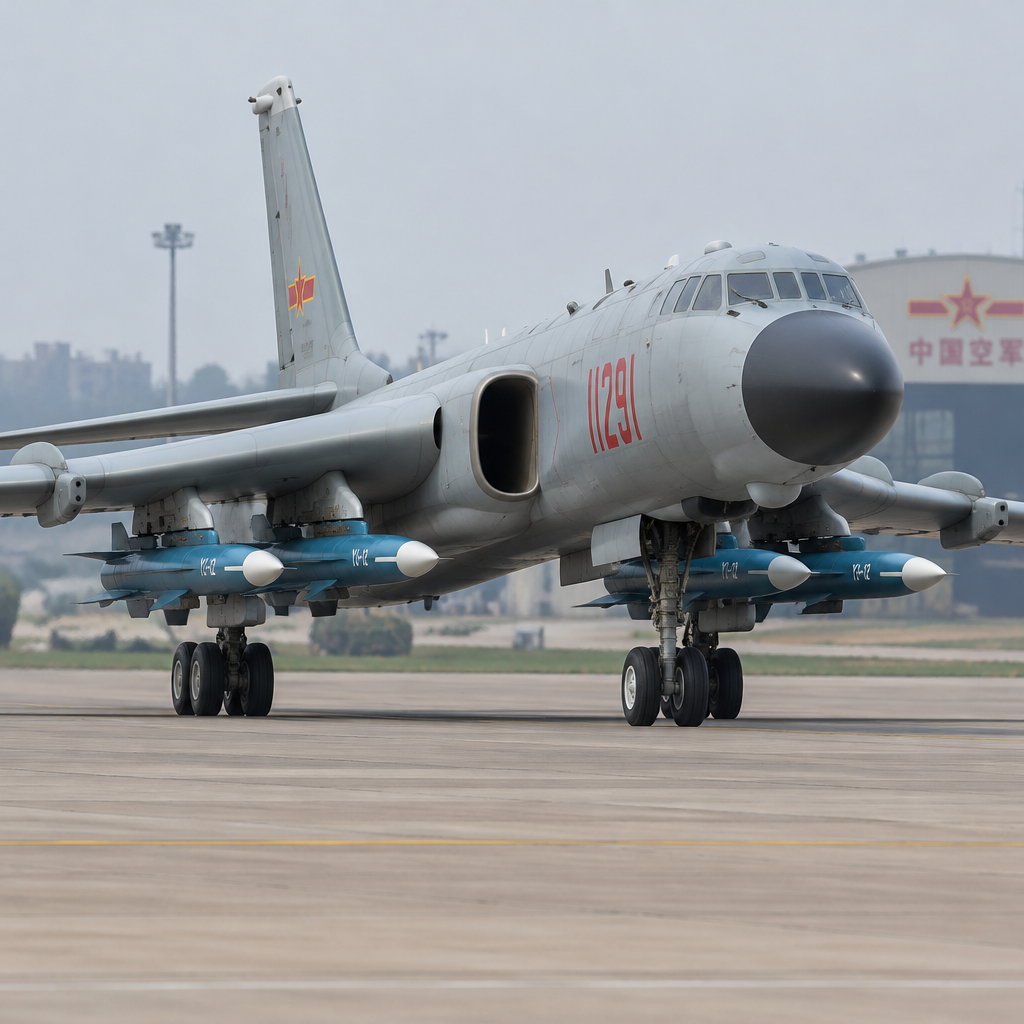
An H-6J photographed carrying four YJ-12 supersonic air-launched anti-ship cruise missiles and small electronic‑warfare pods on its wingtips illustrates a modest but practical upgrade to a long-serving bomber fleet: organic self‑protection that travels with the aircraft, not beside it.
The H-6 fleet's maritime strike role
The People's Liberation Army's H-6 family — including the Air Force's H-6K and the Naval Air Force's H-6J — remains a central platform for China's anti‑access/area‑denial posture. The platform is "primarily employed in the maritime strike role," extending the PLA's ability to threaten surface vessels well beyond the reach of coastal missile batteries, the post reports.
That maritime role is supported by the aircraft's payload flexibility: the H-6J photo shows a loadout tailored for ship attack, while other H-6Ks have been pictured with different pod configurations, underlining the platform's modular employment across missions.
YJ-12 supersonic air‑launched anti‑ship cruise missiles
The photographed H-6J carried four YJ-12 supersonic air‑launched anti‑ship cruise missiles. Those missiles, when hung on a long‑range bomber, give the platform the ability to generate stand‑off anti‑ship effects at ranges that supplement, and in some tactical scenarios exceed, fixed coastal batteries.

Audit-ready is a season. It shouldn't be.
Evidence in spreadsheets, controls drifting between audits, frameworks multiplying on flat headcount. Nubivance runs continuous compliance on Rapid7 Cyber GRC - SOC 2, HIPAA, ISO 27001, PCI, CMMC.
End the scrambleWingtips: self‑protection electronic warfare pods
The H-6s in the photos are fitted with self‑protection electronic warfare (EW) pods mounted on the wingtips. The post notes that these pods "provide the aircraft with an additional layer of survivability during long‑range missions." It adds that "there is no guarantee that dedicated electronic warfare escorts will always be available or capable of accompanying the bomber throughout the entire mission profile," so organic EW is a valuable fallback.
Photographs show at least two pod configurations in service: the H-6J with pods when carrying YJ‑12s, and an H-6K observed more recently with a different pod set — a small but material signal that the PLA is experimenting with or fielding multiple self‑protection suites on the same basic airframe.
Peacetime signaling and the bomber advantage over ballistic missiles
The post draws a tactical distinction that helps explain why bombers remain relevant: unlike a ballistic missile, a bomber "can be launched as a visible signal of intent, loiter near an area of interest, and then be recalled if tensions ease." That peacetime deterrence function — visible presence, reversible action — is why operators prize long‑endurance bombers, the commentary notes, using the U.S. B‑52 as a familiar parallel.
What this means for PLAAF and PLANAF mission planners, fighter escorts, and surface vessel commanders
- PLAAF and PLANAF mission planners: Organic EW pods expand mission options when dedicated EW aircraft or escorts are absent or unable to remain on station; pods add survivability without changing fundamental sortie planning.
- Fighter escorts: The post emphasizes the H‑6's "significantly greater endurance and range compared to its fighter escorts," a constraint that helps explain the appeal of self‑contained EW: escorts may lack the range or endurance to stay with bombers for the full mission profile.
- Surface vessel commanders and planners: The combination of air‑launched YJ‑12s on long‑endurance bombers increases the envelope from which ships can be targeted, supplementing coastal missile batteries and complicating defense geometry at sea.
Foreign military observers cited in the source have previously quantified how those ranges combine: the H‑6K's flight range was reported at about 3,500 kilometers, and its cruise missile a minimum of 1,500 kilometers, “which means the bomber is able to hit targets at least 5,000 km from its takeoff point.” Whether measured in photographs of pods on wingtips or in aggregated range estimates, the operational picture is consistent: the H‑6 fleet is being configured to sustain long‑range maritime strike operations with a greater degree of self‑defense.
The practical upshot is straightforward. Small, wingtip EW pods do not transform the H‑6 into a stealthy penetrator, but they do reduce risk for long‑distance sorties and increase the bomber's value for signaling and sustained presence. How often those pods will be paired with particular missile loads, which pod variants will become standard, and how escorts will be allocated remain matters for PLA planners — and for observers watching maritime stability in the region.