"Deterrence depends on unapologetic American strength; highly capable weapon systems that adversaries fear produced in quantities they can’t imagine at a price taxpayers can afford," Castelion CEO and co‑founder Bryon Hargis said.
Castelion’s Blackbeard design and test imagery
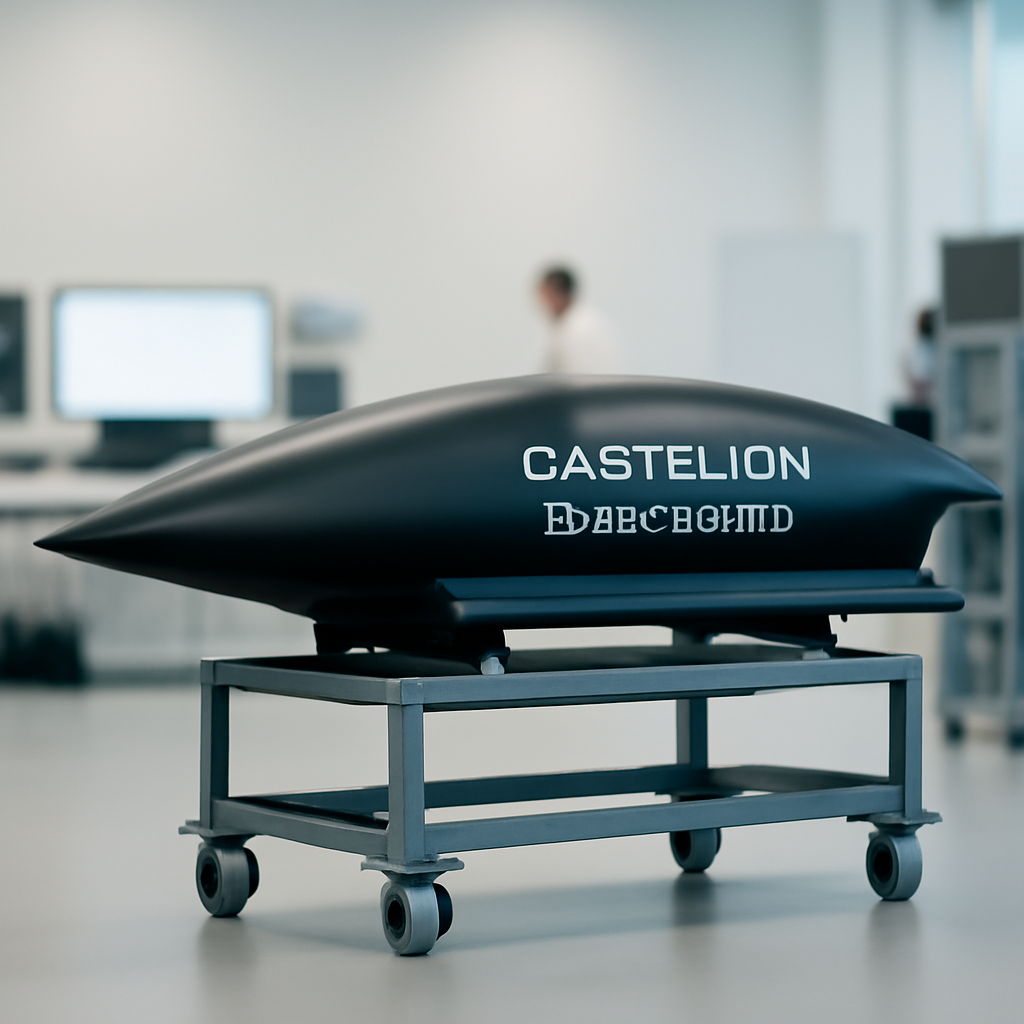
Castelion, a startup begun by former SpaceX employees, on August 20, 2026 released the first public view of its Blackbeard hypersonic weapon. The image and company material show a two‑stage weapon: a ballistic missile‑like booster topped by an unpowered hypersonic glide vehicle (HGV). Both stages feature cruciform fins; the HGV displays a pronounced chine along its body and a slightly beaklike nose. The weapon sits on a trolley that provides a sense of overall size, and the blue stripes visible on each stage normally signify an inert, non‑explosive round used for training or tracking — indicating the article on display was likely an unarmed missile rather than a pure mockup.
Flight concept, prior tests, and performance hints
Castelion’s choice of a booster plus unpowered glide vehicle contrasts with air‑breathing hypersonic cruise designs. The company has not published precise performance figures for Blackbeard in this release, but has previously hinted the system could reach targets out to just under 500 miles. Castelion has shown multiple earlier test configurations — described by the company as "representative of the low‑cost internally developed test vehicles we use to enable rapid subsystem design iteration" — and those experimental articles included tail sections resembling Standard‑series surface‑to‑air missile designs.
Castelion’s social posts point to a steady test tempo: the firm tweeted about two development flights completed on October 7, 2025, and noted a pair of flights in February 2025 with the company’s second flight within 30 days. The new image provides the clearest look yet at the configuration Castelion is taking toward production.

Audit-ready is a season. It shouldn't be.
Evidence in spreadsheets, controls drifting between audits, frameworks multiplying on flat headcount. Nubivance runs continuous compliance on Rapid7 Cyber GRC - SOC 2, HIPAA, ISO 27001, PCI, CMMC.
End the scrambleFinancing, valuation, and the Project Ranger manufacturing push
Castelion announced it had secured $1 billion in new financing to accelerate production of Blackbeard. Separately, the company disclosed a Series C that the firm described as comprising $800 million in equity financing and $250 million in committed financing; that equity round values Castelion at approximately $13 billion, the company said. Interlagos Capital’s Tom Ochinero, who participated in the financing, called Castelion "building the capabilities to produce thousands of hypersonic weapons a year."
A central element of Castelion’s effort is Project Ranger, a roughly 1,000‑acre campus in Sandoval County, New Mexico that Castelion describes as the largest dedicated hypersonic missile manufacturing site in the United States. The company previously committed more than $250 million of its own capital to infrastructure there and says it will invest "hundreds of millions of dollars more" to expand production capacity. Castelion says it has designed both the weapon and its production processes around the expectation that large numbers will eventually be required.
Procurement signals: Pentagon, Army, Navy, and Air Force links
The Pentagon in May outlined plans to acquire at least 10,000 Blackbeard missiles, along with a similar number of lower‑cost cruise missiles, over the next three years as part of a broader effort to expand U.S. long‑range standoff stockpiles and strengthen the defense‑industrial base. Castelion says it has secured more than $500 million in U.S. military contracts over the past 18 months.
The U.S. Army has signaled clear interest in a ground‑launched Blackbeard. Army budget documents state Blackbeard Ground Launch (GL) will "attack/neutralize/suppress/destroy using hypersonic missile delivered precision fires (seeker based) against time sensitive moving targets and hardened targets at a much‑reduced cost per missile than currently exists in the Army inventory," and describe GL as "an affordable, mass‑produced hypersonic weapon designed for mid‑range precision." The Army has discussed firing Blackbeard from new uncrewed launcher vehicles and from existing M142 HIMARS launchers, while noting its pursuit is being managed through a phased approach with "multiple off‑ramps."
Castelion also announced a Navy contract to integrate Blackbeard onto the F/A‑18E/F Super Hornet and transition the system to an early operational capability in 2027, work that the company said will include system safety and certification testing, flight testing, and other carrier integration activities. The company has received past work from the U.S. Air Force related to long‑range strike weapon concepts, and Castelion says it is pursuing a longer‑range precision strike weapon that will reuse Blackbeard technologies and manufacturing techniques.
What this means for the Army, the Navy, and U.S. manufacturers
- The Army: will continue phased acquisition of a ground‑launched Blackbeard variant for time‑sensitive and hardened targets, pursuing integration with HIMARS and new uncrewed launchers while retaining off‑ramps in its budget path.
- The Navy: will carry out carrier‑based safety, certification and flight testing to reach an early operational capability for a Blackbeard variant on the F/A‑18E/F in 2027; the service could also assess ship and submarine integration options.
- U.S. manufacturers and suppliers: Castelion’s Project Ranger and the company’s stated manufacturing philosophy aim to draw small and large U.S. suppliers into a higher‑rate production model, with the company committing its own capital and investor financing to scale facilities and processes.
Castelion portrays Blackbeard as a deliberate bet that a lower‑cost, highly manufacturable hypersonic design can be produced in numbers that change the calculus of deterrence. The firm says the design moved from a clean‑sheet concept to a program of record in less than four years, with fielding targeted for 2027, and that it will leverage fast, iterative design cycles and modern manufacturing practices. The concrete tests ahead are the company’s flight and certification milestones tied to the Navy and the Army’s phased buys, and whether Project Ranger can deliver the production rates the company and its investors expect.
Source: This Is The New Blackbeard ‘Cheap’ Hypersonic Weapon — The War Zone