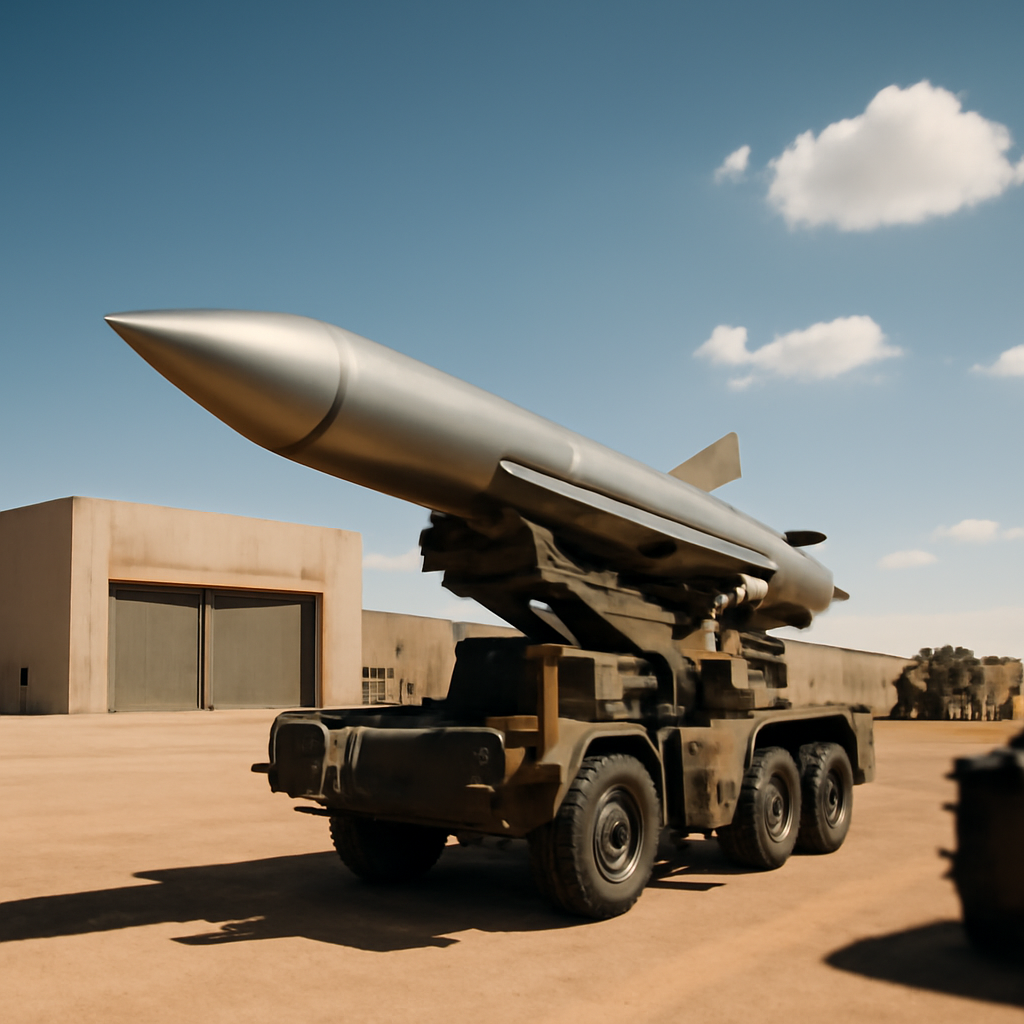
Originally, the range of the BrahMos missile was capped at approximately 290 kilometers — a deliberate limit set to remain below the Missile Technology Control Regime (MTCR) Category I threshold of 300 km/500 kg.
The UAE's gap in long-range precision strike
The United Arab Emirates fields one of West Asia’s most sophisticated air and missile defense networks, including THAAD, the MIM-104 Patriot, and the KM-SAM. Yet recent combat in the Iran conflict exposed limitations in Abu Dhabi’s long-range conventional strike options: the Black Shaheen is a subsonic, Mach 0.8 land-attack missile, and U.S.-supplied ATACMS only provides short-range ballistic precision land attack. The UAE currently lacks a supersonic precision-strike missile that can engage both maritime and land targets.
Reports that India is in talks with the UAE to export BrahMos and the Akashteer air defense command-and-control system respond directly to that gap. Acquisition of BrahMos would give the UAE a conventional anti-access/area-denial (A2/AD) capability against surface combatants and land targets, and provide an alternate strike option should airbases — as happened when Iranian strikes damaged Al Dhafra and Al Minhad — be degraded.
Russia's inventory squeeze and the BrahMos option
Russia, a co-developer of the BrahMos and a 49.5 percent stakeholder in BrahMos Aerospace, is reportedly considering inducting the missile onto its naval platforms despite owning indigenous missiles such as the P-800 Oniks, Kalibr, and Kh-35. The Ukraine war has significantly depleted Russia’s missile inventory, creating an urgent need to replenish stocks and expand production. While no orders from Russia have been placed yet, Moscow’s unique status as an MTCR member and partner changes the acquisition calculus compared with ordinary export customers.

This site is the portfolio.
OSINTSights runs on Cloudflare Workers, D1, R2, and Vectorize, with an AI pipeline on Hetzner ARM. Nubivance designed, built, and operates it. We do the same for clients.
See what we buildRange, MTCR, and export constraints
The BrahMos was built around India’s requirements and initially constrained to roughly 290 km to avoid MTCR complications when India was a non-member. India acceded to the MTCR in 2016, loosening those constraints and enabling New Delhi to pursue extended-range variants. India’s exports to date have remained limited to the original 290-km variant to avoid export friction, but the joint program structure leaves open the possibility that Russia, as a partner and MTCR member, could field extended-range variants now exceeding 400 km — and suggestions have been made of future iterations up to 800 km.
That technical and legal complexity matters because the MTCR does not impose a blanket ban but establishes a “strong presumption of denial” for transfers of Category I systems to non-MTCR states, with case-by-case assessment. Russia’s dual role as co-developer and MTCR member means any Russian induction of BrahMos would likely be handled under program-specific arrangements not publicly disclosed.
How BrahMos diverged from the P-800 Oniks
Although BrahMos traces its lineage to the Russian P-800 Oniks, the missile has transformed significantly. The program evolved to include much longer ranges, indigenous Indian guidance systems, navigation, software, seeker technology, and integration across multiple platforms. That evolution underpins its appeal to maritime customers and to states seeking supersonic precision-strike options.
India's support and logistics shortfall
Despite technical progress, India lacks an extensive network of overseas maintenance hubs, logistics networks, and institutional support that established exporters such as the United States or France provide. India’s defense-export industry remains largely platform-centric: deliveries prioritize individual systems over integrated life-cycle support. Prospective buyers may therefore face uncertainty about integration with existing command-and-control networks, timely access to spare parts in crises, software upgrades, depot maintenance, and training.
What this means for the UAE, Russia, and confirmed buyers
- The UAE will evaluate BrahMos chiefly as a way to add a supersonic, sea-and-land precision strike option and to reduce reliance on manned air operations in contested scenarios, while confronting integration demands with existing C2 systems.
- Russia could see BrahMos as a rapid supplement to depleted inventories and a candidate for naval deployment, but any induction would be governed by the undisclosed terms of the joint program and could diverge from typical export standards.
- Confirmed buyers such as the Philippines and Vietnam — and prospective ones like Indonesia — gain capability on paper, but their long-term effectiveness will depend on New Delhi’s ability to provide sustained technical support, spare parts, software upgrades, and training.
The BrahMos story has moved from a bilateral development to a potential litmus test of India’s emergence as a defense exporter: technical prowess is clear, and demand is growing from Southeast Asia to the Gulf. The longer-term question, however, is institutional. Without the maintenance hubs, logistics, and lifecycle commitments that buyers expect, BrahMos may face limits on adoption — even as range politics, MTCR rules, and Russia’s own needs reshape which variants and production models ultimately circulate.