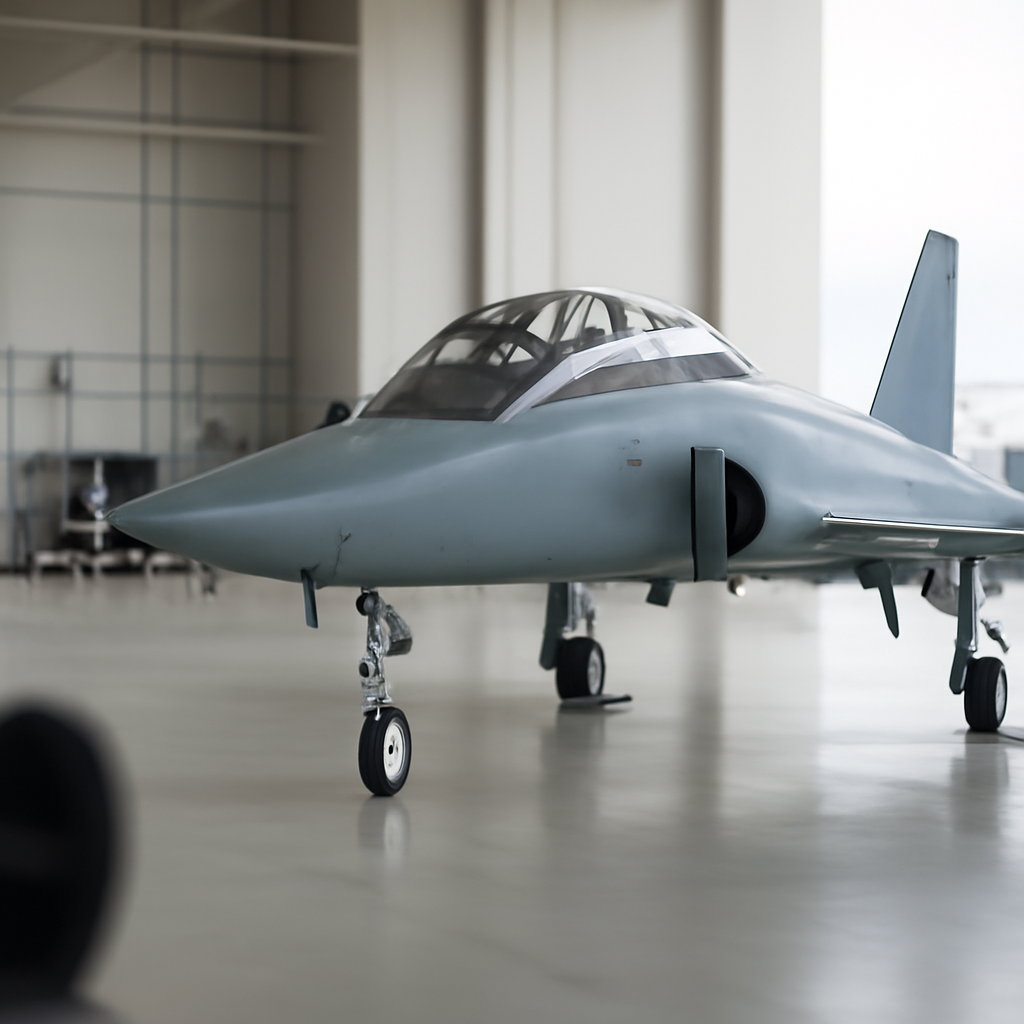
“Boeing is focused on meeting our commitments, and we bid for programs where we believe we can provide the right solution tailored to our customers’ needs and requirements,” a Boeing spokesperson told Breaking Defense.
Boeing’s withdrawal and its stated reasons
Boeing announced today that it will not bid on the Navy’s Undergraduate Jet Training System (UJTS) request for proposals. The company said it had previously planned to compete but, after evaluation, concluded that the T-7A Red Hawk it is producing for the Air Force “does not meet the U.S. Navy’s Undergraduate Jet Training System requirements,” a Boeing spokesperson told Breaking Defense.
The spokesperson emphasized program and schedule trade-offs: the T-7A is outfitted with the F404 engine, and meeting the engine-qualification requirements the Navy seeks would require “long-cycle development,” which Boeing said would “hamper” its ability to quickly reach initial operational capability. For that reason, Boeing “informed the Navy that we will not bid on the current RFP,” the spokesperson said.
The T-7A’s program status and Boeing’s commitments
The source notes that the T-7A was cleared for low-rate initial production in May and that Boeing framed the jet as “a modern, growth-oriented training solution for 4th, 5th and 6th generation [Air Force] pilots as requirements evolve.” Boeing also said it “remains committed to delivering the T-7A” and to “providing and sustaining both current and future capabilities for the Navy,” despite opting out of the current competition.

The cyber insurance questionnaire just landed. Now what?
SOC 2, HIPAA, insurance renewals - someone has to own security strategy. Nubivance provides fractional CISO leadership without the full-time salary.
Get a security leadWho remains in the UJTS competition
Boeing’s exit follows Lockheed Martin’s earlier decision to drop its offer of the TF-50N with Korea Aerospace Industries, a move Breaking Defense first reported in April. With Boeing and Lockheed Martin out, the remaining competitors named in the report are:
- Textron Aviation Defense offering the Beechcraft M-346N as part of a partnership with Leonardo
- SNC offering its Freedom trainer in partnership with Northrop Grumman and General Atomics
Navy requirements in the RFP and the updated program budget
The Navy issued the UJTS request for proposals in March and set out two notable departures from the current training fleet. First, the new trainer will not be required to land on aircraft carriers — a change from the legacy T-45 Goshawk, which the Navy has used since the early 1990s to train Navy and Marine Corps aviators for carrier aviation and tactical strike missions. Second, the aircraft will not be required to support field carrier landing practice (FCLP) to touch down; instead, the aircraft must support FCLP to wave off and competitors must detail “unique aircraft simulation capabilities” to prepare aviators for carrier landings, the RFP said.
Budget assumptions shifted during the early procurement phase. The Navy initially set a price ceiling of roughly $1.8 billion for the engineering and manufacturing development phase and up to seven low-rate initial production aircraft. In May, the service raised that price cap to $2.7 billion after industry signaled the original ceiling could pose challenges.
What this means for the Navy, Boeing, Textron Aviation Defense, and SNC
- The Navy: With two prime contractors—Boeing and Lockheed Martin—no longer in the race, the Navy will evaluate proposals from the remaining teams against the March RFP constraints (no carrier landing requirement, FCLP wave-off only) and the updated $2.7 billion cap.
- Boeing: The company has prioritized meeting its T-7A commitments and avoiding an extended engine-qualification development path that it says would slow initial operational capability; Boeing also reiterated its intent to support “current and future capabilities for the Navy.”
- Textron Aviation Defense and SNC: Both firms remain the named bidders in the report and will now carry greater weight in meeting the Navy’s specified simulation and training requirements without carrier touch-down or FCLP touchdown capability.
Boeing’s departure narrows the field and reshapes the dynamics of the UJTS competition: a program that initially attracted multiple aircraft offers now rests, according to Breaking Defense, primarily on two proposals that must meet an RFP that shifts the focus from physical carrier qualification to simulation and training fidelity — all within a revised $2.7 billion ceiling. Will the remaining teams demonstrate the “unique aircraft simulation capabilities” the Navy has demanded while satisfying cost and schedule requirements? That is the next concrete test the Navy faces as it seeks a successor to the T-45.