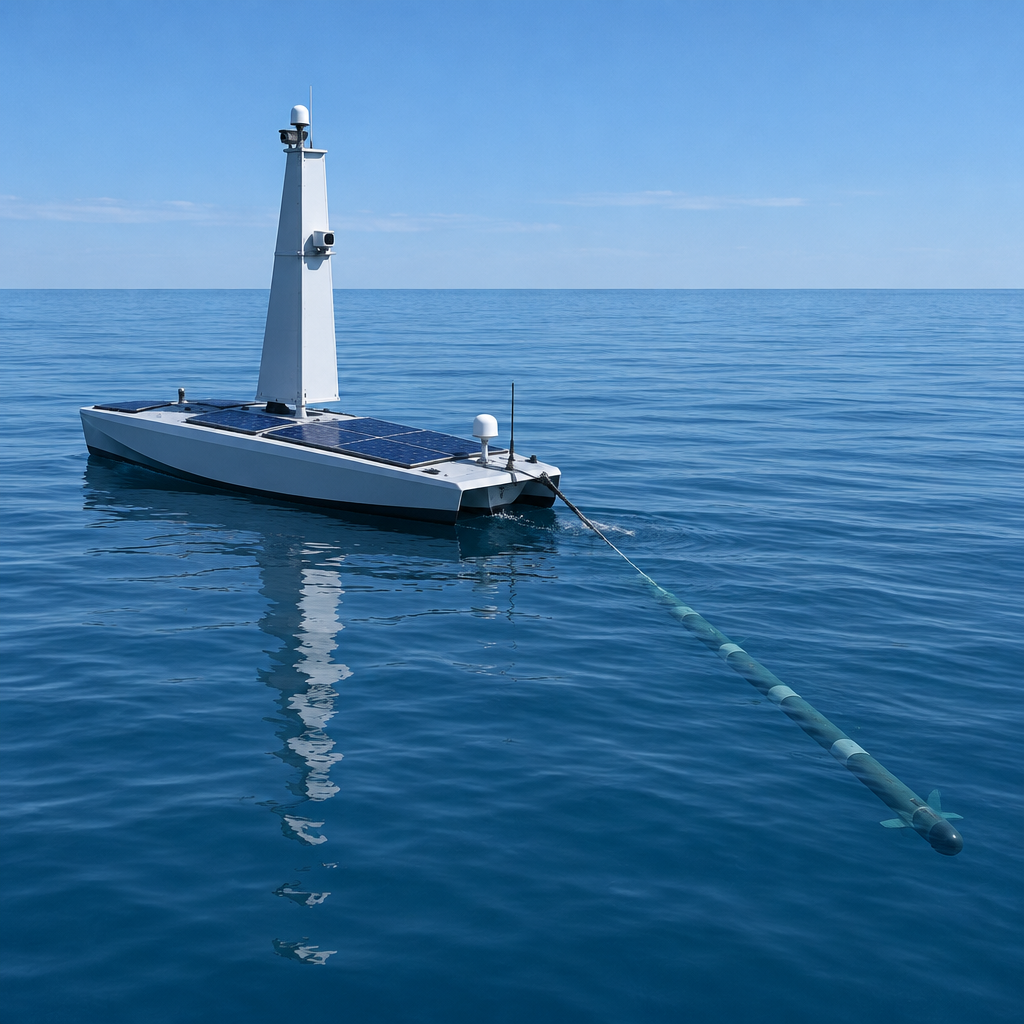
"a highly sensitive acoustic payload engineered to detect and track underwater threats with unmatched precision and persistence," ThayerMahan said of the towed-array it is supplying for Bluebottles.
Ocius Bluebottle: endurance, propulsion and patrol speed
The Ocius Bluebottle is a 6.8-metre uncrewed surveillance boat developed in Australia whose defining characteristics are long endurance and low speed. It uses solar and wave energy for propulsion and to power onboard equipment, and is fitted with a sail. Ocius reports deployments exceeding six months. In March 2026, then chief of navy Mark Hammond described patrol speeds as varying with the mission, up to about 6 knots. That combination — months at sea but limited top speed — makes the platform suited to sustained observation rather than rapid repositioning.
Operation Multus: a month of identification around New Zealand’s North Island
Operation Multus in 2024 illustrated how endurance and persistent sensors translate into maritime awareness. A Bluebottle operating around the North Island first monitored vessels of interest at Tauranga Harbour and then recorded patterns of normal activity in the Firth of Thames. Over the course of a month’s operations, the Royal New Zealand Navy reported that the Bluebottle had identified 182 vessels using radar, cameras and ship transponders.
The Bluebottle used in Operation Multus carried four navigation cameras, a separate camera with pan, tilt and zoom functions, and a radar with a reported vessel-detection range of about 22 km, the New Zealand navy said. Those sensors supported classification and patterning of traffic rather than high-speed pursuit.

Audit-ready is a season. It shouldn't be.
Evidence in spreadsheets, controls drifting between audits, frameworks multiplying on flat headcount. Nubivance runs continuous compliance on Rapid7 Cyber GRC - SOC 2, HIPAA, ISO 27001, PCI, CMMC.
End the scrambleFiji, 2025: layered surveillance and 24/7 sharing
In 2025 New Zealand deployed two Bluebottles to help identify and track suspect vessels in Fiji’s exclusive economic zone. During part of that deployment a King Air light aircraft provided additional surveillance and a Fijian navy vessel was available for boarding and seizure. Fiji and New Zealand shared operational duties 24/7.
These arrangements demonstrate a recurring operational model: long-endurance uncrewed platforms extend the time-on-station and situational awareness, while crewed aircraft and ships provide speed, reach and the capacity to overtly interdict or board vessels.
Payload choices: cameras, radar and towed-array sonars
Payload selection determines what a Bluebottle can detect and the missions it can support. The Operation Multus loadout emphasised electro-optical and radar sensing for surface identification. For anti-submarine or underwater threat detection, Australia has contracted US maritime surveillance company ThayerMahan to supply 40 towed-array sonars to equip Bluebottles. ThayerMahan described the model as "a highly sensitive acoustic payload engineered to detect and track underwater threats with unmatched precision and persistence," and in August 2026 the company said the payload had operated for over 85 consecutive days during exercises, detecting, classifying and tracking targets.
Operational limits: coverage, tracking handover and adversary risk
Bluebottles’ low speed constrains how they can be used. A single boat can loiter on station and observe passing traffic, but continuous tracking of a moving ship requires either a second Bluebottle or another sensor positioned to pick the track up as it leaves range of the first. Operators therefore face a trade-off: a given number of Bluebottles can be spread to increase geographic reach or concentrated to provide overlapping coverage in priority areas. The mission profile and the availability of other sensors, such as aircraft, dictate that choice.
Uncrewed endurance does not eliminate human roles: people must still interpret observations, and information must arrive early enough for response assets to intercept or take over tracking. The source deployments were in cooperative waters; the record of peacetime operations does not show how Bluebottles would fare in wartime. In adversarial seas another state could interfere with, seize or attack a Bluebottle, and the possibility of capture affects payload choice because equipment or stored information could be exposed.
What this means for navies, onshore patrols and vendors
- Navies: Bluebottles can extend time-on-station and provide low-cost, persistent observation, but navies will need to plan sensor mixes and layered responses so that detection leads to timely investigation or interdiction rather than late awareness.
- Onshore patrols and boarding teams: Information from Bluebottles can support onshore reconnaissance and patrols, as happened off northwestern Australia in October 2022, by supplying observations that complement ground activity.
- Vendors and payload suppliers: Companies such as ThayerMahan will be judged on endurance, continuous-operation performance (the company reported over 85 consecutive days of towed-array operation) and on how they mitigate the risks of hardware or data exposure if a Bluebottle is seized.
Bluebottles are demonstrably useful where long watches and slow, steady observation suffice: charting traffic patterns, cueing aircraft, and supporting shore parties. Their limits are equally clear — coverage gaps, handover needs, and vulnerability in contested waters — leaving a set of practical choices for operators about numbers, payloads and how quickly human decision-makers can act on what the boats see.
https://www.aspistrategist.org.au/where-bluebottles-long-watch-pays-off/