"A moment to step back and reassess the fragility of our space launch infrastructure," Todd Harrison said — and the May 28 Blue Origin New Glenn mishap made his point with a wrecking ball rather than a thought experiment.
Todd Harrison on fragility and the falloff in competition
Hours after a Blue Origin rocket explosion at a Florida pad, a SpaceX vehicle launched a military payload from a nearby site — a sequence that exposed what Harrison, a defense space expert at the American Enterprise Institute, called the vulnerability of current plans. The practical consequence is stark: just two companies are certified to handle the nearly 100 National Security Space launch missions the Pentagon has budgeted for in the next five years — SpaceX and United Launch Alliance (ULA). With Blue Origin's New Glenn test failing to advance vehicle qualification and ULA's Vulcan still sidelined amid a probe into a solid rocket booster anomaly, heavy-lift capability (defined in reporting as payloads between 22 and 55 tons) is effectively concentrated with one provider for now.
Blue Origin's New Glenn test and the damaged launch pad
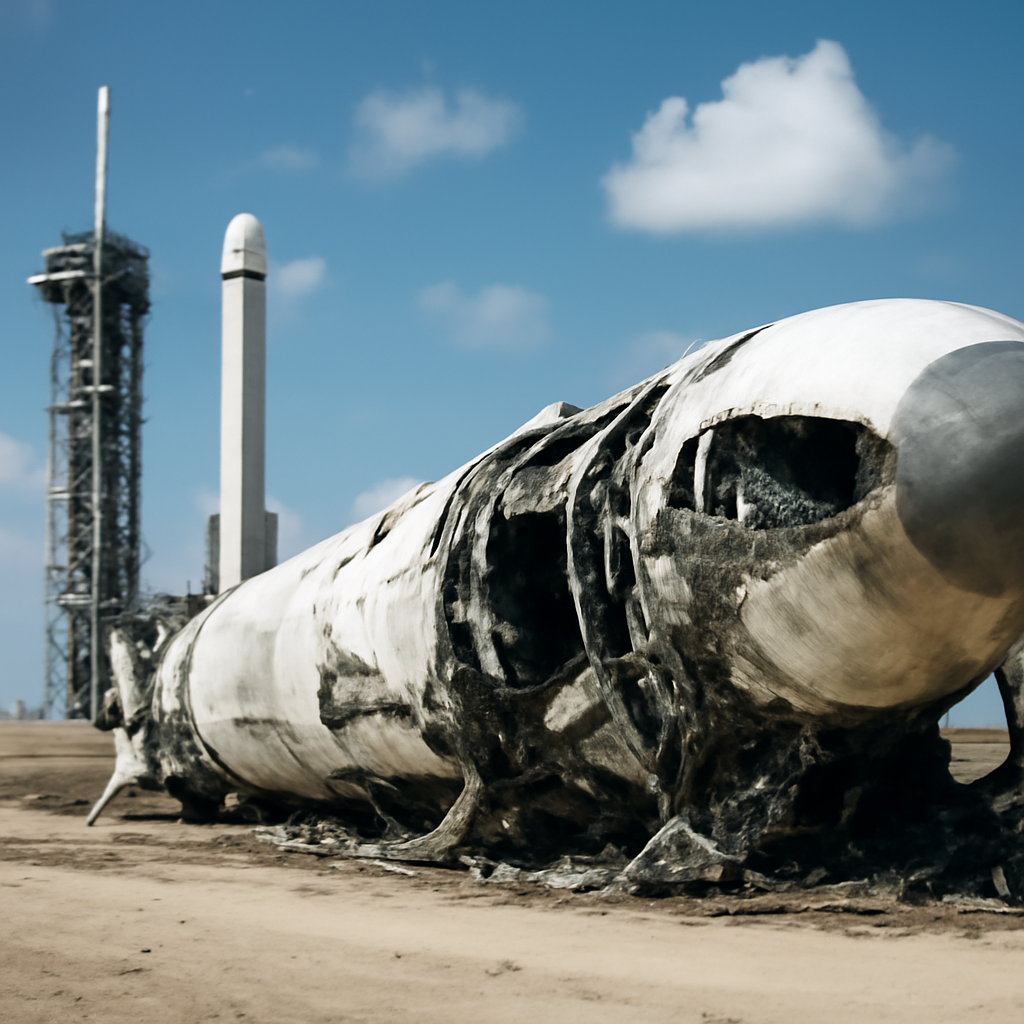
The May 28 integrated vehicle hot fire test of New Glenn ended in an explosion that damaged Blue Origin's only pad. Just before the mishap, service officials had awarded the Jeff Bezos–owned company a task order for a National Reconnaissance Office mission slated for late 2027 or early 2028. Within days, Space Systems Command issued a May 29 press release saying the U.S. Space Force and NRO "remain committed partners with Blue Origin and will work with them on the New Glenn vehicle anomaly." Blue Origin CEO Dave Limp later posted that the company plans to have another New Glenn in the skies by "the end of this year," but the article notes uncertainty about how long recovery will take — SpaceX itself needed more than a year to repair a pad after a 2016 Falcon 9 explosion.

Audit-ready is a season. It shouldn't be.
Evidence in spreadsheets, controls drifting between audits, frameworks multiplying on flat headcount. Nubivance runs continuous compliance on Rapid7 Cyber GRC - SOC 2, HIPAA, ISO 27001, PCI, CMMC.
End the scrambleSpaceX's market dominance and its internal financial profile
SpaceX has emerged as the de facto backbone of national-security launches. In its S‑1 filing, the company wrote, "We are the primary launch provider for the U.S. government." The filing and reporting document that SpaceX rockets launched 11 of last year's 12 national-security launches and that the company holds the contracts for five of seven high-profile launch missions in the current fiscal year. SpaceX also operates Starlink, which "has become crucial for military operations." At the same time, the S‑1 disclosed business weaknesses: the launch business lost roughly $657 million last year, the company's AI segment lost $6.3 billion, and the only profitable segment was Starlink with $4.4 billion in income. Analysts quoted in the reporting warned that SpaceX's breadth of ambitions — from launch to SATCOM to AI and orbital data centers — complicates its positioning as a pure defense contractor.
Congressional scrutiny: the House Armed Services Committee and the 2027 NDAA
Congress is taking notice. The House Armed Services Committee's initial draft of the 2027 National Defense Authorization Act directs the Air Force Secretary to brief lawmakers by March 2027 on how the Space Force is "investing in capability and capacity" to increase launch cadence and to present ideas to "accelerate development and reduce barriers to participation by nontraditional defense contractors." A HASC staffer told reporters the committee retains "continued interest in maintaining and growing competition across the space enterprise, to include launch."
Objective Force 2040, launch cadence, and infrastructure constraints
Service planning documents and industry groups paint a picture of sharply rising demand colliding with constrained infrastructure. The Space Force plans to launch more than 200 rockets from Cape Canaveral and Vandenberg this year; its "Objective Force 2040" document projects that could increase to more than 3,000 launches per year in the next decade and warns that reliance on those two bases "creates enduring vulnerability to natural hazards, operational disruption, and degraded performance during periods of peak demand." The Commercial Space Federation reported that "U.S. orbital launch demand has surpassed 180 launches per year, straining infrastructure that must be developed years in advance of its need," and recommended coordinated investment by the Defense Department, NASA, local governments, and private companies. Service leaders told Defense One they are exploring expanding launch capabilities to other sites and more providers.
What this means for the Space Force, the NRO, and Congress
- Space Force and NRO: Both organizations are publicly committed to working with Blue Origin on the New Glenn anomaly, but planners face a near-term reality where primary heavy-lift capability rests with a single certified provider while two prospective alternatives are stalled.
- NRO and mission planners: Awarded tasking to Blue Origin for a late‑2027/early‑2028 mission now sits against an uncertain New Glenn recovery timeline, increasing schedule risk for downstream payload integration.
- Congress: HASC's draft 2027 NDAA language signals lawmakers will press the Air Force for a plan to expand capacity, reduce barriers to nontraditional contractors, and accelerate infrastructure investment — a request due by March 2027.
The Blue Origin test failure did more than destroy hardware; it removed a little of the sheen from projections of a fast-arriving, diversified launch market. With New Glenn's qualification set back, Vulcan under investigation, and nearly 100 national-security launches budgeted over five years, the Pentagon's reliance on certified providers and limited pads is now a tangible operational constraint. The immediate path forward — whether through accelerated infrastructure investment, regulatory shifts to bring more providers online, or continued dependence on the current leaders — is the next hard test for planners and policymakers.