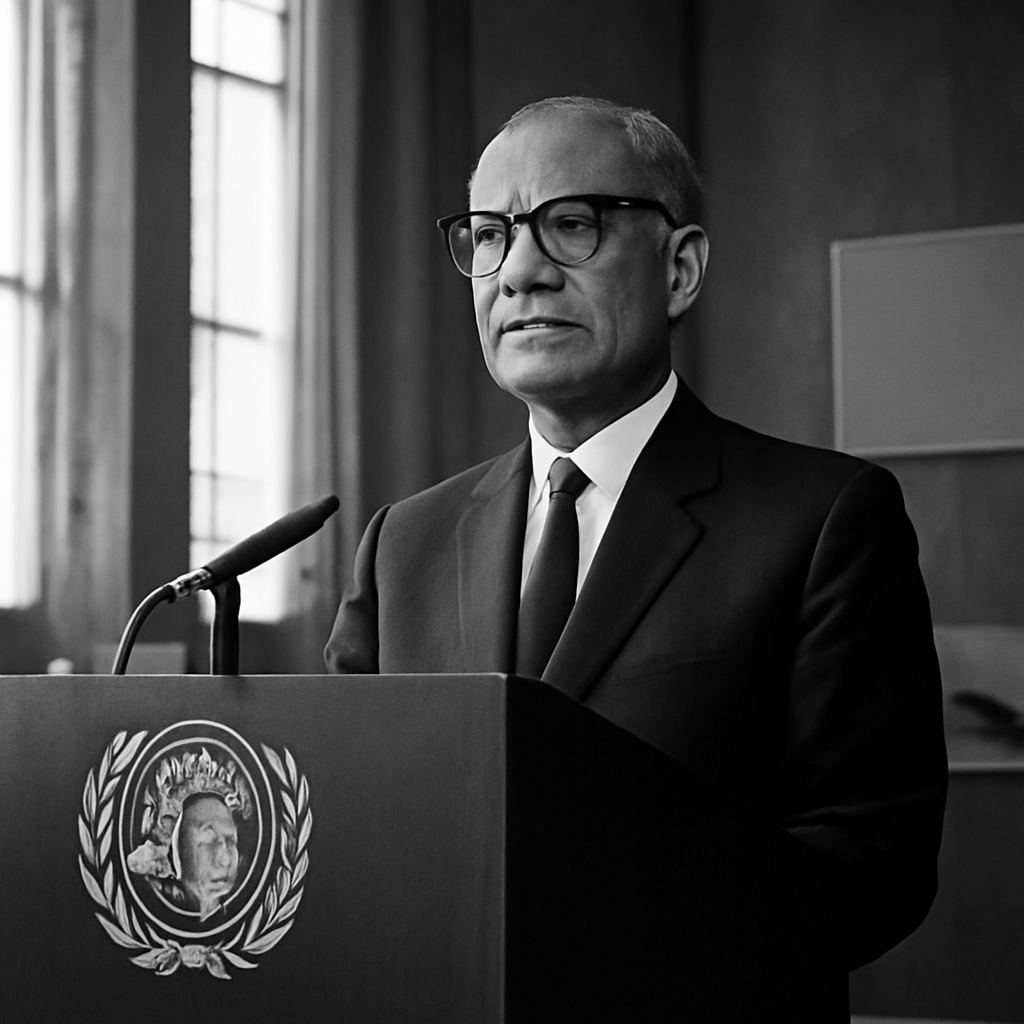
“All conflicts have more than two sides, those of the two antagonists and that of the rest of the world.” — U Thant, addressing the UN Security Council during the Cuban missile crisis.
U Thant’s unlikely ascent to the UN’s top job
U Thant’s path from a small town in then–rural Burma to the UN secretary-generalship was, by any measure, unexpected. He studied for two years at Rangoon University, served as headmaster of his local school and entered government service after Burma’s independence in 1948 at age 39. In less than a decade he rose to become the prime minister’s secretary and later Burma’s ambassador to the United Nations. When Dag Hammarskjöld died in a plane crash on a peacekeeping mission to the Congo in September 1961, the United States and the Soviet Union advanced divergent succession plans. Thant emerged as the compromise candidate acceptable to both superpowers and the membership; the General Assembly unanimously elected him in November 1961.
Thant at the Security Council: Cuba, restraint, and the limits of negotiation
Thant’s decade at the UN was visibly proactive and frequently controversial. Peacemaker, a new biography by his grandson Thant Myint-U, highlights Thant’s behind-the-scenes role in resolving the 1962 Cuban missile crisis. Addressing the Security Council at the height of tensions, Thant framed his approach in the language of wider responsibility — the oft-cited admonition that conflicts affect “the rest of the world” as well as the principal antagonists. Thant Myint-U’s account uses that episode to underscore a central lesson of the period: negotiations and restraint depend on the willingness of the principal parties to engage.

Audit-ready is a season. It shouldn't be.
Evidence in spreadsheets, controls drifting between audits, frameworks multiplying on flat headcount. Nubivance runs continuous compliance on Rapid7 Cyber GRC - SOC 2, HIPAA, ISO 27001, PCI, CMMC.
End the scrambleThe 1965 Vietnam proposal, Dean Rusk, and a deteriorating relationship with Washington
Peacemaker documents a lesser-known episode from 1965 in which Thant proposed peace negotiations over Vietnam. According to Thant Myint-U’s archival account, Secretary of State Dean Rusk did not pass Thant’s proposal on to President Lyndon Johnson. Thant treated the non-delivery of his proposal as a missed opportunity, and the episode chilled relations between Thant and the State Department. Over the course of the decade, rising tensions around the Vietnam war and the Arab-Israeli conflict pushed Thant’s ties with the United States “to near breaking point,” the book reports.
Crises that tested the UN’s authority: Six-Day War and Czechoslovakia
As the 1960s advanced, the UN’s ability to shape outcomes came under severe strain. Thant was widely criticized for not doing more to prevent the buildup of tensions that led to the Six-Day War in the Middle East, and the Soviet invasion of Czechoslovakia in 1968 reinforced the impression of the organisation as ineffectual. The decade began with the UN on a high and enjoying strong support from the Kennedy administration — including close working ties between Thant and US UN ambassador Adlai Stevenson — but the multiplication and intensity of global conflicts made the balance between superpower interests and the organisation’s credibility ever harder to maintain.
Thant in person: the diplomacy of small details
Thant Myint-U’s narrative is rich in personal detail. The biography notes Thant’s taste for daiquiri cocktails and Burmese cigars, describes the furniture and artwork in his office on the 38th floor of the UN building, and portrays a man who entertained heads of state, politicians and diplomats — and even show-business figures such as Frank Sinatra and John Lennon. Those personal touches are coupled with archival research to present a rounded portrait of a leader whose public actions were framed by private rituals and social connections.
What candidates to succeed Antonio Guterres, the U.S. State Department, and Afro-Asian member states will watch
- Candidates to succeed Antonio Guterres: Peacemaker’s account of the backroom dealing that accompanies UN leadership transitions will serve as a practical guide to the informal diplomacy and cross‑power acceptability that have decided past selections.
- The U.S. State Department: The 1965 episode in which Dean Rusk did not forward Thant’s Vietnam proposal illustrates how withholding or relaying initiatives can shape the secretary-general’s credibility and bilateral relations.
- Afro-Asian member states: The 1960s expansion of recently independent Afro-Asian countries transformed the UN’s balance of interests; their evolving roles then — and the compact institutional environment of the era — are central elements in Peacemaker’s narrative and will inform how these states view candidacies and influence today’s contest.
Thant Myint-U’s Peacemaker is presented as a thoroughly researched, elegantly written account that seeks to become the definitive biography of U Thant. Beyond biography, it is a practical reminder that the UN secretary-general’s power often rests less on formal authority than on the ability to be acceptable to competing capitals, to seize diplomatic openings, and to press for negotiation and restraint at delicate moments. With Antonio Guterres’s term at the UN ending in December and candidates already lining up, the lessons from Thant’s decade — the successes, the missed chances, and the social architecture of influence — arrive at an apt moment for reflection.