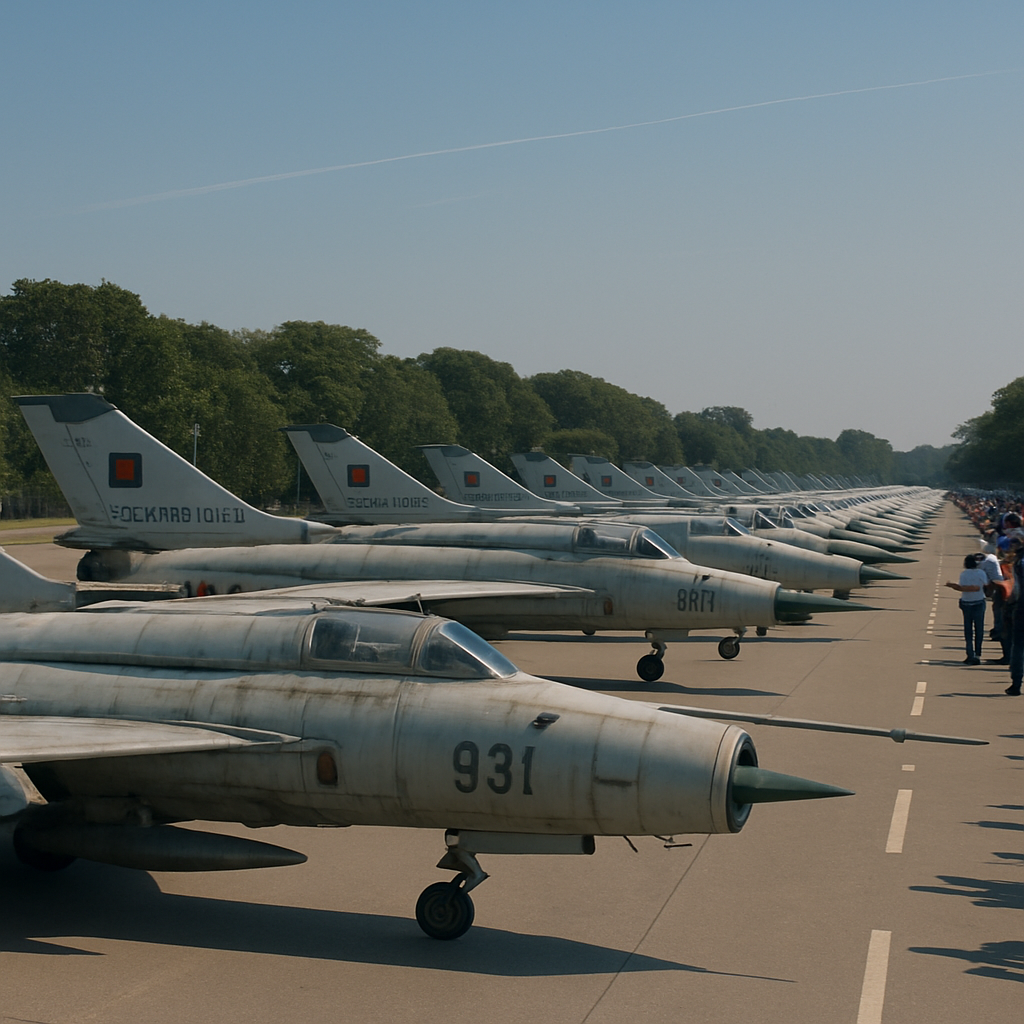
"The Bangladesh Air Force will become a paper tiger," warns the assessment of current trends — a blunt conclusion that rests on a few stark numbers and a parade that failed to convince a watching public.
March 26 Independence Day parade: spectacle and backlash
On March 26, jets carved patterns across the sky in a meticulously choreographed aerial display meant to signal strength. Instead, the event reignited long-standing criticism. Social media, particularly among younger Bangladeshis, reacted to what they saw as a lackluster combat aircraft inventory and an air force "out of step with the demands of modern warfare." The parade affirmed popular frustration that had been building for years rather than resolving it.
Fleet composition: 44 combat aircraft, aging cores
The statistics are plain: the Bangladesh Air Force (BAF) fields 44 combat aircraft. Of those, 36 rely on the Chengdu F-7 platform and the remaining eight are MiG-29s. The assessment characterizes the F-7 fleet as "aged and outdated" and describes the MiG-29s as "legacy platforms" that are "well past their prime." With only eight MiG-29s, the service does not even possess what constitutes a full operational squadron in conventional terms.

The cyber insurance questionnaire just landed. Now what?
SOC 2, HIPAA, insurance renewals - someone has to own security strategy. Nubivance provides fractional CISO leadership without the full-time salary.
Get a security leadModern air power: beyond raw aircraft numbers
The evaluation stresses that modern air power is not defined by the tally of airframes alone. Combat effectiveness increasingly depends on electronic warfare capabilities, system integration across platforms, and the ability to operate within a joint-force framework. On those measures the BAF is evaluated as falling behind. Without robust electronic warfare, platform interoperability, and networked operations, individual purchases risk contributing to a fragmented patchwork rather than an integrated fighting force.
Procurement dynamics: promises, diversions, and the Eurofighter episode
Bangladesh's modernization planning—formalized in "Forces Goal 2030"—has long included acquiring modern multi-role combat aircraft. But the pattern, the assessment finds, is familiar: announcements and letters of intent that do not lead to signed contracts or concrete timelines. A December 2025 letter of intent to purchase the Eurofighter Typhoon briefly suggested decisive movement; ultimately no contract was signed and momentum faded without a clear schedule for follow-up discussions.
Procurement decisions are framed as more than technical choices. The piece notes that New Delhi's concerns about Chinese military involvement in the region translate into diplomatic pressure and calculated military posturing on Bangladesh's borders, which in turn slows procurement through bureaucratic delays and limited vendor options. As workarounds, Dhaka has purchased Russian-made Yak-130 trainers, acquired Turkish Bayraktar TB2 attack-drones, and continued engagement with Chinese suppliers. It has also discussed the JF-17 Thunder. Those actions demonstrate diversification and exploratory buying but, the analysis cautions, diversification unaccompanied by systems integration may fail to produce a coherent, networked capability.
How Dhaka’s new administration, the Bangladesh Air Force, and New Delhi are positioned
- The new administration in Dhaka is described as having intentions — public commitments under "Forces Goal 2030" and a December 2025 letter of intent — but the record shows a pattern of plans that "eventually lead to no concrete action." The central question posed is whether this administration will convert intention into consistent execution.
- The Bangladesh Air Force faces an operational and technological gap: a small combat fleet (44 aircraft), heavy reliance on the Chengdu F-7, and legacy MiG-29s. Without timely modernization and systems integration, the service risks being unable to meet rising strategic demands in the Bay of Bengal and along contested borders.
- New Delhi exerts a moderating influence on Dhaka’s procurement choices. The assessment describes Indian responses ranging from border military deployments to diplomatic pressure, not always open opposition but effective in slowing or shaping purchase options for Dhaka.
The Bay of Bengal's growing strategic relevance, repeated airspace violations attributed to an unstable Myanmar, and external powers' increasing activity in the Indo-Pacific form the context that makes the BAF's capability shortfalls consequential. The article's throughline is concise and unforgiving: Bangladesh has articulated a strategic vision and dabbled in diversification, yet without continuity in procurement or a focus on integration, those intentions may not translate into effective air power.
The next concrete marker will be whether the government advances signed contracts, establishes interoperable acquisition choices rather than a scattered inventory, and prioritizes electronic-warfare and integration capabilities alongside airframes. Absent that, the assessment concludes, the BAF risks evolving into the very "paper tiger" critics fear — impressive in appearance on parade days, but deficient when measured against the demands of contemporary warfare.
Source: The Diplomat — Bangladesh’s Air Power: Intentions Meet a Widening Capability Gap