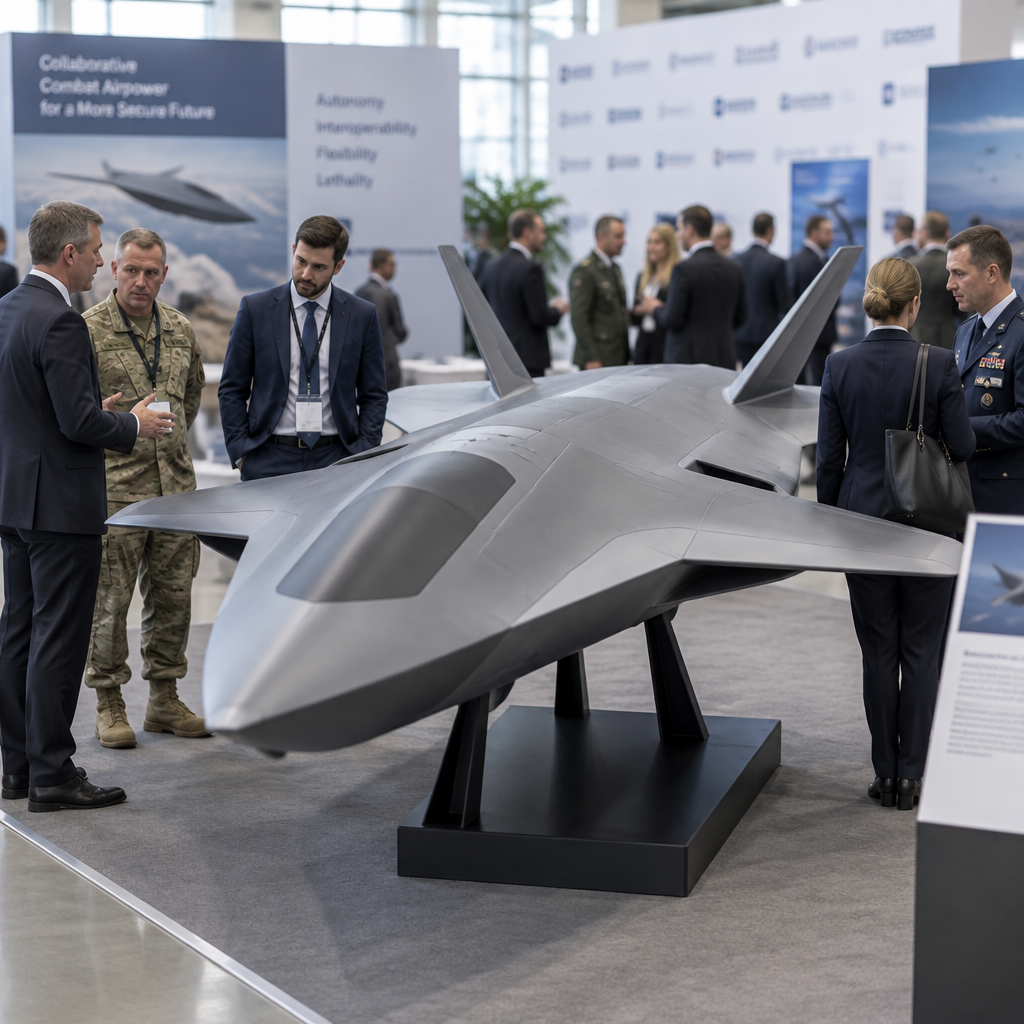
"The next two years will matter more than the last 15 years," Saab warned at the International Fighter Conference in Munich, where collaborative combat aircraft (CCA) dominated the discussion and the show floor.
Munich conference: six CCA mock-ups, beer on the house, Chatham House Rule
The annual International Fighter Conference, held in Munich in early November, was dominated by CCA contractors. They were the lead sponsors, provided the beer – a recurring social lubricant at an event populated by fighter pilots – and displayed six mock-ups of fighter-like drones, five of them full-size. Three of the mock-ups were from the United States and three from Europe. The conference was conducted under the Chatham House Rule, which restricted identification of individual speakers, and briefings about crewed-fighter programs were sparse: the multinational Global Combat Aircraft Program, Boeing F-47 and F/A-XX details remain closely held, and there was little the Lockheed Martin F-35 builders wanted to share.
Saab’s ACP roadmap: A1 demonstrator next year, A2 testing RF skin, A3 operational by 2035
Saab used Munich to lay out a three-iteration plan for an autonomous collaborative platform (ACP). The company said it will fly a supersonic ACP demonstrator, the A1, next year. The A1 differs from Saab’s earlier A3 model by having tailfins – described in the source as a non‑stealthy feature – while also including a stealth-representative inlet and outer shape and an internal weapon bay, a configuration Saab calls entirely new to the company. Saab described the A3 as the third, operational iteration of the series and said an operational A3 could be in service by 2035.
Saab described the A2 as demonstrating conformal radio‑frequency apertures integrated into structural skin panels, work being led by its radar and electromagnetic-warfare unit and enabled by additive manufacturing, along with AI integration. Saab also said it had integrated a Helsing AI combat system on a JAS 39E in 2025 and that, because of its partitioned mission system, the AI addition could be tested in international airspace; it contrasted that with similar US tests, which Saab said have been confined to controlled ranges. Saab noted its vertical integration across radar, EW, missile units and experience with fighter datalinks, and it pointed to ownership of the GlobalEye long‑range radar surveillance aircraft as "an ACP enabler."

Audit-ready is a season. It shouldn't be.
Evidence in spreadsheets, controls drifting between audits, frameworks multiplying on flat headcount. Nubivance runs continuous compliance on Rapid7 Cyber GRC - SOC 2, HIPAA, ISO 27001, PCI, CMMC.
End the scrambleShield AI, Ryan Tseng and the X‑Bat pledge
Private-sector demonstrations and promises were on display. Ryan Tseng, co‑founder of Shield AI, presented a tail‑sitting, truck‑transported X‑Bat and promised a December flight demonstration to a sceptical audience. The presentation was described as lively and confident. Such pitches contrasted with Saab’s more measured tone and highlighted the range of approaches to CCA demonstrations at the conference.
US Air Force framing: CCAs tied to the F‑47, pilots and "affordable mass"
US Air Force presenters at Munich framed CCAs as a force-multiplying companion to emerging crewed platforms. One senior US Air Force officer linked CCAs strongly to the emerging F‑47, noting the F‑47 alone will not deliver what the service calls "affordable mass" — the ability to field large numbers of aircraft and missiles. The service is testing Increment 1 CCAs alongside the F‑22; the F‑22, the presentation said, is being upgraded as a lead‑in to the F‑47 and retains a primary air‑to‑air role.
A USAF presenter argued that "what we mean by affordable mass depends on the problem you’re trying to solve," and warned that, looking into the 2030s, even if the service could build more fighters "we couldn’t find the pilots." The presenter added that "operations and support are what make the fifth‑generation platform expensive," and suggested a pilot acting as a quarterback for CCAs would need only "one or two live flights" a year in addition to simulated training.
Engines and industrial limits: F414, FJ44 and the 4,000–7,000 lbf gap
The conference surfaced a practical industrial constraint: propulsion. Saab’s A1 will use a General Electric F414, the same engine in the JAS 39E Gripen. Several Increment 1 CCAs from Anduril and General Atomics are powered by the Williams FJ44; Lockheed Martin’s Vectis, not part of the USAF program, will make its first flight with the FJ44 but is talking to GE about a new engine. The conference assessed that there is no modern, existing engine in the 4,000–7,000 pounds‑thrust class (18–31 kN) — the thrust band needed to step up CCA size to larger, self‑deploying, multi‑mission platforms. The source quoted the assessment that even if an engine is not required to run for thousands of training hours like a crewed fighter’s engine, it still must be reliable, and that investing in a cheap, low‑margin product without a spares and support tail is a poor business case.
What this means for Saab, the US Air Force, Anduril and small air forces
- Saab: The company is positioning itself to lead AI‑enabled air combat by combining in‑house radar, EW, missile capabilities, the Helsing AI integration on a JAS 39E in 2025, and its GlobalEye asset as an enabler.
- US Air Force: The service is tying CCAs explicitly to the F‑47 and F‑22 upgrade path, balancing promises of "affordable mass" against pilot‑availability and life‑cycle costs for fifth‑generation platforms.
- Anduril and other venture‑backed firms: Smaller contractors working Increment 1 designs face funding and specification risks — the source noted venture capital contenders are already sounding unhappy about delays in funding the second batch of early production aircraft, and a substantial Increment 2 specification change could be a "cold shower" for them.
- Small air forces: Saab argued that for smaller services there are "no attritable systems, just expendable weapons and survivable aircraft," and claimed the ACP could halve life‑cycle costs versus a Gripen and target half the acquisition cost, although Saab conceded that acquisition savings are "more difficult."
The Munich event made plain that CCAs have moved from lab demonstrations to public roadshows, prototype mock‑ups and programmatic linkages to crewed platforms. The practical challenges that followed — engines in a mid‑thrust class, funding cadence for Increment 2, pilot availability and the economics of sustainment — now stand between the enthusiasm on the floor and any sustained, large‑scale fielding. The next concrete checkpoints cited in Munich were Saab’s A1 demonstrator flight next year and the promised X‑Bat flight in December.