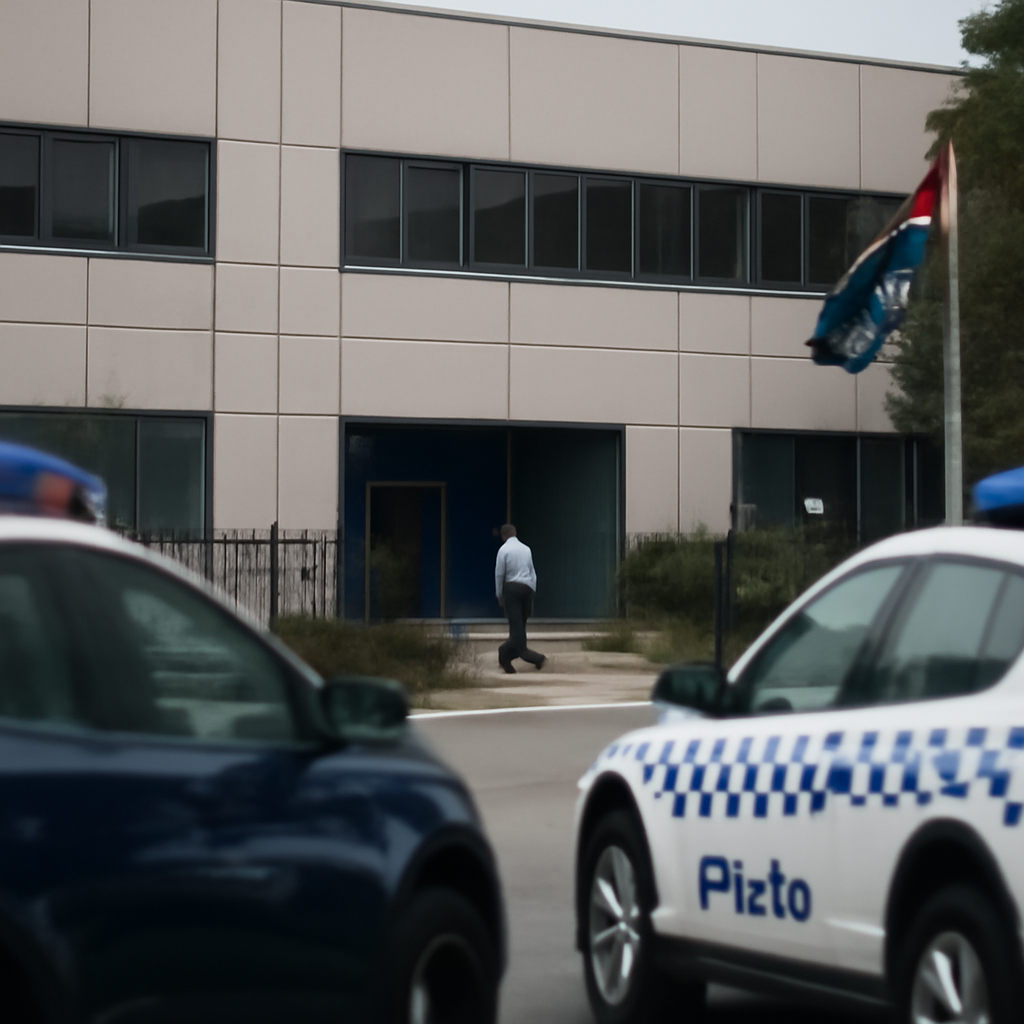
"The joint counterterrorism team... said yesterday it was investigating the attack as an ‘act of terrorism, potentially orchestrated by far-left extremists with anarchist and revolutionary ideologies.’" That sentence—issued by a joint taskforce of the Australian Federal Police, Victoria Police and the Australian Security Intelligence Organisation—frames an investigation whose implications extend well beyond a single night of damage.
Joint counterterrorism team investigation
On 5 July 2025 unknown people vandalised property at Melbourne-based Lovitt Technologies. The Victorian Joint Counter Terrorism Team, composed of the Australian Federal Police, Victoria Police and ASIO, is treating the incident as an act of terrorism while investigating whether it was "potentially orchestrated by far-left extremists with anarchist and revolutionary ideologies." The question of whether the incident legally qualifies as terrorism, the taskforce and the commentary note, is ultimately for investigators, prosecutors and the courts to determine.
Lovitt Technologies, its work, and the incident
Lovitt Technologies makes aerospace components, including for the global F-35 fighter program. On 5 July 2025 the company’s property in Melbourne was vandalised and vehicles were set alight. The material published about the case does not identify suspects or provide operational detail beyond the fact of damage and the fact that the matter is being examined by the joint counterterrorism team.

The cyber insurance questionnaire just landed. Now what?
SOC 2, HIPAA, insurance renewals - someone has to own security strategy. Nubivance provides fractional CISO leadership without the full-time salary.
Get a security leadHow language has blurred protest and coercion
The public debate around this investigation is not only legal but strategic. The source warns that over time Australia’s public boundary between peaceful protest, civil disobedience, criminal coercion and terrorism has become "increasingly blurred." That drift, the commentary argues, is driven in part by imprecise vocabulary: trespass recast as "direct action," deliberate obstruction called "disruption," property damage relabeled "non-violent resistance," and assaults on police reduced to "clashes."
Equally, governments sometimes risk adding to the confusion by too readily invoking the language of extremism when responding to unpopular activism. The consequence, the piece contends, is that language shapes legitimacy, legitimacy shapes social norms, and social norms shape behaviour—so losing precise terms can change what is accepted as legitimate political behaviour.
Restoring a democratic taxonomy for political action
The commentary sets out a reasserted taxonomy designed to clarify the boundary between persuasion and coercion. It distinguishes five categories:
- Peaceful protest: communicating ideas without committing offences against others.
- Civil disobedience: deliberately breaching the law while openly accepting legal consequences.
- Criminal coercion: unlawful conduct used to impose operational, financial or psychological costs on others for political ends.
- Politically motivated violence: deliberate use of violence or serious intimidation to advance ideological objectives.
- Terrorism: the narrower statutory category reserved for conduct intended to intimidate the public or coerce governments through serious harm.
The argument advanced is not that escalation inevitably produces terrorism, but that democracies should pay attention to incremental coercion long before terrorism laws become engaged. Historical examples referenced—anti-apartheid protests in 1981, Franklin Dam environmental protests in the early 1980s, anti-lockdown demonstrations, and campaigns targeting defence companies—are offered to show how smaller groups can adopt more coercive tactics as less extreme methods lose effect.
What this means for police, protesters, and defence companies
- Police and security agencies: must balance proportionate law enforcement with political neutrality. The source notes the strain on resources—the deployment of almost 1,800 Victoria Police officers each day during the 2024 Land Forces protests is cited as an example of growing operational demands—and points to ASIO warnings that politically motivated violence is becoming more ideologically diverse.
- Protesters and activists: face a choice between civil disobedience that accepts legal consequences and tactics that risk categorisation as criminal coercion or worse. The commentary stresses that figures such as Gandhi and Martin Luther King Jr are held up as examples of civil disobedience that strengthened legitimacy because their participants accepted punishment.
- Defence companies and employees: have the right to conduct lawful activities without criminal interference and to attend work safely. The Lovitt Technologies incident is presented as a reminder that attacks on business property can trigger both criminal and counterterrorism responses.
The central prescription is institutional and linguistic discipline. Democracies damage themselves when they conflate peaceful protest with extremism, rely unnecessarily on extraordinary powers, or respond disproportionately to lawful demonstrations. Restoring a shared taxonomy—so that protest, civil disobedience, criminal coercion, politically motivated violence and terrorism are recognised and treated differently—aims to preserve the democratic advantage of resolving political disagreement by persuasion rather than compulsion.
Whatever legal finding emerges from the Melbourne arson investigation, the broader lesson urged is procedural and cultural: re-establish the boundary between persuasion and coercion before normalised coercion becomes simply another form of protest. The source leaves a clear next step implicit—reclaim language and practice that distinguish lawful dissent from criminal intent—so that enforcement, public debate and civic norms can operate with shared meaning and proportionate response.
Source: ASPI Strategist — "Democracy needs a boundary between protest and coercion"