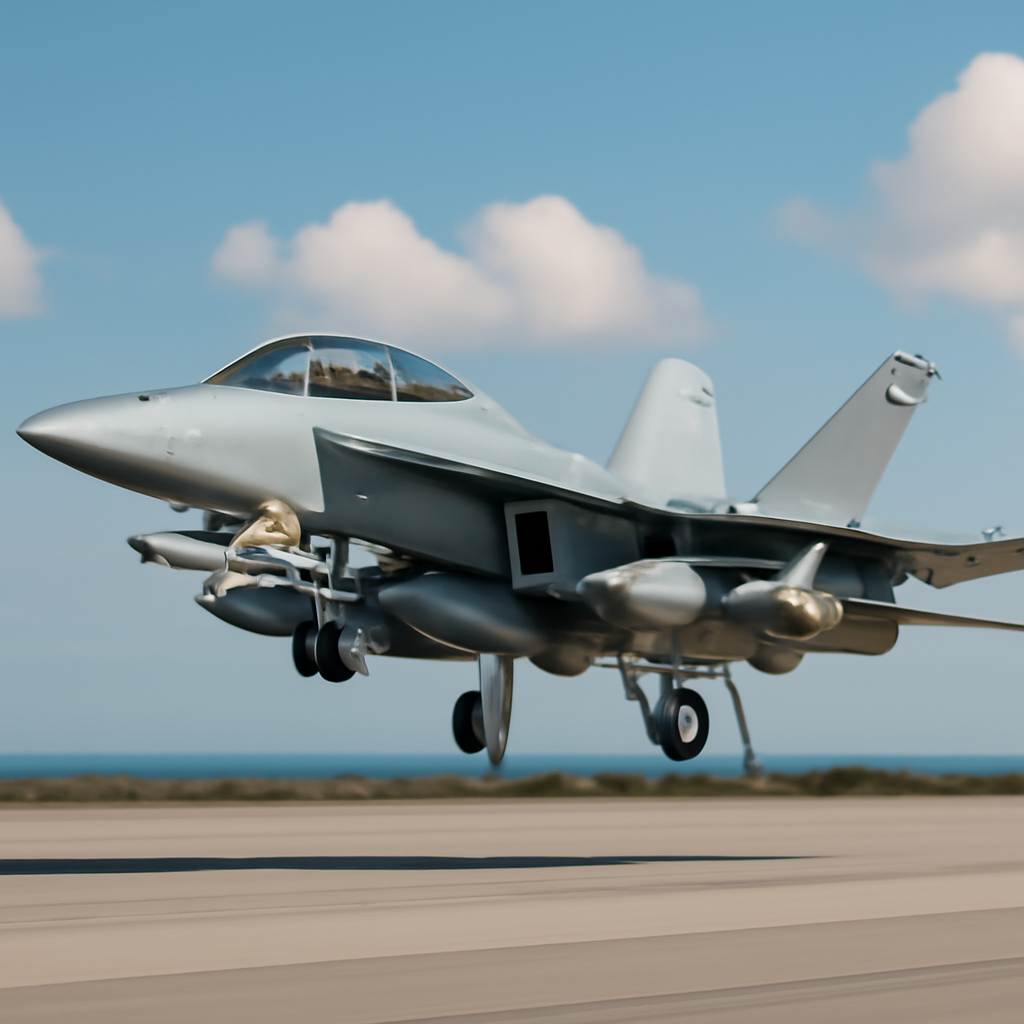
A Royal Australian Air Force F/A-18F assigned to No. 1 Squadron was photographed taking off from Naval Base Ventura County Point Mugu on September 11 during Gray Flag 2026, carrying an inert AIM-260 Joint Advanced Tactical Missile on station 7 — the “cheek” station — alongside inert AIM-9X and AIM-120 training rounds and multiple external stores.
What the photograph shows
The U.S. Navy-released image, credited to Dana Rene White, depicts an RAAF F/A-18F with a visible AIM-260 JATM on the cheek station. The aircraft’s loadout also includes a CATM-9X (the inert AIM-9X training variant), a CATM-120 (the inert AIM-120 AMRAAM training variant), three external fuel tanks, an AN/ASQ-228 ATFLIR targeting pod, and a Tactical Combat Training System (TCTS) pod. Blue bands on the missile body confirm it was a training round with an inert rocket motor and/or warhead.
Gray Flag 2026 as the test bed
Gray Flag 2026, the naval aviation test community’s flagship large-force test event, was the largest edition of the exercise to date. According to the Navy, the event brought together more than 3,000 personnel from over 150 organizations, flew more than 750 sorties and logged over 2,000 flight hours across hundreds of multi-domain test objectives. Using the Point Mugu Sea Range, Gray Flag provides a venue for large-scale integration of aircraft, weapons, sensors and networks and has been used previously to test developmental weapons in operationally representative scenarios, including actual missile engagements and behaviors within broader kill chains and kill webs.

Audit-ready is a season. It shouldn't be.
Evidence in spreadsheets, controls drifting between audits, frameworks multiplying on flat headcount. Nubivance runs continuous compliance on Rapid7 Cyber GRC - SOC 2, HIPAA, ISO 27001, PCI, CMMC.
End the scrambleAIM-260 JATM: configuration, purpose, and program status
The AIM-260’s exact specifications remain classified, but the missile is intended to provide substantially greater range than the AIM-120 AMRAAM while retaining a broadly similar form factor — a compact configuration important for both external carriage and internal carriage on aircraft such as the F-22 and F-35. The weapon has been developed, the source reports, as a response to the increasingly long-range air-to-air threat posed by China’s PL-15 and other advanced missiles. Official range figures have not been released, though previous reporting has pointed to an intended range of at least 120 miles and potentially considerably more.
The missile previously appeared publicly on a U.S. Navy F/A-18F operated by Air Test and Evaluation Squadron 31 (VX-31) in May, providing the first publicly known photographic view of the program’s hardware. The Air Force Test Center has confirmed that the missile is undergoing both ground and airborne testing. In September, the Pentagon and Lockheed Martin reached a framework agreement intended to underpin a future multiyear procurement deal and give Lockheed Martin and its suppliers the demand signal necessary to expand production capacity; however, the number of missiles, costs and delivery schedule remain undisclosed.
Australia’s procurement and integration steps
Canberra announced a roughly $480-million procurement of AIM-260 through the U.S. Foreign Military Sales program, with Australian officials saying the missile would first be integrated onto the RAAF’s F/A-18F fleet before being fielded on the F-35A and EA-18G Growler. The government also identified the RAAF’s MQ-28 Ghost Bat collaborative combat aircraft as a possible future candidate for JATM integration. The announcement did not provide a delivery schedule or specify when JATM would enter Australian service.
The Point Mugu photograph is the first apparent public glimpse of an Australian JATM in any context and shows integration has progressed to the point of inert carriage during a major U.S.-based test and integration exercise. The image does not establish whether the missile was an Australian-owned operational weapon, a U.S. test asset, or a missile being used for a particular integration activity.
How the RAAF, the Pentagon and Lockheed Martin, and Canberra are positioned
- Royal Australian Air Force: The RAAF has prioritized initial JATM integration onto its F/A-18F Super Hornet fleet, seeking a long-range counter for frontline fighters; Australia’s F/A-18Fs were named as the first RAAF aircraft to receive JATM.
- Pentagon and Lockheed Martin: The September framework agreement aims to accelerate development and future production of the AIM-260 by signaling demand to expand production capacity, while the Air Force Test Center continues ground and airborne testing.
- Australian government (Canberra): Canberra’s $480-million Foreign Military Sales procurement binds Australia into a U.S. long-range air-to-air weapon program and underscores interoperability priorities between RAAF and U.S. forces operating in the Indo-Pacific.
The image of an Australian Super Hornet carrying an inert AIM-260 at Gray Flag 2026 marks a visible step in the missile’s transition from a tightly held U.S. development program to allied service. Yet several concrete details remain: whether the Round photographed was Australian property, the delivery schedule to Canberra, and the quantities and costs under future production arrangements have not been disclosed. Those gaps will determine how rapidly the weapon moves from inert test carriage to operational employment across the platforms Australia has identified.