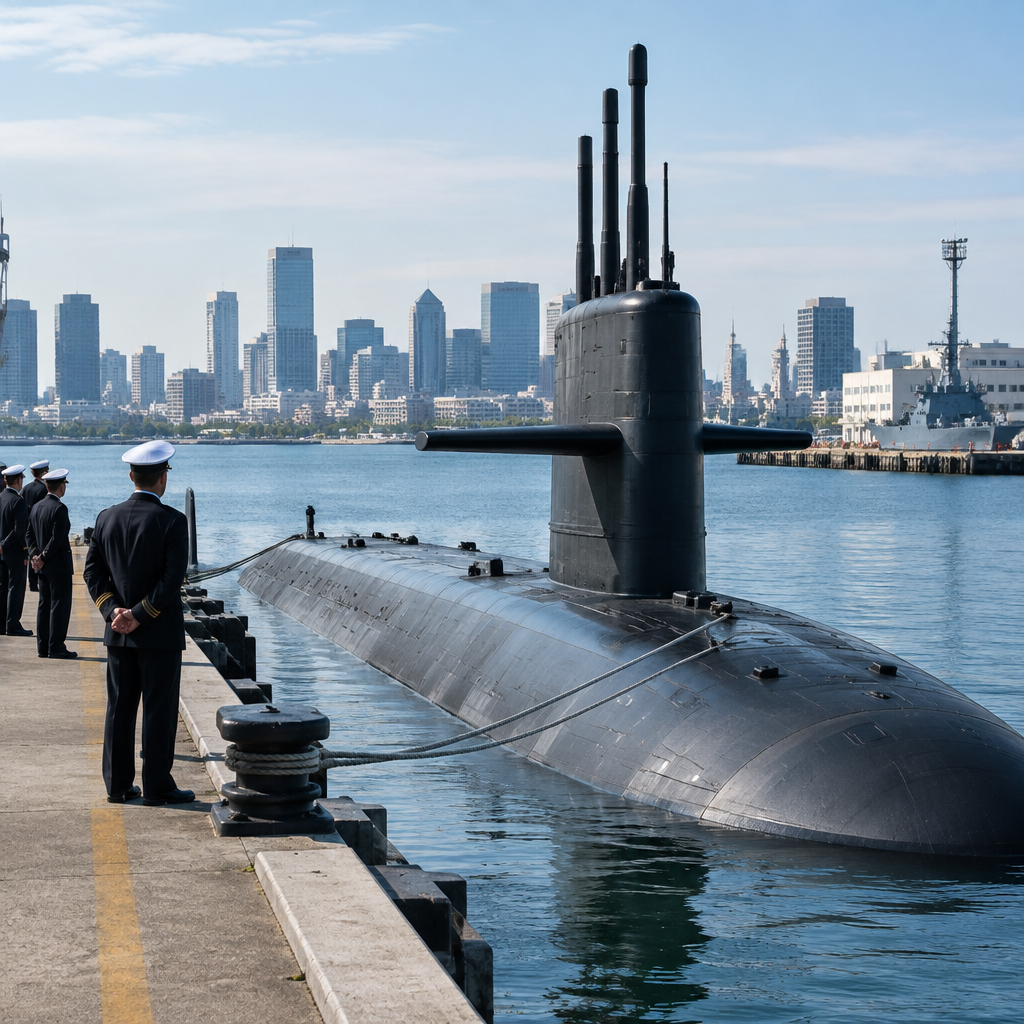
A$180 billion: that is the estimate cited to the AUKUS Public Inquiry for acquiring and sustaining 12 French Suffren-derived attack submarines over 31 years at constant 2025 prices — a figure the inquiry record contrasts directly with the A$268 billion baseline placed against an AUKUS Pillar One build of eight larger boats.
AUKUS Public Inquiry: cancel Pillar One, but keep a sovereign force of 12 SSNs
The independent AUKUS Public Inquiry concluded that AUKUS Pillar One should be cancelled, while affirming that Australia still requires a credible, sovereign fleet of 12 submarines to defend its maritime approaches. The inquiry accepted that nuclear propulsion remains an option, even as it recommended ending the current Pillar One plan.
Why critics say Pillar One fails on engineering, industrial and budgetary realities
The inquiry’s critique, as set out in the source material, frames Pillar One’s shortfall not in strategic intent but in practical execution. The plan’s reliance on second-hand Virginia-class boats drawn from an overstretched US Navy, followed by construction of the unbuilt SSN-AUKUS design with an untested reactor, would “guarantee a capability chasm” through the 2030s and 2040s.
The sequence described: retiring Collins-class boats while Virginias are unavailable because of US Navy shortages, and SSN-AUKUS production being deprioritised behind Britain’s Dreadnought-class ballistic missile submarine programme, is presented as producing a prolonged gap in Australia’s undersea capability.

Audit-ready is a season. It shouldn't be.
Evidence in spreadsheets, controls drifting between audits, frameworks multiplying on flat headcount. Nubivance runs continuous compliance on Rapid7 Cyber GRC - SOC 2, HIPAA, ISO 27001, PCI, CMMC.
End the scrambleThe Suffren-derived LEU alternative: cost, crew and build cadence
An operational, in-production alternative is described: France’s Suffren-class attack submarine as the design basis for Australian SSNs. The source argues twelve Suffren-derived boats would have roughly half the displacement of a Virginia-class and require about half as large a crew — changes that feed into affordability and sustainment.
Retired senior public servants Jon Stanford and Michael Keating analysed Parliamentary Budget Office through-life costings in a submission to the inquiry, estimating that a continuous Australian build of 12 Suffren SSNs over 31 years would cost about A$180 billion at constant 2025 prices. By contrast, the source cites a minimum A$268 billion baseline for buying and running eight larger AUKUS submarines — a comparison that, in the source’s account, delivers 50 percent more operational boats at about 70 percent of the through-life cost.
HEU waste liabilities, LEU fuel and existing Australian experience
The source places nuclear fuel type at the centre of risk and cost comparisons. It notes the Suffren design operates on standard, civil-grade low-enriched uranium (LEU) fuel, which the source says avoids the non‑proliferation hurdles and sole‑supplier dependence attributed to highly enriched uranium (HEU).
The source records that Australia already has “decades of experience” managing LEU at the Lucas Heights research reactor and maintains “an active, routine bilateral arrangement with France to export and reprocess spent LEU fuel.” By contrast, it states neither the United States nor Britain has an operational, fully costed disposal pathway for retired HEU naval reactor cores, and points to 23 decommissioned British submarines tied up at Rosyth and Devonport — 12 of which have sat for decades waiting to have their nuclear fuel removed.
Crucially for the financial calculus, the source cites the AUKUS Inquiry’s A$120 billion estimate to manage unbudgeted HEU waste liabilities — a figure that, when added to other costs, is presented as a decisive argument in favour of LEU-fuelled designs.
What this means for policymakers, procurement leaders, and the Australian public
- Policymakers and defence planners: must weigh the inquiry’s recommendation to cancel Pillar One against the operational requirement for 12 submarines and the projected capability gap tied to US and UK shipbuilding schedules.
- Procurement and shipbuilding leaders: will face a choice between a continuous domestic build of a known-in-production Suffren derivative — argued in the source to lower schedule and technical risk — and an AUKUS pathway tied to second‑hand Virginias and a future untested SSN-AUKUS design.
- The Australian public and environmental regulators: are pointed toward fuel-cycle questions — the source highlights existing LEU handling arrangements and warns of substantial HEU waste liabilities quantified by the inquiry.
National security strategy, the source concludes, must be driven by operational risk and capability rather than political pride. The inquiry’s record, and the cost comparisons and fuel-cycle arguments it reports, frame a stark choice for decision-makers: pursue the Pillar One path with its engineering, industrial and waste‑disposal liabilities, or adopt a continuous LEU Suffren-derived build that the source argues would lower schedule, technical and environmental risk while delivering a larger operational fleet at lower through‑life cost.