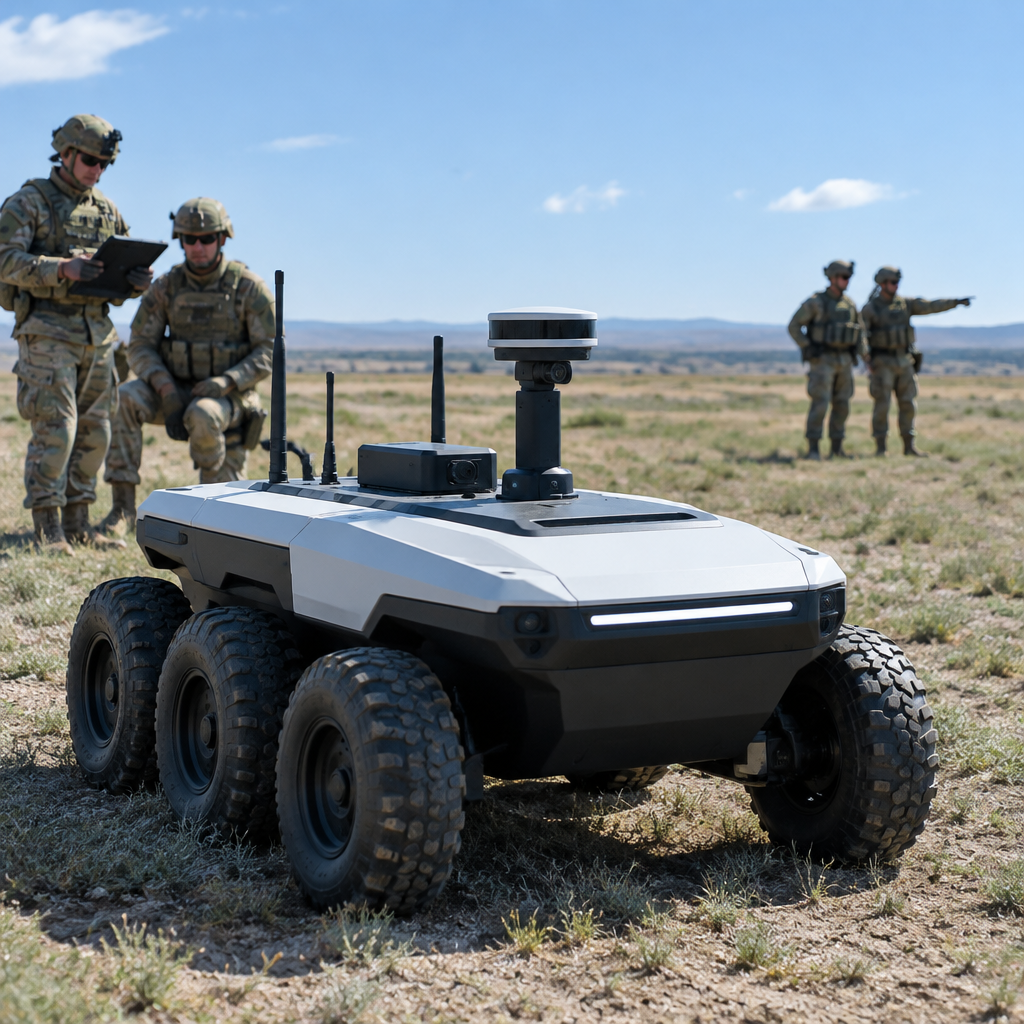
“Software-defined ground systems give operators the flexibility to scale resources up or down instantly, adapt services as requirements change, and deploy new offerings faster. That agility delivers immediate operational benefits, accelerates time to revenue, and drives a faster return on investment,” said Sridhar Kuppanna, CEO of ST Engineering iDirect, framing a practical pivot in how states will exercise military SATCOM sovereignty.
Keith Blanchet on interoperability, control, and sovereignty
At the Space Defense & Security Summit in Paris, Keith Blanchet, Vice President of International Government and Defense at ST Engineering iDirect, argued that sovereignty in military satellite communications now rests on operational control of architecture rather than on owning every component of the stack. Blanchet told the panel "Next-Generation Military Satcom: Capabilities, Architectures, and Sovereignty" that interoperable architectures that allow a nation to choose and control multiple services are central to a modern definition of sovereignty. In practice, he said, that means designing systems so that a government can exercise authority over how disparate assets are used, even when those assets are provided by partners or run across hybrid ecosystems.
Beyond a single “best” orbit
Blanchet rejects the notion that one orbital regime — HEO, GEO, MEO, or LEO — will be the universal answer. Instead, mission dictates transport: each orbital regime has complementary strengths, and the engineering challenge is making them work together transparently. Achieving that requires common terminals, flexible modems, interoperable waveforms, and orchestration governed by policy rather than by the satellite itself. When layered against an accelerating threat environment, the argument is that adaptable, multi-orbit networks are not optional but essential.

Audit-ready is a season. It shouldn't be.
Evidence in spreadsheets, controls drifting between audits, frameworks multiplying on flat headcount. Nubivance runs continuous compliance on Rapid7 Cyber GRC - SOC 2, HIPAA, ISO 27001, PCI, CMMC.
End the scrambleSoftware-defined ground infrastructure as the locus of control
The article stresses that, while satellites provide transport, sovereignty is increasingly exercised in the ground segment. Terminals, waveforms, modems, security architecture, and the orchestration layer determine how effectively a defense organization can marshal space assets to execute missions across land, sea, and air. Orchestration enables dynamic path selection and network reconfiguration as mission requirements, network conditions, or threats change — and it is the ground architecture that allows those capabilities to be directed by a nation’s policy. Kuppanna framed software-defined ground systems as delivering the ability to reconfigure a network’s behavior without waiting for a hardware refresh cycle — a form of sovereign control measured in operational agility rather than in physical ownership.
AI as assistant: forecasting, detection, and human-in-the-loop safeguards
Blanchet cautioned that AI should assist decision-making rather than replace it. Drawing a parallel to human-in-the-loop implementations in medical robotics, he argued that AI builds trust by acting initially as a decision-aid and only moving to greater autonomy when experts judge it ready. In SATCOM, the practical roles for AI described in the source include forecasting network conditions, identifying anomalies and interference, optimizing resource allocation, and helping orchestration systems select optimal orbit paths. The consistent emphasis is that AI enhances human judgment; it forecasts and proposes, but humans retain authority over mission execution.
What this means for technologists, policymakers, and defense planners
- Technologists and security teams: prioritize common terminals, flexible modems, interoperable waveforms, and orchestration tools that can be policy-driven rather than satellite-driven. Software-defined ground systems and orchestration layers will be the technical levers of sovereignty.
- Policymakers and procurement leaders: move away from a satellite-by-satellite procurement model toward acquiring capabilities that can be orchestrated across orbits and partners; measure sovereignty by operational control of architectures, not by exclusive ownership of hardware.
- Defense planners and operators: treat AI as a decision-support tool for forecasting, anomaly detection, and path selection, keeping human-in-the-loop governance while planning for progressively greater automation as trust and testing permit.
Taken together, the presentations and arguments collected in this report point to a future military SATCOM posture that is multi-orbit, software-defined, increasingly autonomous, geographically distributed, and sovereign by design. The article closes on a clear call to shift emphasis from choosing the “best” orbit or satellite to building an orchestrated network of networks that "answers, unambiguously, to its rightful authority." How rapidly defense organizations and suppliers can reframe procurement, engineering, and policy around that architecture — and how they validate AI-assisted orchestration under human control — will determine whether the 2035 vision Blanchet described becomes operational reality.