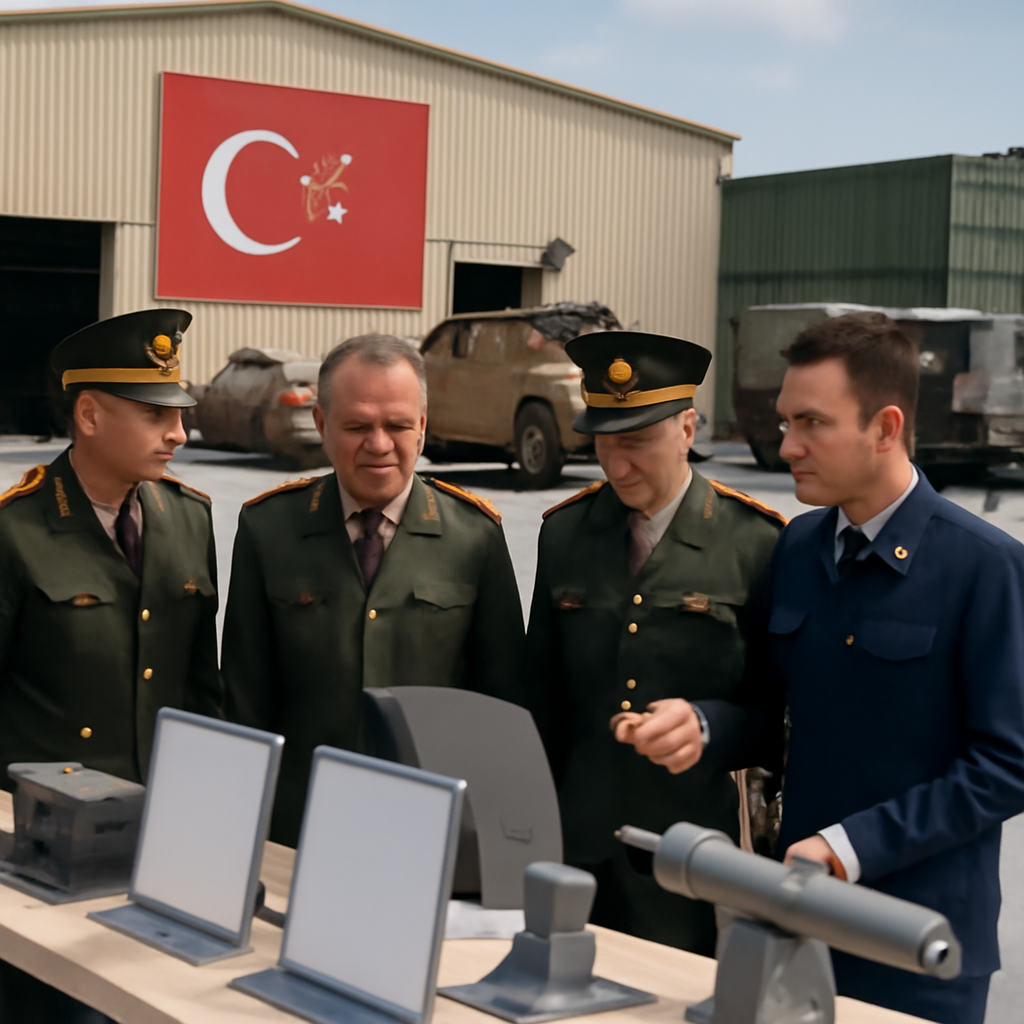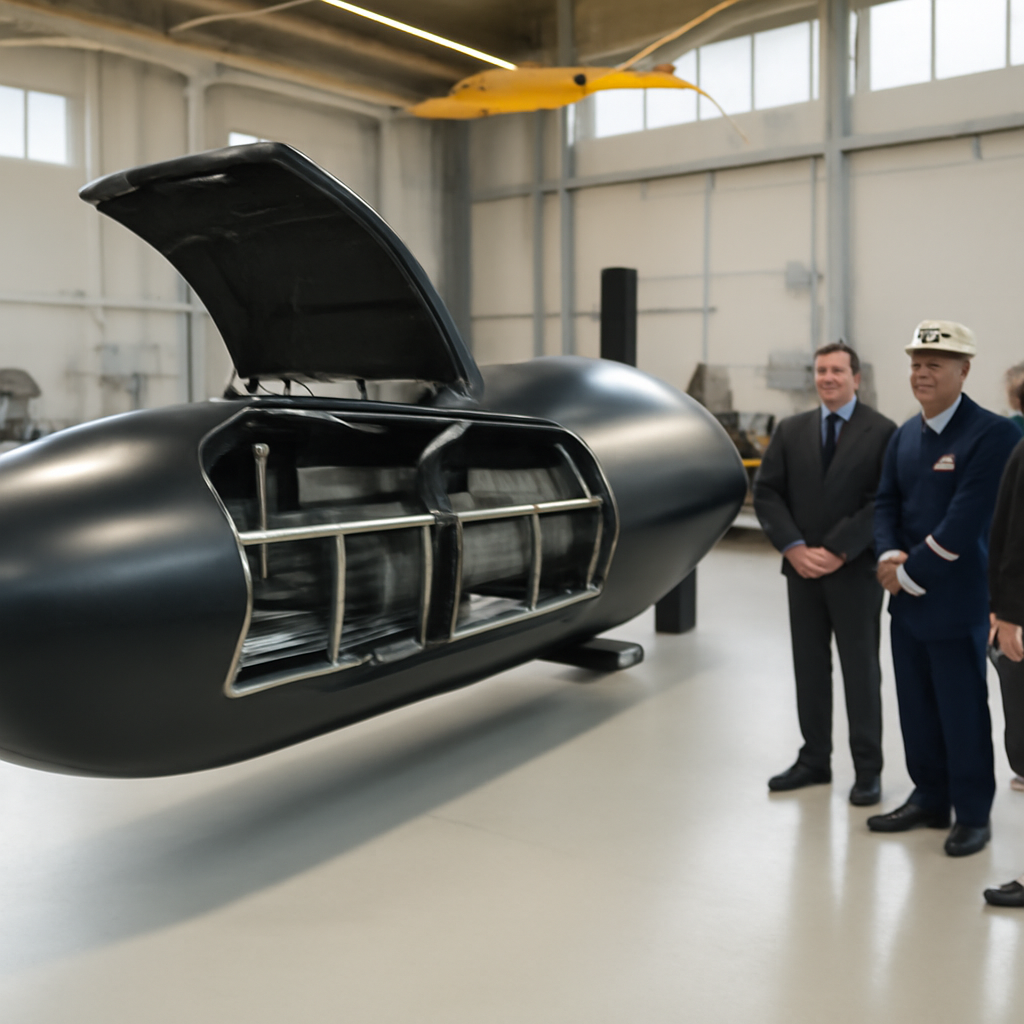
David Goodrich, CEO of Anduril Australia; Chief of Navy, Vice Adm. Matthew Buckley; Professor Tanya Monro, AC Chief Defense Scientist; and Pat Conroy, Minister for Defense Industry, stand in front of a Ghost Shark, with payload bay open, at the Anduril Australia factory in Sydney, New South Wales.
The payload bay: a first public look at Ghost Shark’s modular core
New photographs taken during a visit by Pat Conroy to the Anduril Australia factory offer the first clear public view inside the payload bay of Australia’s Ghost Shark extra-large autonomous underwater vehicle (XL-AUV). The imagery reinforces the vehicle’s modular design: a separate nose and tail with an expandable middle section and interchangeable, mission-specific hull segments. That approach, the government has said, is intended to allow a single platform to be reconfigured rapidly for different tasks.
Inside the displayed bay, observers noted cylindrical spacers formed in segments and materials that “look as if they are fabricated from plywood or similar.” The spacers and other fixtures do not appear to be operational stores, leaving open whether they are ballast for trials or part of a mockup used for demonstration and fit checks.
Three payload concepts publicly disclosed: mines, seabed caches, and aerial drones
The Australian government disclosed three previously undisclosed payload options: the capacity to deploy up to 12 sea mines in a mission, the ability to emplace supply caches on the seabed, and a launcher for Anduril’s ALTIUS aerial drones for reconnaissance or strike missions. “Ghost Shark now has teeth, and will have the ability to inflict damage on any potential adversary,” Conroy said.
A Rheinmetall Asteria 533mm-diameter mine was pictured alongside a Ghost Shark at the factory, though the manufacturer’s mine was not installed in the vehicle’s payload bay. According to the manufacturer, the Asteria can be deployed from surface vessels, aircraft, and submarines (normally via torpedo tubes) and is remotely controllable via an acoustic link.
The seabed-supply concept — being developed by the Defense Science and Technology Group (DSTG) — would let Ghost Shark position equipment or supplies underwater for later retrieval. Naval analyst Alex Luck told the reporting outlet that the cache payloads would likely take capsule forms similar in shape to the Asteria mine, though the specific designs were not on display.

This site is the portfolio.
OSINTSights runs on Cloudflare Workers, D1, R2, and Vectorize, with an AI pipeline on Hetzner ARM. Nubivance designed, built, and operates it. We do the same for clients.
See what we buildALTIUS UAVs: underwater launch to extend ISR and deliver effects
Of the three options, the ability to launch Anduril’s ALTIUS family of aerial drones from undersea stands out. Models at the Anduril Australia facility were derivatives of the ALTIUS-600 family. Notable variants include the ALTIUS-600 for ISR and the ALTIUS-600M designed for strike missions. The basic ALTIUS-600 weighs between 20 and 27 pounds depending on its payload (typically three to seven pounds), has a maximum range of around 275 miles, and can remain airborne for at least four hours, according to its developer.
The photographs and accompanying details did not disclose which ALTIUS variants Ghost Shark will carry, nor the capsule or launch mechanism that would house and release the UAVs from underwater. Unarmed ALTIUS-600 variants are designed to be recoverable and reusable, although the reporting noted uncertainty about the practicality of recovery after a UUV launch.
Maritime Big Play Pacific, AUKUS Pillar II, and deployment concepts
Some of these payload capabilities are slated to appear during Exercise Maritime Big Play Pacific in San Diego, described as an AUKUS Pillar II activity focused on advanced maritime capabilities and interoperability. The Australian government said the development effort involves the Royal Australian Navy, the Defense Science and Technology Group, the Advanced Strategic Capabilities Accelerator, and defense industry.
Under AUKUS Pillar II, Australia is collaborating with the United Kingdom and the United States on Ghost Shark and associated capabilities; Pillar II sits alongside Pillar I, which centers on nuclear-powered submarines. Practical deployment concepts discussed by officials include launching Ghost Shark from a shipping container, from the back of a small vessel using a crane, and prior demonstrations showing Ghost Shark loaded in a standard shipping container for transport in a Royal Australian Air Force C-17A.
What this means for the Royal Australian Navy, AUKUS partners, and naval technologists
- Royal Australian Navy: Ghost Shark’s modular payload bay promises flexible mission sets — from mine emplacement to seabed resupply and UAV-enabled ISR or strike — but the navy will need to resolve integration details for capsules, acoustic links, and underwater launch mechanisms before operational use.
- AUKUS partners (United Kingdom and United States): The vehicle and its payload concepts are being developed under Pillar II collaboration; exercise participation in Maritime Big Play Pacific will serve as an early interoperability testbed for shared doctrine and systems.
- Naval technologists and system integrators (DSTG, Anduril Australia, industry): The photographs and announced payloads move development from concept toward engineering questions — specifically capsule design for UAVs, mine carriage and release mechanisms, and the form factors for seabed cache capsules.
Australia’s 2026 National Defence Strategy and Integrated Investment Program allocates up to A$5.8 billion over the decade for autonomous and uncrewed undersea warfare capabilities, including A$1.7 billion for a new fleet of Australian-designed and built Ghost Shark vehicles (approximately $4.05 billion and $1.19 billion respectively in the figures released). The newly released interior views and payload disclosures offer the clearest picture yet of how Canberra intends to expand Ghost Shark beyond surveillance toward a broader suite of undersea effects. The next milestones the government has signalled — integration trials and Maritime Big Play Pacific participation — should reveal how those theoretical capabilities become practical tools at sea.