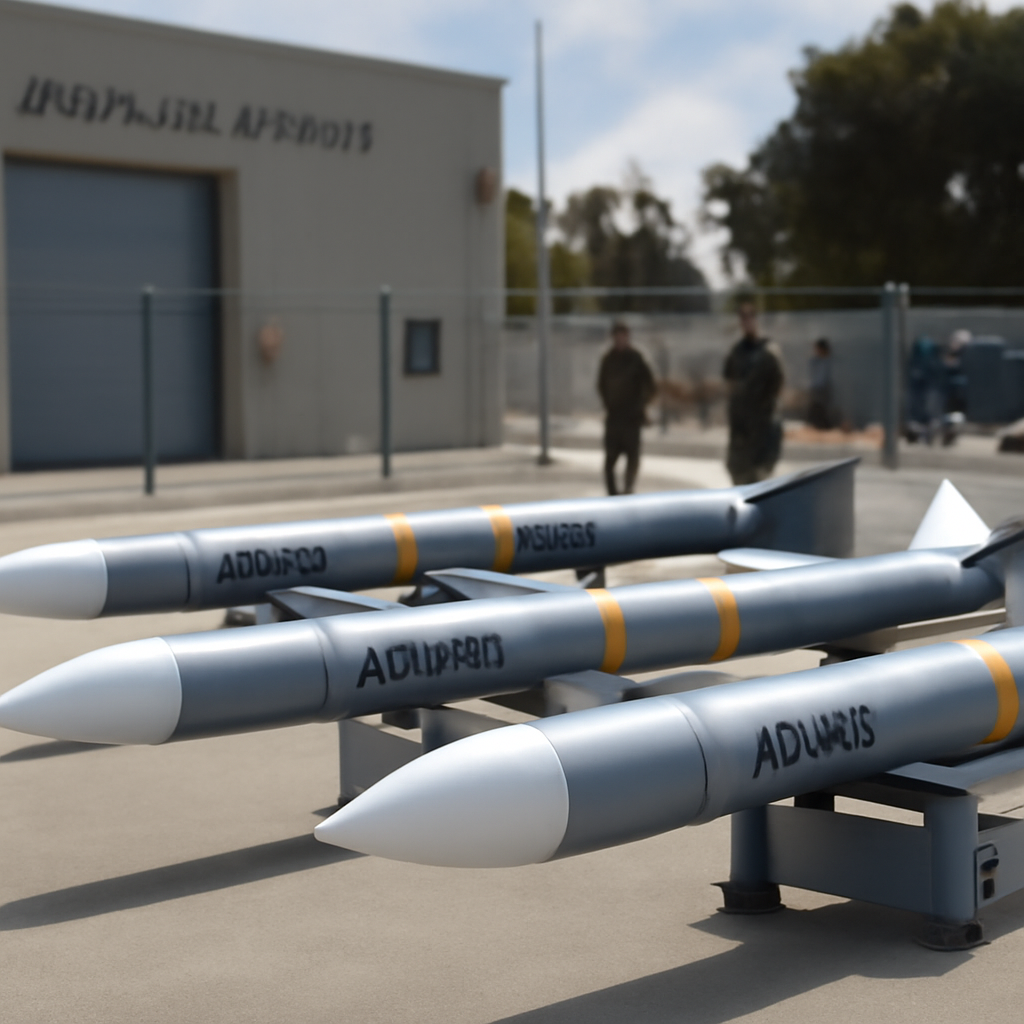
"A really significant purchase to upgrade the capability," Defense Minister Richard Marles said as he announced Australia will buy the American-made AIM-260 Joint Advanced Tactical Missile — a move that makes Canberra the first export customer for the closely held weapon.
AIM-260 JATM purchase details and cost
Australia will invest “almost” $736 million AUD ($518 million USD) to acquire “up to 450” AIM-260 JATM missiles for the Royal Australian Air Force (RAAF), Defence Minister Richard Marles said during a visit to the Pitch Black multinational air combat exercise at RAAF Base Darwin. The Department of Defence framed the acquisition as strengthening Australia’s airborne deterrent while complementing existing air-to-air and surface-based missile capabilities across the Australian Defence Force (ADF).
The missile is Lockheed Martin-made and has been tightly controlled by the United States; it was publicly photographed for the first time in May, according to Air and Space Forces Magazine. Canberra received clearance from the U.S. State Department in March for the sale. Earlier reporting — at the time of that clearance — estimated that a full purchase, including additional test articles and associated equipment, could carry a price tag of over $3 billion USD.
Which aircraft will carry the AIM-260 in Australia
Canberra plans a staged integration of the AIM-260. The Department of Defence said the RAAF will first field the missile on Boeing F/A-18F Super Hornet multi-role fighters, followed by the Lockheed Martin F-35A Lightning II fifth-generation fighters, and then on Boeing EA-18G Growler electronic attack aircraft. The sequencing outlines a pathway to embed the missile across multiple mission sets: air superiority and multi-role operations on Super Hornets and F-35As, and electronic attack missions on Growlers.

Audit-ready is a season. It shouldn't be.
Evidence in spreadsheets, controls drifting between audits, frameworks multiplying on flat headcount. Nubivance runs continuous compliance on Rapid7 Cyber GRC - SOC 2, HIPAA, ISO 27001, PCI, CMMC.
End the scrambleHow Australia and the U.S. framed the strategic benefits
The Department of Defence said the AIM-260 would “provide Air Force platforms with a credible deterrent against airborne targets, complementing existing air-to-air missile capabilities and other surface-based missile capabilities across the Australian Defence Force.” The statement also emphasized that the acquisition “will further enhance Australia’s interoperability with the United States.” That interoperability underpinning is reinforced by the March decision from the U.S. State Department to clear the sale.
Domestic propulsion milestone: Koonibba Rising 3.0 solid rocket motor
On the same day as the JATM announcement, the Australian Defence Department reported a successful flight test of a domestically developed solid fuel rocket motor intended for guided weapons. The Koonibba Rising 3.0 motor — a 100 kg (220 pound) class solid rocket motor — was tested at a range in southern Australia and was developed under a partnership between the Defence Science and Technology Group and Thales Australia. The flight test was conducted by Southern Launch, and the department said the motor performed “as designed.”
The DoD framed the motor test as a step toward sovereign guided weapons capability: “This milestone marks another significant step towards Australia’s sovereign guided weapons capability, demonstrating the ability of Australian industry to design, manufacture, integrate and test rocket motor technologies relevant to future tactical missile systems,” the release said. Minister for Defence Industry Pat Conroy described the test as showcasing “the strength of collaboration between Defence, Australian industry and research organisations.”
What this means for the RAAF, Australian defence industry, and U.S.–Australia interoperability
- RAAF: The service will begin integrating the AIM-260 on its Boeing F/A-18F Super Hornets first, then on F-35A Lightning IIs and EA-18G Growlers — a clear equipment pathway that places the missile across air-superiority and electronic-attack missions.
- Australian defence industry: The successful Koonibba Rising 3.0 test signals progress toward domestic rocket-motor design, manufacture and testing capabilities for tactical missiles, and demonstrates continuing collaboration between Defence, the Defence Science and Technology Group, Thales Australia, and Southern Launch.
- United States and interoperability: The March State Department clearance and Canberra’s purchase signal closer operational alignment with U.S. missile architecture; the Australian Department of Defence explicitly ties the acquisition to enhanced interoperability with the United States.
The announcements pair an immediate procurement commitment — almost $736 million AUD for up to 450 AIM-260 JATMs — with a domestic technology step forward in propulsion. Together they map a two-track approach: fielding a U.S.-made, tightly controlled missile across multiple RAAF platforms while building homegrown rocket-motor competence for future guided weapons. A concrete next step flagged by the record is whether Canberra will pursue the full, larger package that was previously estimated to exceed $3 billion USD, which would include additional test articles and associated equipment.