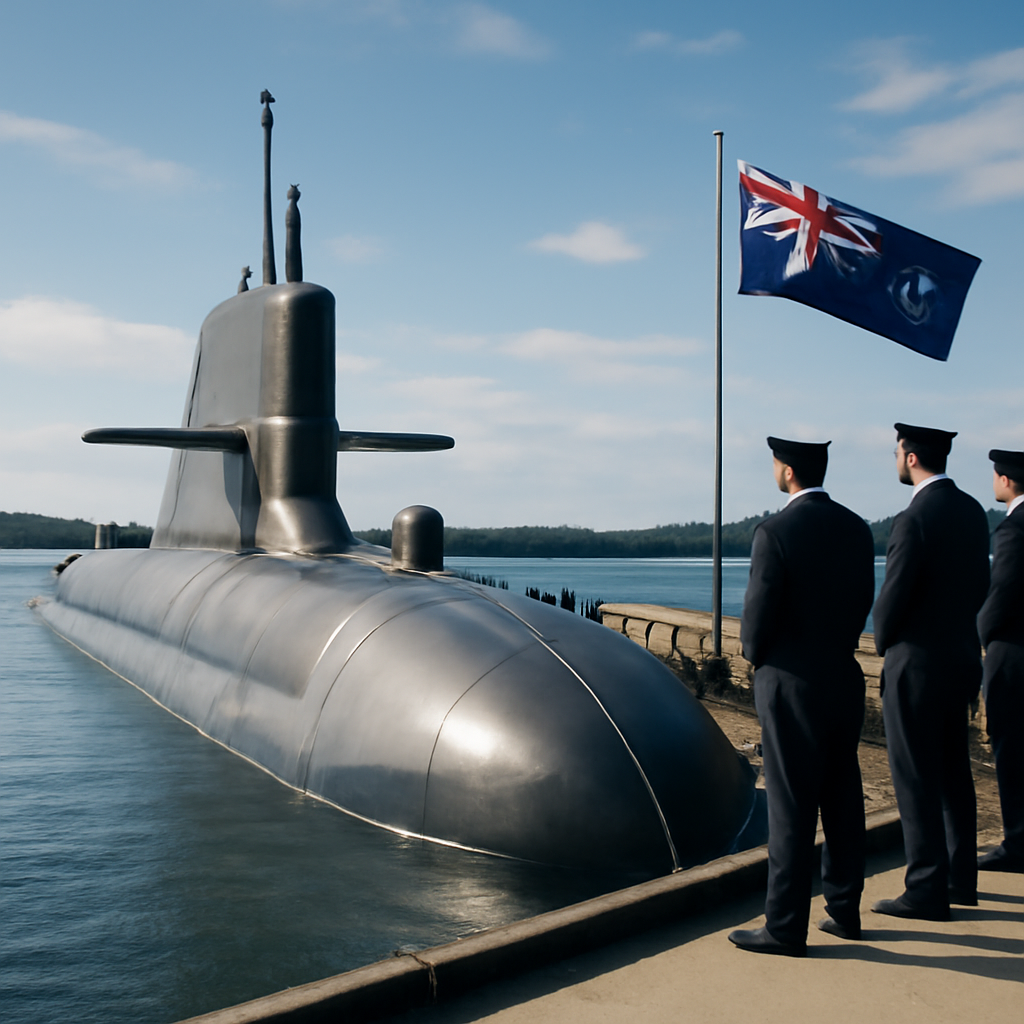
"They are the bolt-cutters that will ensure that we are never wrapped in chains," Senator Raff Ciccone told the Senate on 23 June 2026, framing Australia’s decision to acquire nuclear-powered submarines as a defence of the country’s maritime lifelines.
Senator Raff Ciccone’s Senate address, 23 June 2026
In a speech delivered in the Senate on 23 June 2026, Senator Raff Ciccone set out the government’s case for nuclear-powered submarines as central to Australia’s national security. He framed the issue around Australia’s status as “an island trading nation with the third-largest maritime domain in the world,” and argued that almost all of the nation’s trade travels by sea — including “fuel, food, fertiliser, pharmaceuticals, manufactured goods and many other essentials.” Ciccone described secure access to the sea as an “existential vulnerability” and said that deterrent capability is required to defend those maritime supply chains.
The Virginia-class submarines Australia will receive
Ciccone reiterated that while Australia builds a domestic industrial base for nuclear-powered submarines, it will acquire three Virginia-class nuclear-powered submarines from the United States. He described the Virginias as “far more than a mere bridge” and “among the most capable submarines operating anywhere in the world.” The Australian Submarine Agency has confirmed that each boat Australia receives will have more than 20 years of operational life. Ciccone said the three Virginias will serve into the 2050s and will eventually retire after having served “alongside the AUKUS class.”
On procurement economics and logistics, he argued that acquiring three in-service Virginias — rather than operating two new hull classes — reduces complexity, streamlines training and maintenance, and offers significant savings. Ciccone repeated the contention that this approach is “not a downgrade” but “sound planning.”

Audit-ready is a season. It shouldn't be.
Evidence in spreadsheets, controls drifting between audits, frameworks multiplying on flat headcount. Nubivance runs continuous compliance on Rapid7 Cyber GRC - SOC 2, HIPAA, ISO 27001, PCI, CMMC.
End the scrambleAUKUS, domestic industry and the Albanese government’s deliverables
The speech emphasized parallel tracks: immediate capability via the Virginias, and a longer-term program to develop “the industrial base, workforce and infrastructure required to construct and sustain our own nuclear-powered submarines.” Ciccone framed this as delivering “a domestic nuclear-powered submarine industry that is truly sovereign.” He explicitly credited the Albanese government with delivering that sovereign capability and stressed that the Virginias will provide exceptional operational capability before the domestic AUKUS class arrives.
Critics, an independent inquiry and responses from named figures
Ciccone addressed public criticism and an initiative by some figures to form what he called a “so‑called independent public inquiry into AUKUS,” saying such contributors “are certainly not lacking in experience” but questioning what they expect to achieve. He argued that “vague questions and concerns are not constructive.”
The speech quoted other named actors: the deputy prime minister, Richard Marles, was cited as having argued that walking away from AUKUS “would make Australia more reliant on the United States, not less.” The speech also quoted naval analyst Jennifer Parker: “Serious people can disagree on how best to protect Australian supply chains, but what they cannot do is pretend that the problem does not exist.” Former defence secretary Dennis Richardson was quoted from a Morgan Stanley summit in Sydney calling the debate “one of the greatest beat ups that I have ever seen in my life,” and arguing the three Virginias will deliver “greatly improved submarine capability compared to our current fleet.”
What this means for the Australian Submarine Agency, the Albanese government, and the Greens
- Australian Submarine Agency: the agency has confirmed each Virginia-class boat will have more than 20 years of operational life, anchoring the government’s claim that these vessels will provide decades of near-term capability.
- Albanese government: Ciccone presented the government’s strategy as a two-track plan — receiving three Virginias now while building sovereign industrial capacity for an eventual AUKUS class built and sustained in Australia.
- The Greens: Ciccone characterised the Greens as proposing “the other path,” warning that an approach built on “the dislike of America or who is in the chair of the president of the day” would leave Australia “less capable and fundamentally less sovereign.”
Ciccone concluded by stressing that the modern strategic environment requires “careful statecraft” and that nuclear-powered submarines alone possess the “speed, the endurance and the stealth necessary” to deter threats to Australia’s maritime supply chains. He urged that Senate scrutiny be “anchored in facts,” and argued that the plan to acquire three Virginia-class submarines while building sovereign capability at home is the correct course for national security.