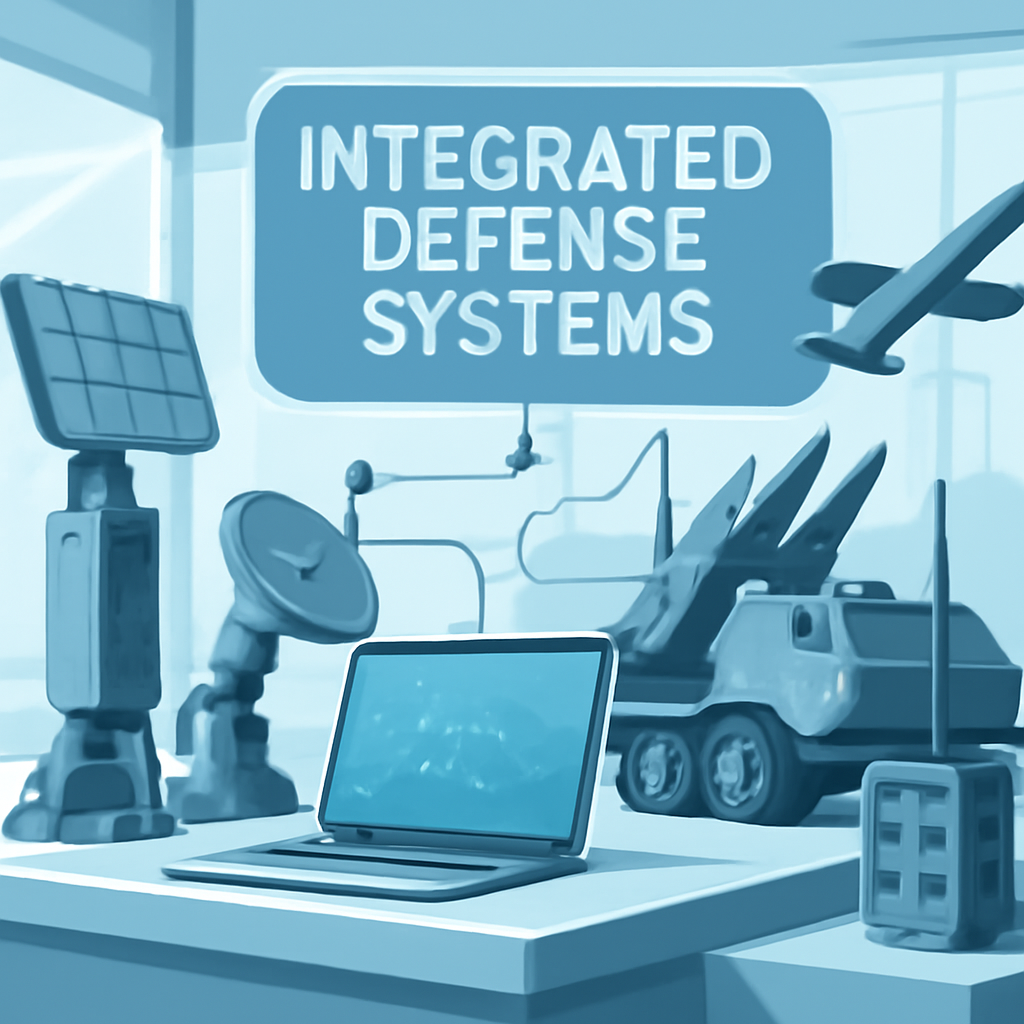
"ASELSAN’s latest launch portfolio, introduced at SAHA 2026, reflects a broader shift in defense thinking," ASELSAN said — and the company’s new products make that shift concrete.
A unified, layered operational approach
At SAHA 2026 ASELSAN presented a portfolio designed around a single operational principle: systems that do not operate in isolation but as coordinated layers. The company describes a networked framework in which sensors, effectors, and decision-making elements operate together so that detection, command-and-control, electronic warfare, and kinetic response form interconnected layers of a single architecture. ASELSAN positions this architecture to address both conventional and asymmetric threats across land, air, sea, and the electromagnetic spectrum.
Naval strike and distributed maritime options: KILIÇ and TUFAN
ASELSAN’s maritime entries translate the layered idea into surface and subsurface tools. In the subsurface domain the company introduced the KILIÇ Family of Kamikaze Autonomous Underwater Vehicles — described as expendable autonomous systems capable of detecting, tracking and neutralizing maritime targets with high precision and low visibility, and intended to support distributed and asymmetric operations. On the surface, TUFAN Unmanned Surface Vehicle combines autonomous operation, swarm capability and mission flexibility to support reconnaissance, surveillance and offensive roles.

This site is the portfolio.
OSINTSights runs on Cloudflare Workers, D1, R2, and Vectorize, with an AI pipeline on Hetzner ARM. Nubivance designed, built, and operates it. We do the same for clients.
See what we buildExtending the electromagnetic layer: KORAL AD, ILGAR, EJDERHA
Electronic warfare features prominently in ASELSAN’s layered architecture. The new KORAL AD Air Defense Electronic Warfare System is presented as providing advanced electronic support and attack against hostile radar systems, enabling long-range detection, classification and suppression. The updated ILGAR Communication Electronic Warfare System brings mobile electronic attack against V/UHF and partial SHF communications, combining electronic attack, electronic support and direction finding on a highly mobile platform.
For countering small unmanned aircraft in the electromagnetic domain, ASELSAN showcased EJDERHA High-Power Microwave Weapon System, described as neutralizing mini and micro unmanned aerial vehicles — particularly swarm threats — using high-power electromagnetic wave technology. EJDERHA is presented as a fully autonomous, stand-alone counter-UAV solution with a newly integrated radar, enhanced electro-optical systems and improved engagement effectiveness.
Layered counter-UAVs: kinetic, laser, and platform protection
ASELSAN set out a multi-layered counter-UAV approach combining soft-kill and hard-kill options. New products introduced at SAHA 2026 extend those layers: GÖKALP Autonomous Kinetic Drone Interception System is a high-speed interceptor drone intended to neutralize FPV and kamikaze threats through kinetic impact. MİĞFER Self-Protection FPV Interception System provides close-range self-defense for armored platforms with integrated detection and physical neutralization capabilities optimized for mini and micro-UAV threats.
Complementing kinetic options is the new version of GÖKBERK, the GÖKBERK 10 kW Laser Weapon System, which adds a directed-energy layer. ASELSAN describes GÖKBERK 10 kW as using a high-quality indigenous laser source with advanced electro-optics and tracking sensors to engage Class I fixed-wing and rotary-wing UAVs as well as improvised explosive threats, and positions it for protection of critical facilities, land platforms, energy plants and headquarters with silent, invisible, day-and-night operation.
Airborne sensing and strike: FULMAR 500-A and the TOLUN family
Airborne systems are presented as the data and strike nodes that feed the integrated architecture. ASELSAN unveiled the FULMAR 500-A AESA Surveillance and Reconnaissance Radar, a multi-function AESA capable of air, land and maritime surveillance with SAR, ISAR and GMTI modes in a single system. The company highlights FULMAR 500-A’s ability to detect surface-laid naval mines, identify low-altitude drones and produce high-resolution SAR imagery.
On the strike side, ASELSAN expanded the TOLUN munition family. TOLUN-L adds an integrated laser seeker for precise engagement of moving and time-sensitive targets with reduced collateral effects. TOLUN-F features a cockpit-programmable, time-delayed electronic fuze and a proximity sensor that allows the warhead to detonate at a specific distance before impact. TOLUN-EW brings loitering electronic attack capability for suppression and disruption missions, extending the family’s operational flexibility within the layered concept.
How procurement leaders, military planners, and critical facility operators will respond
- Procurement leaders will be assessing packages that emphasize integrated operation over single-purpose systems, given ASELSAN’s explicit focus on a scalable, interoperable ecosystem of EW, sensors, munitions and autonomous platforms.
- Military planners will be focused on how airborne sensors such as FULMAR 500-A can feed long-range EW tools like KORAL AD and effectors from KILIÇ AUVs to GÖKALP interceptors, stitching surveillance and strike into coordinated sequences across domains.
- Critical facility operators and platform defenders will be watching the mix of directed-energy (GÖKBERK 10 kW), microwave (EJDERHA) and kinetic options (MİĞFER, GÖKALP) as a set of complementary choices for layered close-in protection.
ASELSAN’s SAHA 2026 lineup is less a set of isolated products than a manifesto for integrated defense: subsurface expendable AUVs, swarming USVs, long-range EW, microwave counter-UAVs, laser weapons, multi-mode airborne radars and a family of munitions are all presented as parts of a single architecture. The claim to watch next is not whether each system works on its own — ASELSAN’s materials describe that as a baseline — but how these elements will be connected operationally to deliver the layered, networked effect the company promises.