"Both prototype divisions will begin implementing the common data layer baseline as soon as possible, with minimum disruption to operational exercises and training events," the Army said in a statement to Defense One.
Anduril to lead the push to a single baseline
The Army announced Monday that Anduril will lead the effort to converge two prototype divisions onto a common next-generation command-and-control (NGC2) configuration. The decision follows months of parallel prototyping: the 25th Infantry Division, led by Lockheed Martin, and the Colorado-based 4th Infantry Division (4ID), led by Anduril and Palantir. Anduril’s role is part of an enterprise licensing agreement that the Army disclosed without attaching a dollar figure.
NGC2, the common data layer, and Anduril’s Lattice
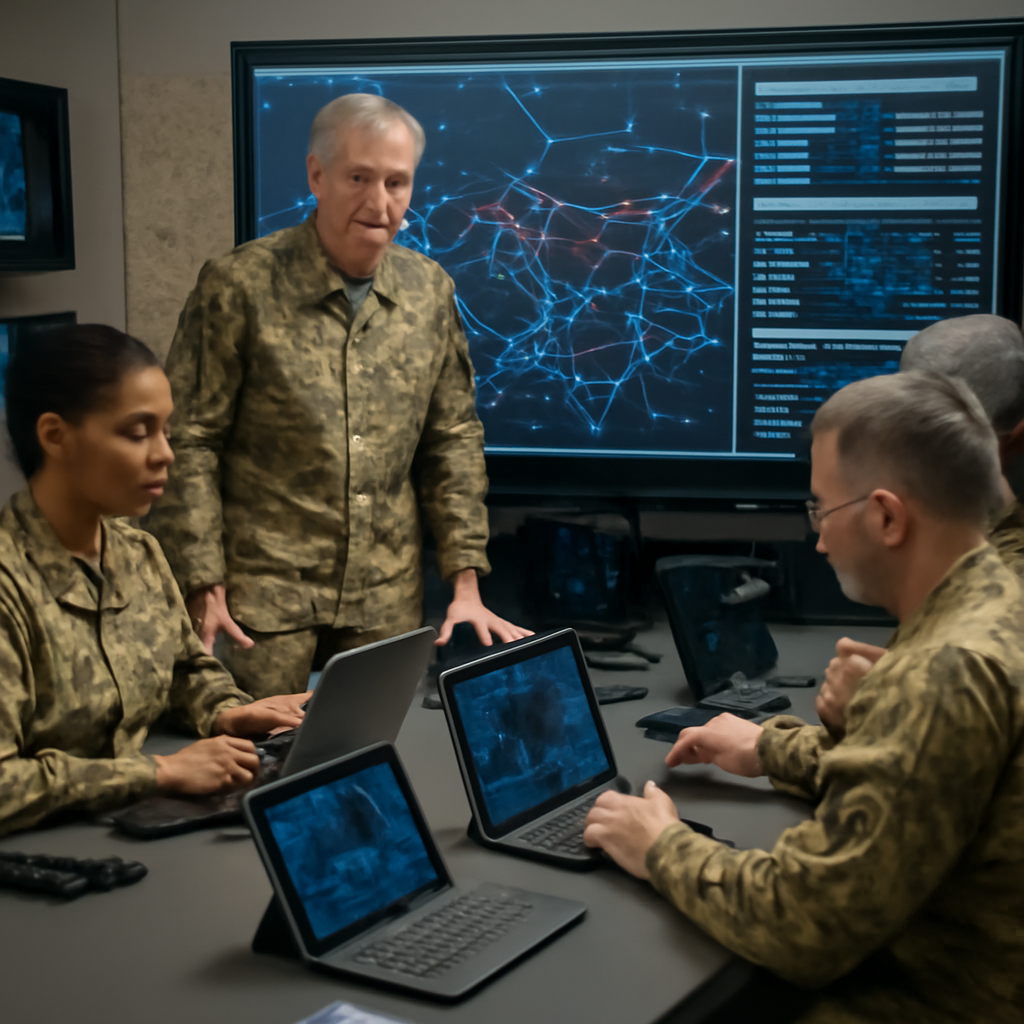
NGC2 began as experiments in 2024 and became a program of record in April 2025. Central to the program is a common data layer that various applications plug into so disparate sources of information can cohere on a single platform. Anduril will use its Lattice software and, teaming with Palantir, will continue to lead work on that shared data layer. The data layer supports different applications — logistics, analytics, and others — and exposes "a common API surface" so products such as Govini and Rune can plug in.

This site is the portfolio.
OSINTSights runs on Cloudflare Workers, D1, R2, and Vectorize, with an AI pipeline on Hetzner ARM. Nubivance designed, built, and operates it. We do the same for clients.
See what we buildHow the divisions have been using the system
The 4th Infantry Division has been testing the “full stack” NGC2 system for about a year in recent military exercises, while the 25th Infantry Division has been developing a prototype led by Lockheed Martin. Army officials said the two divisions and their industry teams have already worked together during Ivy Sting-Mass and Lightning Surge events to "share lessons learned, reuse applications, and converge capabilities" toward a common framework.
NGC2 is intended to let soldiers and commanders use the same platform for battle planning across locations and devices. In one live-fire example cited by the Army, an Army M777 howitzer shot down a target using data generated by the Marine Corps; NGC2 also allowed the Army to share target data with the Marine Corps during exercises.
Benchmarks, form factors, and integration scope
Anduril’s general manager for mission command, Zach Kramer, told reporters the company aims to have the systems fully integrated across both divisions by the end of the year: "The intention is certainly by the end of the year…if not sooner, that we would get them onto a common baseline." Kramer said Anduril has set benchmarks for scale, usage, and unit feedback to decide whether the effort is successful, highlighting questions such as: "Are the soldiers using the system," is it helping them "be successful, and how are they seeing the system working and functioning."
Kramer described the integration work as broad: UASs, other sensors and effectors, multiple types of communications and radios, and different compute platforms can feed the data layer and host applications. He also described several human-facing entry points already available or under development, including Palantir tools on a laptop, Maven Smart Systems that units already possess, a new Android-based wearable form factor with a touchscreen, and vehicle-mounted applications.
What this means for soldiers, acquisition leaders, and vendors
- Soldiers and commanders: They will be asked to adopt a common baseline across two divisions and to provide the unit feedback that Anduril and the Army will use to judge success — specifically usage, mission effectiveness, and system functionality.
- Acquisition and procurement leaders: The move is being executed under an enterprise licensing agreement; officials said teams have demonstrated "great teamwork and flexibility" in establishing the baseline and setting groundwork for rapid scaling.
- Anduril, Palantir, and Lockheed Martin: Existing prototypes and applications will need to be reconciled into a single common data layer so tools like Govini and Rune, existing Palantir products, and third-party sensors can interoperate through the common API surface.
The Army frames this as a step toward a more resilient, reliable network for soldiers and part of a broader strategy of continuous transformation via prototyping and soldier feedback. The immediate, concrete milestone is clear: bring both prototyping divisions onto a common NGC2 baseline, led by Anduril, with full integration targeted by the end of the year. How well the system performs will be measured in usage, soldier success, and the ability of multiple applications and sensors to operate through the common data layer.