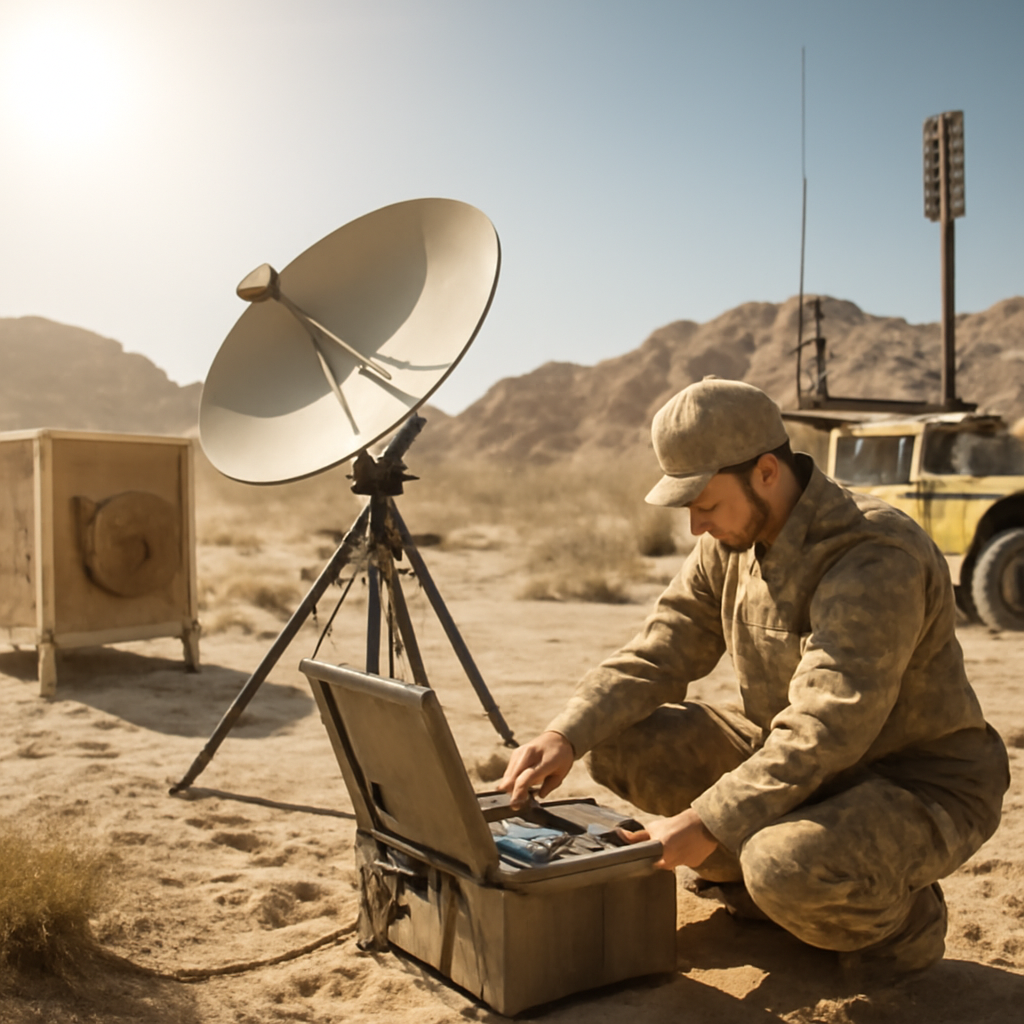
"Two days ago, it was 106 degrees Fahrenheit out here. So that brings a whole new aspect to anything you do with electronics and communications," Lt. Gen. Michael McCurry said, describing the environmental stress the Army intends to use as a deliberate test variable during Project Convergence Capstone 6.
Lt. Gen. Michael McCurry on Mojave heat and rugged terrain
McCurry, the commanding general of Army Futures and Concepts Command and director of PCC6, framed the exercise as an opportunity to stress communications and electronics not only through adversarial contest but through extreme environmental conditions. He contrasted the arid, rugged terrain of Fort Irwin, California, with the May trial at Piñon Canyon Maneuver Site, noting Fort Irwin's features such as Tiefort Mountain and the Northern Ridge, including a roughly 5,000-foot peak that "places new stressors on communications."
Project Convergence Capstone 6: scale, schedule, and purpose
PCC6, running July 20–29, is billed as the culmination of a year-long series to build, scale and refine the Next Generation Command and Control (NGC2) ecosystem with the 4th Infantry Division. Army officials describe the capstone as the largest combat training center (CTC) rotation the service has ever conducted in headcount terms — approximately 9,700 soldiers versus the roughly 4,000 who normally attend CTC rotations — while also emphasizing that it is an experiment rather than a standard CTC rotation.

The cyber insurance questionnaire just landed. Now what?
SOC 2, HIPAA, insurance renewals - someone has to own security strategy. Nubivance provides fractional CISO leadership without the full-time salary.
Get a security leadHow the 4th Infantry Division and 25th Infantry Division are approaching NGC2
The Army is running parallel prototype approaches. Over the last year the 4th Infantry Division has been prototyping the NGC2 architecture by rebuilding its network from the ground up; in May the division held "Ivy Mass," the first full-division test and the first electromagnetic and cyber contested event for the architecture at Piñon Canyon. The 25th Infantry Division has been prototyping NGC2 components, but operates on a different baseline: the division has been outfitted with a modernized network baseline called C2 Fix. The two tracks are intended to show what mix of capabilities an architecture will need across a force that contains a combination of legacy and modernized equipment.
Technical priorities: auto‑PACE, software‑defined networking, edge compute, and a commercial‑first approach
Joseph Welch, the portfolio acquisition executive (PAE) for C2/Counter C2, said the exercise will test both hardware and software under extreme conditions and help the Army evaluate a "commercial‑first" sourcing strategy intended to speed fielding at scale. Specific capabilities under scrutiny include auto‑PACE (primary, alternate, contingency and emergency communications), software‑defined networking, and edge compute.
Welch noted the Army expects feedback on practical hardware concerns – "housing, cooling" – that could influence product evaluations. He also said the service is assessing the density and configuration of hardware across formations and calibrating the criticality and maturity of software technologies. Some software items, Welch acknowledged, "may have come in a little bit late or maybe a little bit less mature" and the capstone will inform whether those components should become baselines or need further refinement.
How 4th Infantry Division, 25th Infantry Division, and the 11th Cavalry Regiment are engaged
- 4th Infantry Division: Acting as the primary prototyping formation for the NGC2 architecture, the division has rebuilt its network to exercise integration, data flows and AI‑enabled decision aids across brigade and division functions.
- 25th Infantry Division: Testing components of NGC2 while operating on the C2 Fix modernized baseline, offering a comparative data point on how a different network baseline affects capabilities and configurations.
- 11th Cavalry Regiment ("Blackhorse Regiment"): As the National Training Center's opposing force, the regiment simulates fighting an Army brigade every month and will provide a more demanding, professional, and continuous opposing force than the battalion that served as the opposing force during Ivy Mass.
Contracts, fielding, and the next decision points
Officials say PCC6 will provide the finishing touches on the NGC2 prototype phase to inform upcoming contract awards and decisions about fielding gear. The Army intends to begin fielding equipment to units at I Corps next year, and Welch said the capstone will produce more feedback "on really the selection of the equipment and … a lot of the configurations." The test is therefore both a technical stress test and a decision point for procurement choices — particularly for software selection and where further refinement is required.
The Army will return from Fort Irwin not just with performance metrics and logs from contested electromagnetic environments, but with practical notes about cooling, housing and deployment density that may alter evaluations and contract parameters. PCC6 is timed to convert those operational lessons into purchasing and fielding decisions for I Corps — making this experiment as much about material selection and software maturity as about proving tactics in extreme heat and terrain.