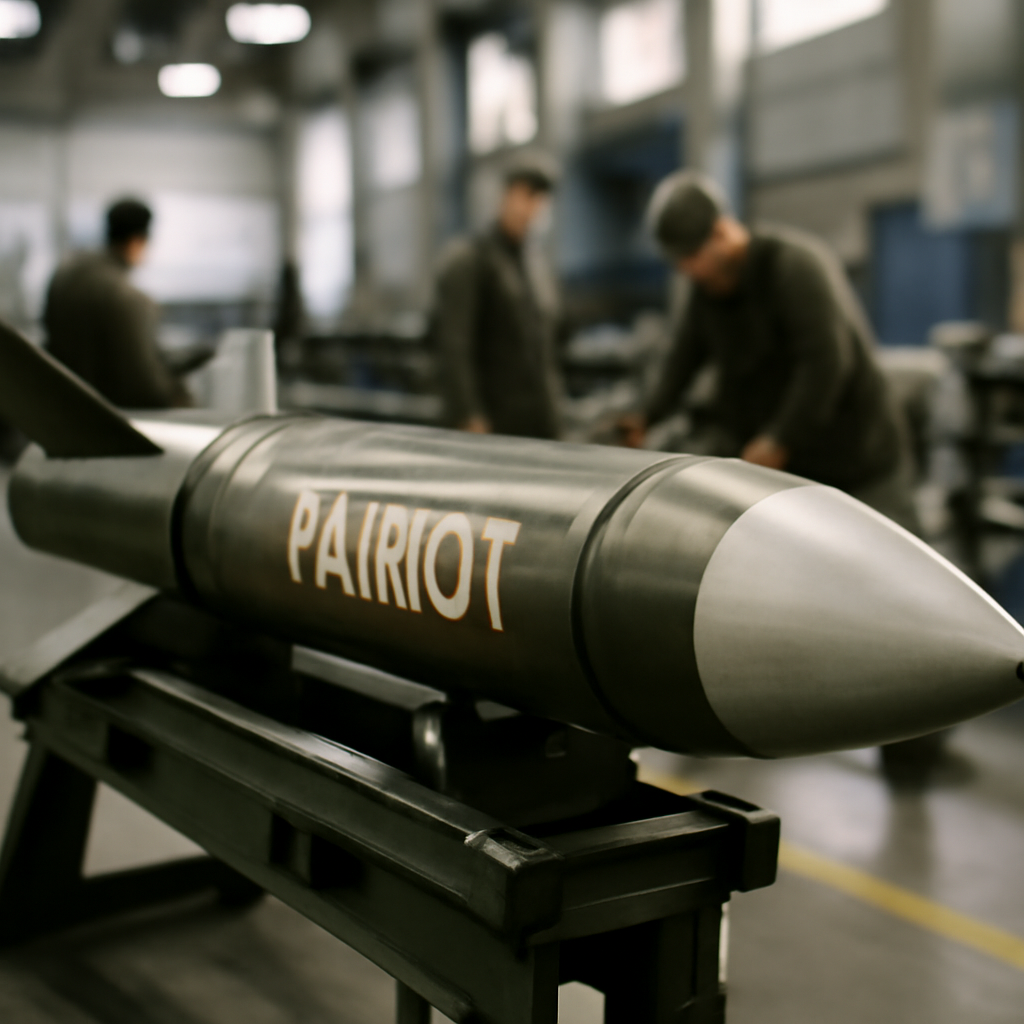
“Our goal has always been to get to 2,000, and we've had a lot of discussions about even more interceptors,” Gen. Frank Lozano said, framing a procurement debate that the Army now acknowledges could shift as the war with Iran continues to shape demand.
Gen. Frank Lozano on Patriot missile goals
Speaking on a panel at the AUSA annual meeting in Washington, D.C., Gen. Frank Lozano, the Army’s fires portfolio acquisition executive, said increasing annual production of Patriot air‑defense missiles — especially the PAC‑3 Missile Segment Enhancement (MSE) — is a top priority. He reiterated a previously stated numeric aim of reaching 2,000 interceptors, but made plain that the Army is discussing much larger aggregate missile‑output scenarios: “is it 4,000, is it 6,000, is it 8,000.”
Lozano framed that choice as one that must balance capability diversity and cost: the Army, he said, needs to “address the threat in a complementary way, meaning we need to fight on a cost curve that's affordable for the U.S. Army to maintain and sustain that warfighting capability abroad.”
Re-evaluating munitions output in light of recent combat
The remarks represent a more open acknowledgement by senior Army acquisition officials of how sustained combat — identified in the session as the Trump administration's war on Iran — is driving reconsideration of stockpile and production objectives. Lozano confronted reporting about depleted stockpiles directly, echoing the department’s broader public posture: “we have the capabilities we need to have to fight and win.” At the same time he emphasized the need to ensure enough “depth within your magazine” across a “varying perspective of capabilities” so the joint force can “contribute to that joint fight in a meaningful way.”

Audit-ready is a season. It shouldn't be.
Evidence in spreadsheets, controls drifting between audits, frameworks multiplying on flat headcount. Nubivance runs continuous compliance on Rapid7 Cyber GRC - SOC 2, HIPAA, ISO 27001, PCI, CMMC.
End the scramblePAC‑2 GEM‑T: an available effector under review
Lozano also said the Army is “looking into” buying PAC‑2 Guidance Enhanced Missile‑Tactical (GEM‑T). “Should we buy GEM‑Ts? Because they're being produced,” he asked, noting the practical appeal of an effector that is currently in production. He described GEM‑Ts as “a really good missile in the battle space [in which] they operate,” and said the Army is evaluating whether “if we have the opportunity, it's probably something we should take advantage of.”
Funding realities: Brent Ingraham on reprisals and priorities
Brent Ingraham, the Army’s civilian acquisition chief, tied the Army’s ability to scale Patriot and other munitions programs directly to congressional appropriations and the broader budget process. “We are looking every day, depending on where the budget lands, what a top line looks like, whether it's a reconciliation or not,” he said, adding that the service has “prioritized the missions that we truly need” and will “have to do some work to reprioritize our systems to focus on those key initiatives,” depending on the final budget.
That sequencing — identify required missions now, then align programs to available funds — is the explicit framework the Army presented for deciding whether to expand production of PAC‑3 MSE, add PAC‑2 GEM‑T purchases, or pursue other munitions options.
What this means for Congress, the Army acquisition enterprise, and missile producers
- Congress: Funding decisions will determine whether the Army can move from discussion to expanded production. Ingraham tied the pace and scale of procurement directly to “where the budget lands” and the resulting top line.
- The Army acquisition enterprise: Officials are prepared to reprioritize systems and missions as budgets require, while attempting to preserve depth in magazines and a “diverse set of capabilities” for the joint fight.
- Missile producers and suppliers: The Army’s explicit interest in PAC‑2 GEM‑T because “they're being produced” signals potential near‑term demand for effectors already in production, alongside a push to ramp PAC‑3 MSE output if funding permits.
The Army’s public posture combines reassurance — “we have the capabilities we need to have to fight and win” — with a candid acknowledgment that sustained combat is pressing planners to revisit long‑term production targets. The critical decisions now sit at the intersection of threat assessment, industrial capacity for PAC‑3 MSE and GEM‑T, and congressional budget action; each will determine whether the service stays with the 2,000‑interceptor benchmark or moves toward the larger production scales under discussion.