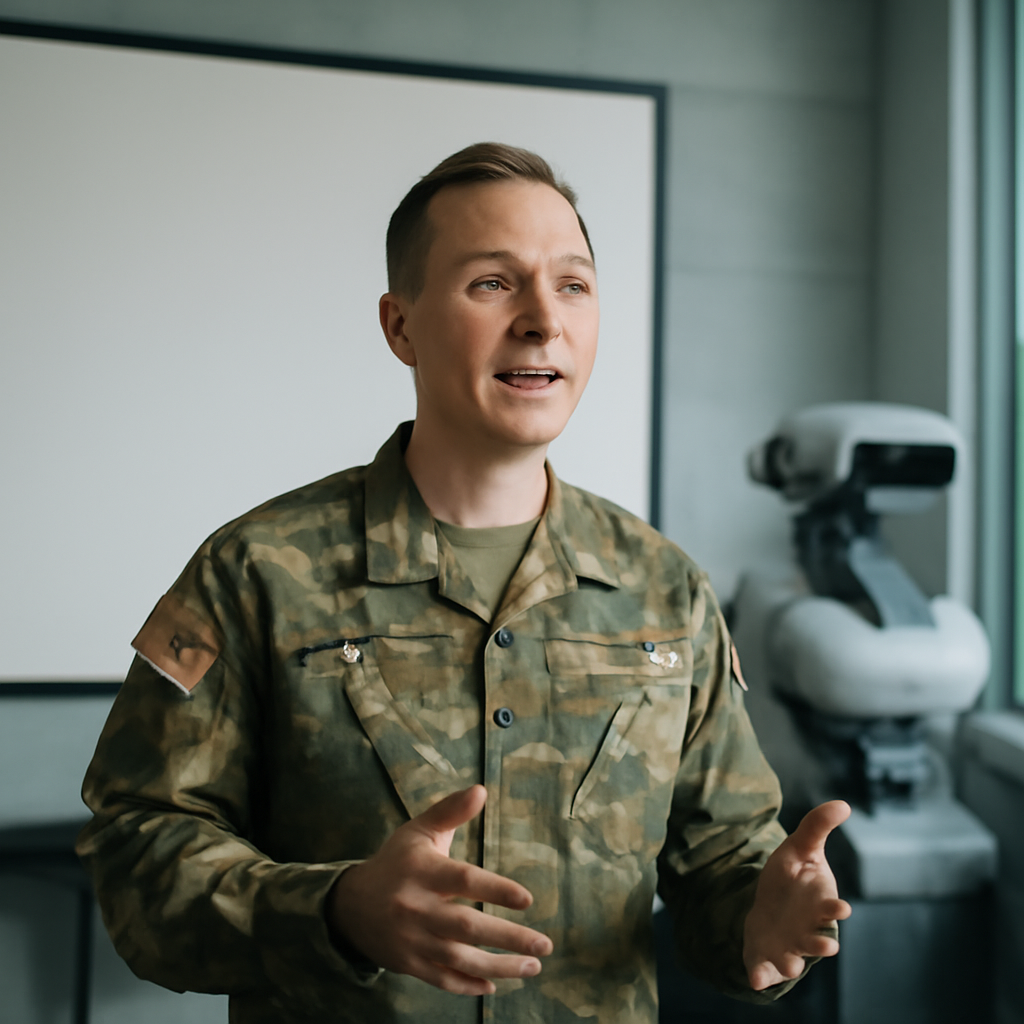
“We are incorporating autonomous and unmanned systems at every single echelon across the formation … with the force structure to match … including introducing UAS [unmanned aerial systems] and robotics military specialties to integrate these technologies at the point of need,” Acting Chief of Staff Gen. Christopher LaNeve said at the annual AUSA conference, announcing a formal change to the Army’s organizational chart.
LaNeve’s announcement at AUSA
Acting Chief of Staff Gen. Christopher LaNeve revealed that the Army has “redesignated” its Futures and Concepts Command (FCC) as the U.S. Army Futures and Autonomous Systems Command, or FASCOM. LaNeve framed the move as part of a broader drive to accelerate the integration of autonomous platforms and unmanned systems across the force. He said the redesignation follows Defense Secretary Pete Hegseth’s Sept. 30 announcement establishing a new four‑star Autonomous Warfare Command (AUTOWARCOM).
From FCC to FASCOM: what changed and what did not
The change is organizational and nominal: FCC, which the Army activated at the beginning of this year, has been redesignated as FASCOM. LaNeve acknowledged that the FCC, in existence only since early 2026, will be "short‑lived" in name following the redesignation. He said the move signals the service is “moving with focus and intention,” a phrase he tied to Acting Secretary Adam Telle’s admonition that “we are gaining velocity.”

This site is the portfolio.
OSINTSights runs on Cloudflare Workers, D1, R2, and Vectorize, with an AI pipeline on Hetzner ARM. Nubivance designed, built, and operates it. We do the same for clients.
See what we buildHow FASCOM is positioned alongside AUTOWARCOM and T2COM
LaNeve tied the redesignation directly to the Pentagon’s decision to stand up AUTOWARCOM, saying “With [Secretary of Defense Pete Hegseth’s] announcement establishing Autonomous Warfare Command, Acting Secretary [Adam] Telle and I have redesignated Futures and Concepts Command to serve as US Army Futures and Autonomous Systems Command … FASCOM.” The FCC had been activated earlier this year by then‑Secretary Dan Driscoll as a subordinate command under the four‑star Transformation and Training Command, or T2COM. T2COM itself was created under the Army Transformation Initiative to consolidate two four‑star headquarters — Training and Doctrine Command and Army Futures Command — and to bolster modernization efforts.
Which organizations FASCOM will integrate
LaNeve said FASCOM will be led by a three‑star general and will “integrate and ultimately accelerate” the work of several existing organizations: the Combat Capabilities Development Command, the Medical Research and Development Command, the 75th Innovation Command, the Joint Modernization Command and the Transformation Decision Analysis Center. In his prepared remarks he emphasized that FASCOM’s remit goes beyond aerial drones: “This goes beyond drones,” he said, adding that “FASCOM will pioneer operational concepts that harness autonomous capabilities across all warfighting functions.”
How technologists, procurement leaders, and operational commanders will respond
- Technologists and security teams: They will need to track how FASCOM centralizes work across the Combat Capabilities Development Command and Medical Research and Development Command, given LaNeve’s emphasis on integrating UAS and robotics specialties "at the point of need."
- Procurement leaders and innovation commands: The 75th Innovation Command and Joint Modernization Command are explicitly named as parts of FASCOM’s integration, so acquisition and experimentation pipelines tied to those commands are likely to be a focus as the three‑star headquarters begins to align force structure and specialties.
- Operational commanders and training organizations: Because the redesignation follows the creation of T2COM and the Army Transformation Initiative’s consolidation of high‑level commands, commanders responsible for force design and readiness will be watching how the new FASCOM’s concepts are translated into specialties and force structure changes across echelons.
The redesignation makes explicit what the Army had signaled in earlier briefings this month: the service intends to place autonomous systems and related specialties at the center of future force design. What remains concrete in the record is the chain of changes — FCC’s activation earlier this year under T2COM, the Pentagon’s Sept. 30 announcement of AUTOWARCOM, and LaNeve’s AUSA declaration that FCC will now function as FASCOM under a three‑star leader while integrating a set of research, innovation and modernization organizations. The next visible steps to watch will be the appointment of FASCOM’s three‑star commander and how the named subordinate organizations are realigned operationally under the new command.