Army Test and Evaluation Command will run operational assessments
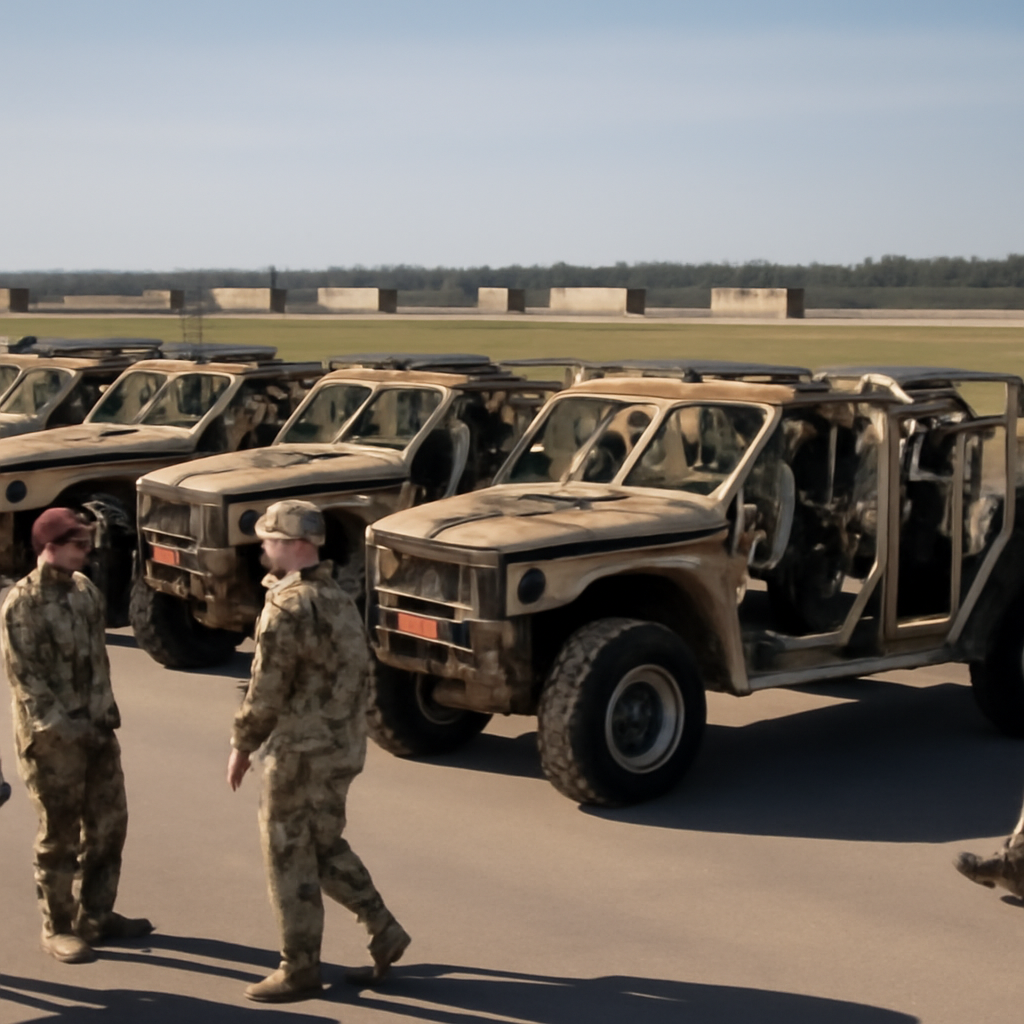
The Army awarded other transaction agreements (OTAs) on June 30 to three vendors to build prototypes for the infantry squad vehicle heavy variant, the service spokesperson told Breaking Defense. Each vendor will deliver three ISV-Heavy prototypes — nine vehicles in total — to the Army by March 30, 2027. Those prototypes will undergo operational assessments and “limited developmental testing” under the Army Test and Evaluation Command (ATEC), according to the spokesperson.
GM Defense, Ford, and BC Customs: nine ISV‑Heavy prototypes due by March 30, 2027
GM Defense, Ford and BC Customs won the prototype awards. GM Defense has previously provided the Army with the original ISV variant based on the Chevrolet Colorado and has announced it will offer a militarized version of the Chevrolet Silverado HD 3500 for the ISV‑Heavy competition. Ford confirmed to Breaking Defense that it will supply a modified version of its F‑Series pickup truck. BC Customs did not respond to a request for comment by the time of publication.
Ford’s public reaction was brief and direct: “We are excited to start work on this Army contract and look forward to delivering several incredibly capable vehicle protypes [sic] that demonstrate the value Ford can provide to the Army and soldiers,” a Ford spokesperson said in a statement.

Audit-ready is a season. It shouldn't be.
Evidence in spreadsheets, controls drifting between audits, frameworks multiplying on flat headcount. Nubivance runs continuous compliance on Rapid7 Cyber GRC - SOC 2, HIPAA, ISO 27001, PCI, CMMC.
End the scrambleJesse Tolleson and the Army’s power-focused requirements
The heavy ISV variant is being positioned to close a specific shortfall the Army has identified. The Army’s principal deputy of Assistant Secretary of the Army for Acquisition, Logistics and Technology, Jesse Tolleson, told lawmakers last month that the original ISV increased battlefield agility and speed, but the service needs a heavier variant to supply more mobile electrical power. Tolleson described the situation as a “critical capability gap.”
That focus is reflected in the commercial solutions opening the Army published in March: the service is seeking vehicles that can carry six soldiers and provide 60 kW of continuous high‑voltage DC power, 15 kW of 28V DC power and 4.8 kW of 120V AC power. Tolleson said the added size of the ISV‑Heavy should allow soldiers to generate exportable power or provide onboard power to support command posts in the field.
How GM Defense, Ford and BC Customs; the Army test community; and soldiers will respond
- GM Defense, Ford and BC Customs: Each vendor must translate commercial pickup architectures into a heavy variant that meets the Army’s power and space specifications and deliver three prototypes by the March 30, 2027 deadline. GM is approaching the contest with the Silverado HD 3500 platform; Ford with an enhanced F‑Series; BC Customs’ offering was not publicly detailed.
- Army Test and Evaluation Command: ATEC will conduct operational assessments and limited developmental testing of the nine prototypes. Those assessments will evaluate whether vendor designs meet the cited power outputs and soldier‑carrying requirements and how they perform in relevant operational conditions.
- Soldiers and commanders: If the ISV‑Heavy meets the published targets for exportable and onboard power, it could be used to sustain command posts and other power‑dependent operations in the field; Tolleson framed the heavy variant explicitly as a means to meet those needs.
Timing, transparency and procurement implications
The awards appear to place the program ahead of the Army’s public timetable. Tolleson had told lawmakers that a request for prototype proposals was expected to be released by the fourth quarter of this calendar year; instead, the OTAs were awarded on June 30. The Army did not provide a dollar amount for the OTA awards when asked, the spokesperson said.
The Wall Street Journal first reported the awards earlier on the day Breaking Defense published the story. Beyond delivery and testing schedules, procurement observers will note two practical details the record makes clear: the service set specific electrical‑power and capacity targets in its March commercial solutions opening, and industry players ranging from large defense contractors to smaller custom shops are engaged in the prototyping phase.
President Donald Trump’s visit to GM’s testing ground
The announcement coincided with a White House‑linked appearance: President Donald Trump toured GM Defense’s Milford Proving Ground in Michigan on the same day, ahead of a planned speech on manufacturing jobs and trade tariffs, the story reports. The visit underscores the public visibility of the awards and the administration’s interest in domestic manufacturing tie‑ins to defense work.
The Army’s next visible milestones will be vendor deliveries by March 30, 2027 and the results of ATEC’s operational assessments and limited developmental testing. With the service’s power requirements spelled out and three distinct vendor approaches now under contract, the ISV‑Heavy competition will shift from design promises to hands‑on evaluation. Observers will watch whether the prototypes meet the specified power outputs and how quickly the Army can decide whether to move beyond prototyping into broader procurement — questions the record does not yet answer.