“This U.S. Armored Division could/would/should take on that specific PLA combined‑arms brigade(s) on open plains,” the blog observed, capturing the tone of an internet pastime that mixes bravado, simplification and a weak grasp of logistics.
Steppe Partner 2026: heavy armor on the Mongolian plain
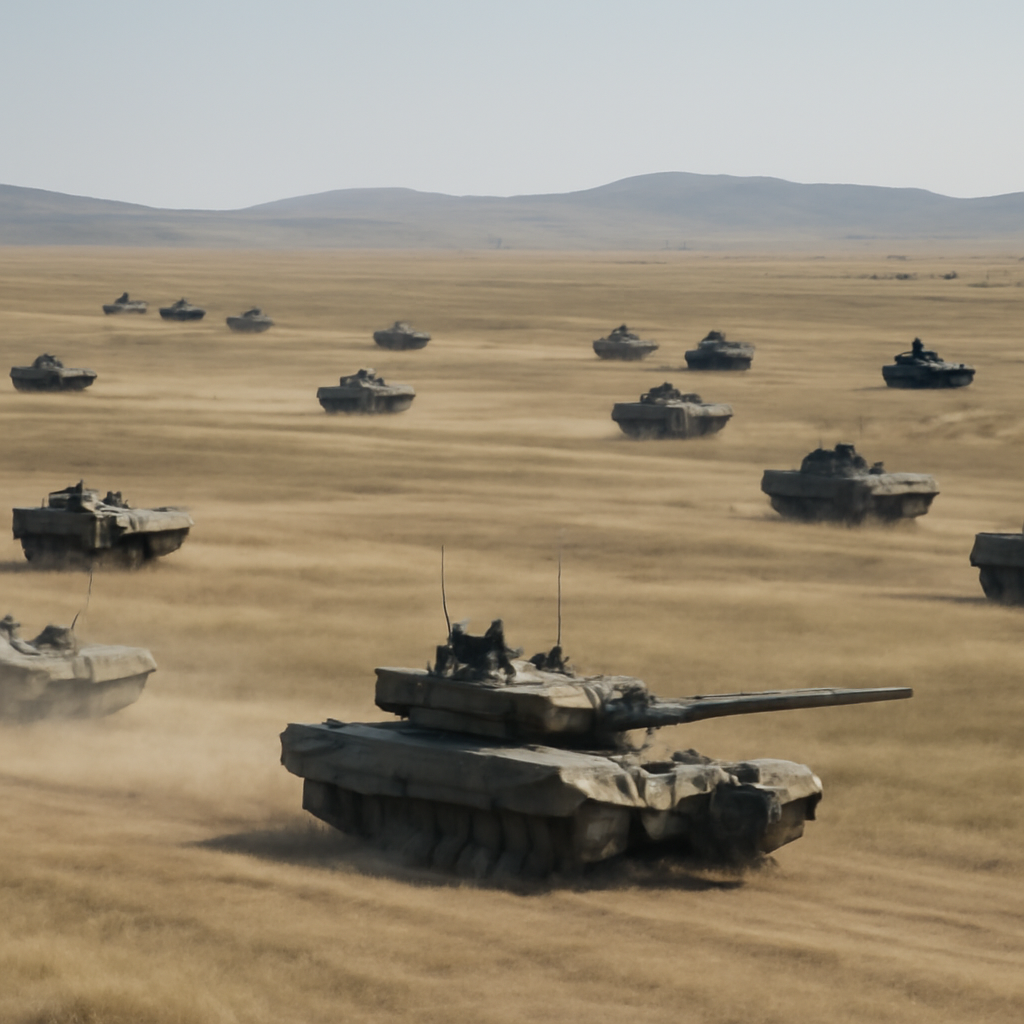
The stimulus for the discussion is visible: the China–Mongolia joint training exercise Steppe Partner 2026, where, as the author put it, “heavy armor charges around like the final episode of 'Dunk and Egg.'” That visual — tanks maneuvering across wide terrain in a publicized exercise — is precisely what fuels online debates comparing hypothetical U.S. armored formations and specific PLA combined‑arms brigades.
Geography and routes matter more than fantasy matchups
Those debates, the author argues, often begin with a hidden assumption: that a U.S. armored division can simply appear on a “conveniently flat, tank‑friendly patch of near Mongolia China.” The post walks through the geography that complicates that fantasy. Moving through northern China runs into “forests and hills;” a coastal approach encounters “one continuous urban belt;” routes southward through Vietnam, Myanmar or Thailand mean “jungle;” transit via India, Pakistan or Afghanistan means “mountains.” Sending forces via Central Asia or Russia, the author notes wryly, depends on “how that diplomatic clearance with Putin goes.”

This site is the portfolio.
OSINTSights runs on Cloudflare Workers, D1, R2, and Vectorize, with an AI pipeline on Hetzner ARM. Nubivance designed, built, and operates it. We do the same for clients.
See what we buildHistoric frames and modern levers: Kursk, armor, and FPV drones
The author acknowledges that armor still matters, invoking history: “One of the largest tank battles in history happened at Kursk back in summer 1943, and funnily enough, there’s a war around that region again.” But the post stresses that the classic notion of a tidy 1:1 tank duel is dated. “FPV drones have a vote now and they tend to win it,” the author writes — a concise claim that shifts the equation away from simple, open‑field matchups.
Why the “open‑field tank unit duel” idea feels dated
Even if the logistical and geographic hurdles were magically removed — the author allows a fictional “Star Trek transporter” for argument’s sake — the whole notion of a clean armored death‑match belongs to another era. The post frames the modern battlefield as one in which unmanned systems and new sensors change engagements, and thus single‑dimension comparisons (tank versus tank in an empty plain) miss the larger dynamics.
Online mock drafts, the PLA in Mongolia, and the pleasure of thought experiments
The piece neatly separates annoyance from amusement. The author calls the internet’s “fantasy‑league tank unit matchups/mock draft” a predictable form of “YouTube‑and‑Twitter silliness,” yet admits to enjoying them: “I’m a fan of the ‘New U.S. Armored Division vs. three PLA brigades’ thought experiments.” The post draws an equivalence — the PLA is running its own exercises in Mongolia, while online commentators run theirs in comment threads, “just with fewer logistics and more imagination.”
What this means for U.S. armored divisions, the PLA, and online commentators
- U.S. armored divisions: Expect the post’s central admonition — don’t assume rapid, unobstructed access to a remote, flat battlefield without addressing the described geographic and diplomatic barriers.
- The PLA: The visible conduct of Steppe Partner 2026 reinforces the imagery that drives online comparisons; the exercises are part of the same visual language that fuels mock matchups.
- Online commentators: The author’s tone is equal parts critique and confession — these matchups are entertaining, but they routinely omit logistics, terrain and the influence of systems such as FPV drones.
Plainly put, the blog’s point is simple: vivid footage of tanks on the steppe invites fantasy, but geography, diplomacy and changing technology make tidy armoured‑division versus brigade death‑matches a relic. Enjoy the thought experiment — but don’t let it replace the map, the manifest and the drone feed.