Anduril’s role: C5ISR backbone and Lattice integration
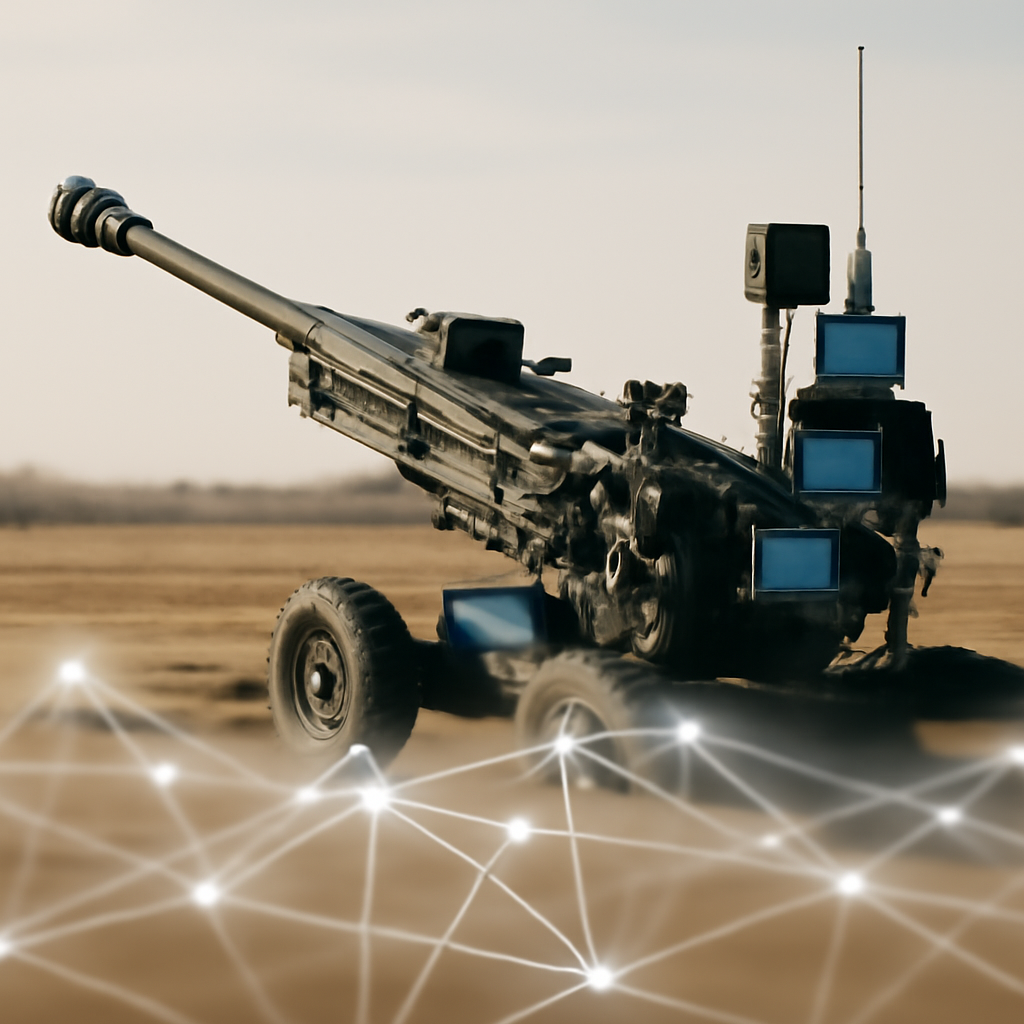
Anduril has joined the Elbit America team to provide the Sigma mobile tactical cannon with its command, control, computers, communications, cyber, intelligence, surveillance and reconnaissance (C5ISR) capabilities, the companies announced in a joint statement. The company will also integrate its artificial intelligence-driven Lattice software platform into the system.
“On Team SIGMA, we’re providing expertise in software, edge compute and autonomy to deliver a connected, software-defined mobile artillery solution that will integrate seamlessly into existing Army Command and Control and fire control architectures,” Michael Roder, managing director at Anduril, said in the release. The language positions Anduril’s contribution as the networking, software and autonomy layer intended to bind sensors, decision aids and weapons together.
Elbit America and OshKosh: weapon, vehicle, and U.S. manufacturing
Under the teaming arrangement, Elbit America will supply the 155-mm, 52‑caliber fully automated cannon for the system while OshKosh Defense will provide the 10×10 vehicle. The companies emphasize U.S. production: an Elbit spokesperson told Breaking Defense at the AUSA Global Force summit in March that the Sigma is fully manufactured in Charleston, South Carolina.
Elbit framed SIGMA as an immediately available, combat-proven option. “Built in the U.S. with a fully domestic supply chain, SIGMA is a combat-proven system that provides the modernization and reliability the Army needs now,” Luke Savoie said in the release.

This site is the portfolio.
OSINTSights runs on Cloudflare Workers, D1, R2, and Vectorize, with an AI pipeline on Hetzner ARM. Nubivance designed, built, and operates it. We do the same for clients.
See what we buildThe competitive field: K9, Caesar, Rheinmetall, and BAE
The Elbit–Anduril–OshKosh team is one entry among several foreign-origin systems being offered to the Army through their U.S. subsidiaries. Breaking Defense named at least four other competitors:
- The U.S. subsidiary of Korean company Hanwha Defense will be submitting its K9 mobile howitzer for the competition.
- The U.S. subsidiary of Italy’s Leonardo DRS together with European land defense specialist KNDS will be offering their Caesar howitzer variant.
- The U.S. subsidiary of German company Rheinmetall is offering their howitzer as well.
- British BAE Systems, through its American subsidiary — which currently produces the Army’s M109A7 Paladin Integrated Management (PIM) program — is also competing, a company spokesperson confirmed to Breaking Defense.
The field thus includes multiple established howitzer designs offered by firms operating through U.S. subsidiaries.
Army schedule and procurement constraints
The Army is aiming to award a contract for the new howitzers next month, a deadline the source describes as a tight turnaround given that a request for information went out to industry in September — roughly 10 months earlier. The competition itself was originally delayed by months to bring it in line with the Army Transformation Initiative, the companies’ release notes.
That schedule compresses evaluation and contracting phases and places pressure on competitors to demonstrate integration — including how each system will mesh with existing command and fire control architectures — within a short timeframe.
What this means for technologists, procurement leaders, and the Army
- Technologists and security teams: The addition of Anduril’s C5ISR stack and AI-driven Lattice into a mobile artillery platform focuses attention on network integration and edge compute. Luke Savoie framed part of the pitch as reducing “network integration risk,” and Anduril says its stack will “integrate seamlessly into existing Army Command and Control and fire control architectures.” Teams will be watching interoperability, data flows, and how AI components are validated.
- Procurement leaders and program managers: The “fully domestic supply chain” claim for SIGMA and the compressed timeline to award a contract next month place supply-chain traceability and schedule performance high on the evaluation checklist. Bidders across the field will need to show both manufacturability in the United States and rapid, demonstrable integration with Army systems.
- The Army as user and integrator: The Army stands to evaluate not only individual howitzer lethality and mobility but also how each offering fits into broader command, control, and fire control frameworks. Anduril’s pitch emphasizes a software-defined, connected artillery solution intended to slot into those architectures.
With the competition’s award expected next month, the immediate questions are operational and procedural: which team can demonstrate rapid, reliable integration of weapons, vehicles and C5ISR; which bidders can substantiate domestic production claims; and whether the compressed timetable will allow the Army to validate those claims fully. The companies’ announcements set the technical terms of the contest — Lattice-enabled C5ISR versus a field of established howitzer platforms offered through U.S. subsidiaries — and leave the next step to the Army’s evaluation and contracting process.