"Hybrid provides us capabilities, not only for range, but also for going to remote areas where there may not be electrical charging available," John Uczekaj, president and COO of AIRO Group, told Breaking Defense.
The platforms: JC250 cargo and JX250 ISR
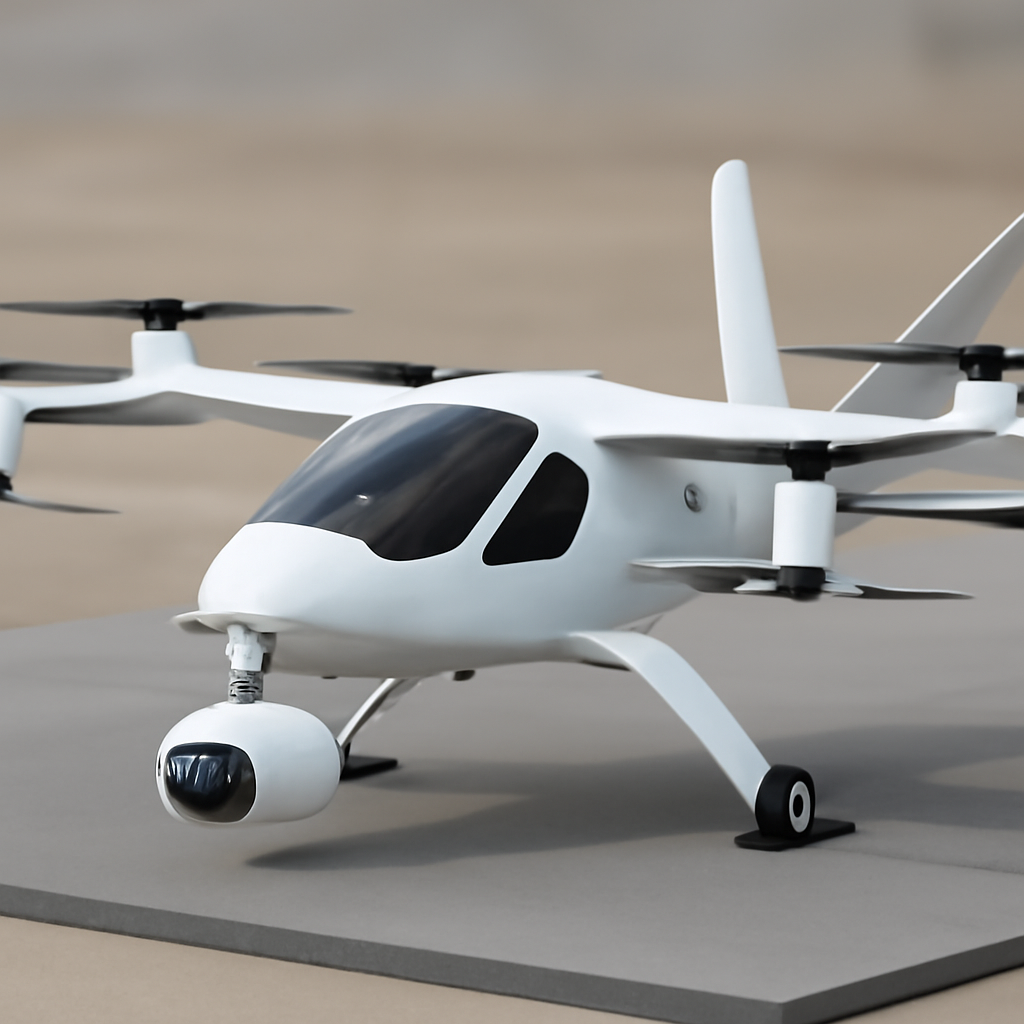
AIRO, under its Jaunt Air Mobility brand, unveiled two variants of a mid-size vertical-takeoff-and-landing (VTOL) aircraft at the Xponential/MDEX conference in Detroit: the JC250 cargo version and the JX250 intelligence, surveillance and reconnaissance (ISR) version. The company described the design as a dual-use platform intended for defense, government, and commercial missions. The ISR demonstrator on display carried a camera mounted underneath; the cargo variant is built to accept a removable belly pod.
Slowed-rotor architecture and the endurance claim
AIRO said the aircraft employs a patented "slowed-rotor" design intended to combine helicopter-like vertical lift with more efficient forward flight. Martin Peryea, AIRO’s senior vice president and general manager of electric air mobility, explained the operational tradeoff: a large rotor is efficient for getting off the ground but inefficient for forward flight, so in AIRO’s design the rotor performs the heavy lift for takeoff and landing, then slows in forward flight and acts "more like a second wing" to improve lift and efficiency.
Peryea asserted that this architecture enables "15 to 18 hours of endurance on this aircraft for ISR missions," adding, "there’s not a single aircraft today that can lift vertically and fly 15, 18 hours. It doesn’t exist." Those are company claims about capabilities that, if realized, would aim to extend on-station time well beyond typical multirotor or conventional helicopter endurance.

Audit-ready is a season. It shouldn't be.
Evidence in spreadsheets, controls drifting between audits, frameworks multiplying on flat headcount. Nubivance runs continuous compliance on Rapid7 Cyber GRC - SOC 2, HIPAA, ISO 27001, PCI, CMMC.
End the scrambleHybrid-electric propulsion: range and logistics flexibility
AIRO pairs the slowed-rotor concept with hybrid-electric propulsion: an electric motor supplemented by an internal-combustion engine. According to Uczekaj, that mix delivers both range and the ability to operate where electrical charging infrastructure may not exist. The company described the JC250/JX250 as a mid-size cargo aircraft with an expected range "roughly 300-500 nautical miles," and the potential to stretch to 1,000 nautical miles because of hybrid-electric propulsion.
Uczekaj framed the hybrid arrangement as an operational hedge: use electric propulsion for efficiency and longer range, and use the gas-powered element to provide onboard charging and additional range when operating in "uncontrolled areas" without known infrastructure.
Military logistics focus: the "middle mile" and runway independence
AIRO positioned the JC250 as a solution for the military "middle mile" — the movement of goods between major distribution hubs and the final delivery point. Company representatives described that space as the area between rear-area stockpiles and forward or remote units, where ground convoys can be slow or vulnerable and manned helicopters may be scarce, costly, or overtasked. The aircraft is portrayed as runway-independent, capable of vertical lift to reach forward or remote locations and to remain on station for surveillance tasks when configured as the JX250.
What this means for the military, commercial logistics, and remote communities
- Military users: If certified and fielded as described, the JC250/JX250 would be aimed at extending logistics reach in the "middle mile" and providing extended-duration ISR without reliance on runways. AIRO is also working to make the aircraft "Blue UAS compatible," which it says would allow U.S. forces to purchase the platform.
- Commercial logistics and emergency responders: The company explicitly envisions roles beyond defense — medical transport, law enforcement, and commercial logistics among them — leveraging VTOL reach and hybrid-electric range in areas lacking charging infrastructure.
- Remote communities: For settlements or operations without electrical charging infrastructure, the hybrid system is presented as a way to deliver supplies or services over hundreds of nautical miles while retaining options for onboard charging and gasoline-fueled range extension.
AIRO said the aircraft will be developed and manufactured in Canada, with a first flight expected by the end of the year and certification to follow. Those milestones — first flight and subsequent certification — are the clear near-term checkpoints that will determine whether the slowed-rotor, hybrid-electric claims translate into operational capability.
Whether the platform will meet its asserted endurance and range in operational settings, and how quickly certification and adoption follow, remain the concrete questions the company has put before military and commercial buyers. For now, AIRO has presented a concept that joins VTOL flexibility with hybrid propulsion and a claimed leap in endurance; the next acts are a test flight and the regulatory and procurement steps that follow.