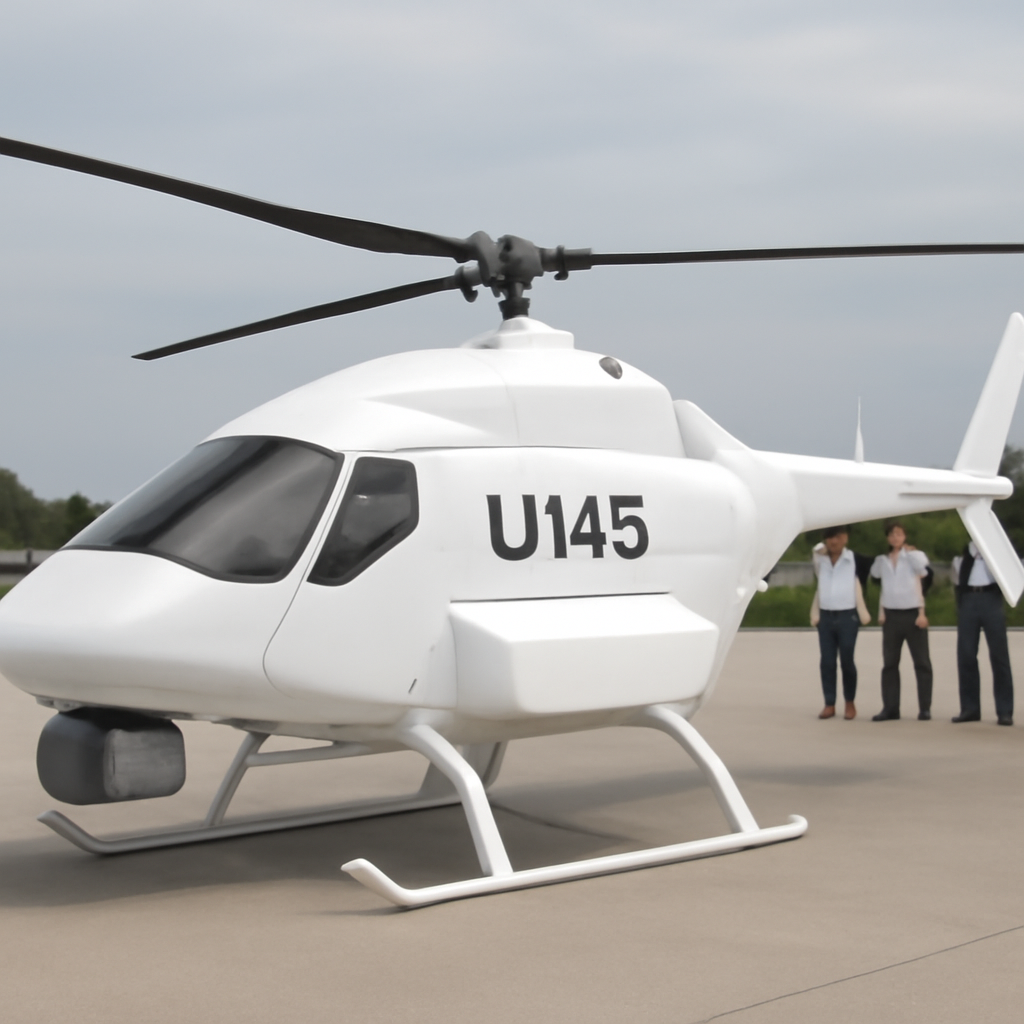
“With the U145, we are offering our customers an autonomous, uncrewed version of our H145 helicopter — combining the proven airframe, power and useful load of the H145 with the autonomy of a UAS,” said Matthieu Louvot, CEO of Airbus Helicopters.
Airbus unveils the U145 ahead of ILA Berlin and plans a late‑2026 first flight
Airbus announced on June 8, 2026 that it is developing an uncrewed variant of its H145 twin‑engine light helicopter, designated the U145, and revealed a full‑scale mock‑up to be shown at the ILA Berlin airshow. Airbus says it is planning a first flight of the U145 with a safety pilot onboard before the end of 2026; an Airbus Helicopters social post accompanying the announcement also states the first flight is set for late 2026. Airbus aims for entry into service at the beginning of the next decade.
Design and technical specifications carried over from the H145
Airbus positions the U145 as an uncrewed, fully autonomous variant optimised for cargo. The aircraft will remove the physical cockpit and feature a clamshell nose door, a loading platform and a dedicated cargo floor while retaining the existing rear clamshell doors and cabin side doors. Airbus states the U145 will have a maximum takeoff weight of around 8,400 pounds and a payload capacity of up to 2,600 pounds.
The U145 will keep several mechanical elements from the H145, which Airbus says has more than 1,800 examples in service. Those carryovers include twin Safran Arriel 2E engines with full‑authority digital engine control (FADEC) and a fenestron tail rotor. Airbus also says the U145 will offer “full autonomy” enabled by a specialised sensor suite and artificial intelligence.

This site is the portfolio.
OSINTSights runs on Cloudflare Workers, D1, R2, and Vectorize, with an AI pipeline on Hetzner ARM. Nubivance designed, built, and operates it. We do the same for clients.
See what we buildHow Airbus pitches roles: cargo, scouting, and a “drone mothership”
Airbus describes the U145 as a “mission‑agnostic solution for civil and military applications, primarily high‑volume cargo supply.” The company is already pitching specific military roles including armed scouting and surveillance. Airbus also plans to adapt the U145 as a “drone mothership” able to carry “launched effects” in partnership with European missile house MBDA.
The manufacturer explicitly contrasts the U145’s logistics role with other emerging rotorcraft concepts. The MQ‑72C Lakota Connector — an uncrewed version of the UH‑72 Lakota developed by Airbus U.S. Space and Defense with partners Shield AI, L3 Harris and Parry Lab — is said to carry a maximum payload of around 4,000 pounds (including slung loads) and is expected to cruise at about 135 knots to ranges of at least 350 nautical miles. Sikorsky’s U‑Hawk concept and Boeing’s discussions about an uncrewed path for the H‑47 Chinook are also cited by Airbus as part of a wider move toward uncrewed rotorcraft that can fire or deploy launched effects.
Industrial strategy, customer commonality, and the European context
An Airbus spokesperson told Breaking Defense that the U145 has not been developed for any specific national or European acquisition. Airbus is nevertheless seeking to leverage the large installed base of the H145 — which it notes has footprints on six continents and is in service or on order with a growing number of international military operators — to drive down support and maintenance costs through commonality.
The announcement arrives amid, in Airbus’s framing, a broader European recognition that states may need to strengthen sovereign capabilities. Airbus says the U145 is intended to expand the uncrewed‑air‑system (UAS) ecosystem in Europe by teaming with “leading autonomous mission partners.”
What this means for European militaries, the U.S. Marine Corps, and commercial operators
- European militaries: Airbus’s pitch and its partner engagements aim to build an autonomous rotorcraft option that can be integrated with existing H145 logistics and utility fleets; European planners watching sovereign capability expansion will note Airbus’s explicit focus on teaming with local autonomy partners and the lack of a single targeted national acquisition.
- U.S. Marine Corps and MQ‑72C observers: the MQ‑72C is already described as primarily aimed at the U.S. Marine Corps, and its higher payload figure (including slung loads) and stated range and cruise speeds give it a different performance profile to compare with the U145.
- Commercial operators and emergency services: Airbus highlights civil uses — disaster management, firefighting, cargo conveyance, remote resupply and logistics to offshore platforms — where a cockpit‑less, cargo‑optimised helicopter with autonomous navigation could change operational models for resupply and hazardous operations.
Airbus is betting that the combination of a proven airframe, retained systems commonality, and autonomous mission systems will accelerate the move to uncrewed rotorcraft. The company’s next concrete milestones are the U145 mock‑up display at ILA Berlin and the planned first flight in late 2026, steps that will determine whether the U145 can translate concept and commonality into operational acceptance while entering an increasingly competitive market for uncrewed cargo helicopters.
Source: Airbus Unveils U145 Uncrewed Cargo Helicopter — The War Zone