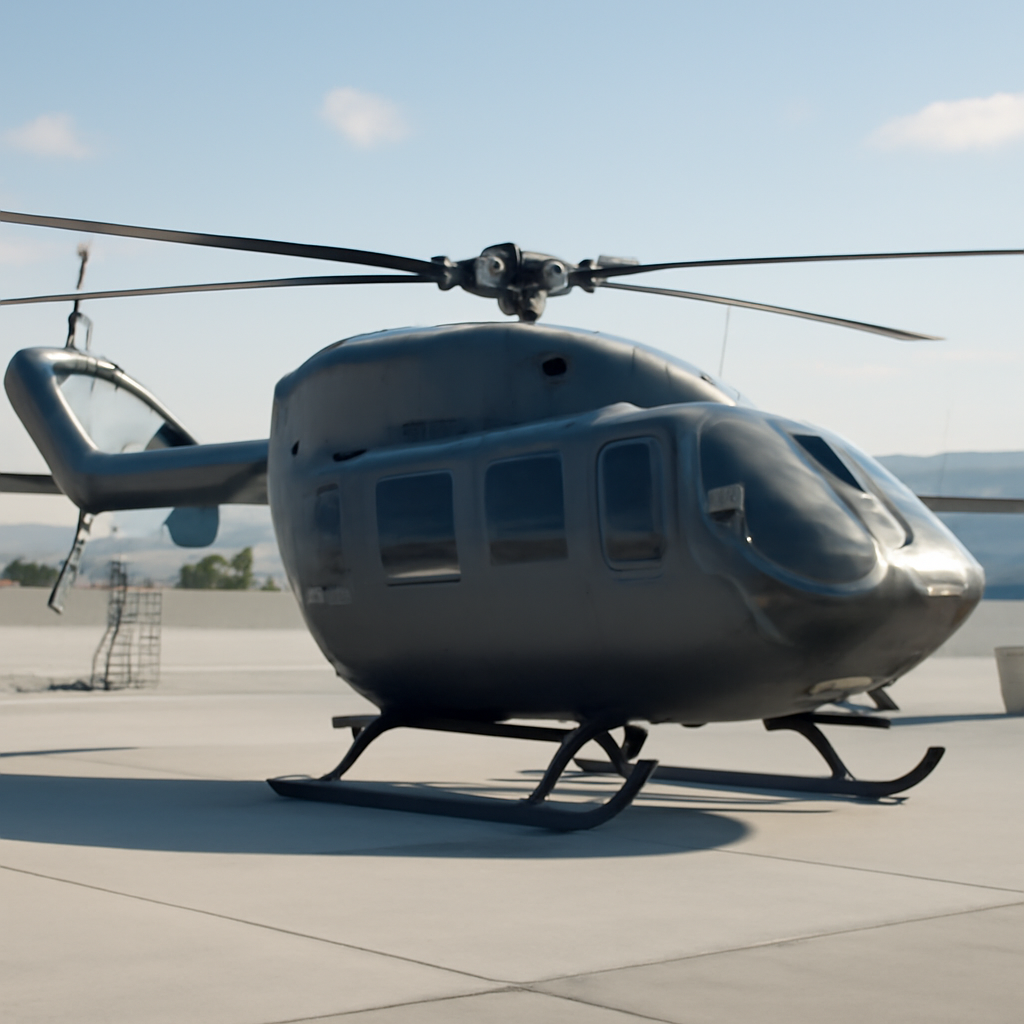
Team Lakota Connector has brought together Shield AI, L3Harris Technologies, and Parry Labs in a prototyping phase for the U.S. Marine Corps.
Airbus U.S. Space and Defense is iterating an uncrewed UH-72B Lakota
Airbus U.S. Space and Defense is actively developing and iterating the technology for the Lakota Connector, an uncrewed, autonomous variant of the multi-mission UH-72B Lakota helicopter. The company characterizes the effort as a move to adapt a proven manned airframe into an autonomous logistics asset — a transition that centers on autonomy and systems integration rather than a new airframe design.
Team Lakota Connector: Shield AI, L3Harris Technologies, and Parry Labs
Testing of Lakota Connector is taking place under the banner Team Lakota Connector. That team assembles three named firms — Shield AI, L3Harris Technologies, and Parry Labs — in a prototyping phase. The arrangement puts multiple contractors together around the common objective of turning the UH-72B platform into an autonomous cargo-capable helicopter that can support military operations.

Audit-ready is a season. It shouldn't be.
Evidence in spreadsheets, controls drifting between audits, frameworks multiplying on flat headcount. Nubivance runs continuous compliance on Rapid7 Cyber GRC - SOC 2, HIPAA, ISO 27001, PCI, CMMC.
End the scramblePrototyping for the U.S. Marine Corps
The effort is explicitly aimed at the U.S. Marine Corps. Testing and the current activity are described as a prototyping phase for that service, indicating the program is still maturing through iterative tests and integrations rather than moving immediately into production or fielding. The partnership model used by Team Lakota Connector signals a cross-vendor approach to meet Marine Corps requirements for uncrewed logistics.
Carl Forsling framed the requirement at AUSA 2026
Jamie Hunter of TWZ spoke with Carl Forsling from Airbus U.S. at the AUSA 2026 trade event in Washington, D.C. Forsling — who is identified in the reporting as a former U.S. Marine Corps CH-46 Sea Knight and MV-22 Osprey pilot — explained the requirement for uncrewed logistics in contested theaters and discussed what’s next for Team Lakota Connector. His comments situate the Lakota Connector work as a response to operational needs the Marine Corps has articulated for logistics capabilities that can operate when traditional manned logistics may be at greater risk.
What this means for the U.S. Marine Corps, Shield AI, and L3Harris Technologies
- U.S. Marine Corps: The service is receiving a prototyping pathway for an autonomous logistics capability built around a known airframe, enabling evaluation of uncrewed logistics concepts in a form factor familiar to Marine aviators and maintainers.
- Shield AI: As a named partner in Team Lakota Connector, Shield AI is positioned to contribute its autonomy expertise to an applied prototyping effort that aims to meet a Marine Corps requirement for contested-logistics operations.
- L3Harris Technologies: As another named partner, L3Harris Technologies is part of the multi-vendor prototyping construct, which signals opportunities to integrate its systems into an autonomous variant of the UH-72B Lakota.
The record in this reporting is straightforward: Airbus U.S. Space and Defense is iterating technologies to produce an autonomous Lakota variant while Team Lakota Connector — composed of Shield AI, L3Harris Technologies, and Parry Labs — drives a prototyping campaign for the U.S. Marine Corps. Carl Forsling’s remarks at AUSA 2026 underscored the program’s purpose: to provide uncrewed logistics options suitable for contested theaters. For now, the program remains in prototyping and testing rather than full production, and the next visible steps are continued integration and iteration under Team Lakota Connector as described at the event.