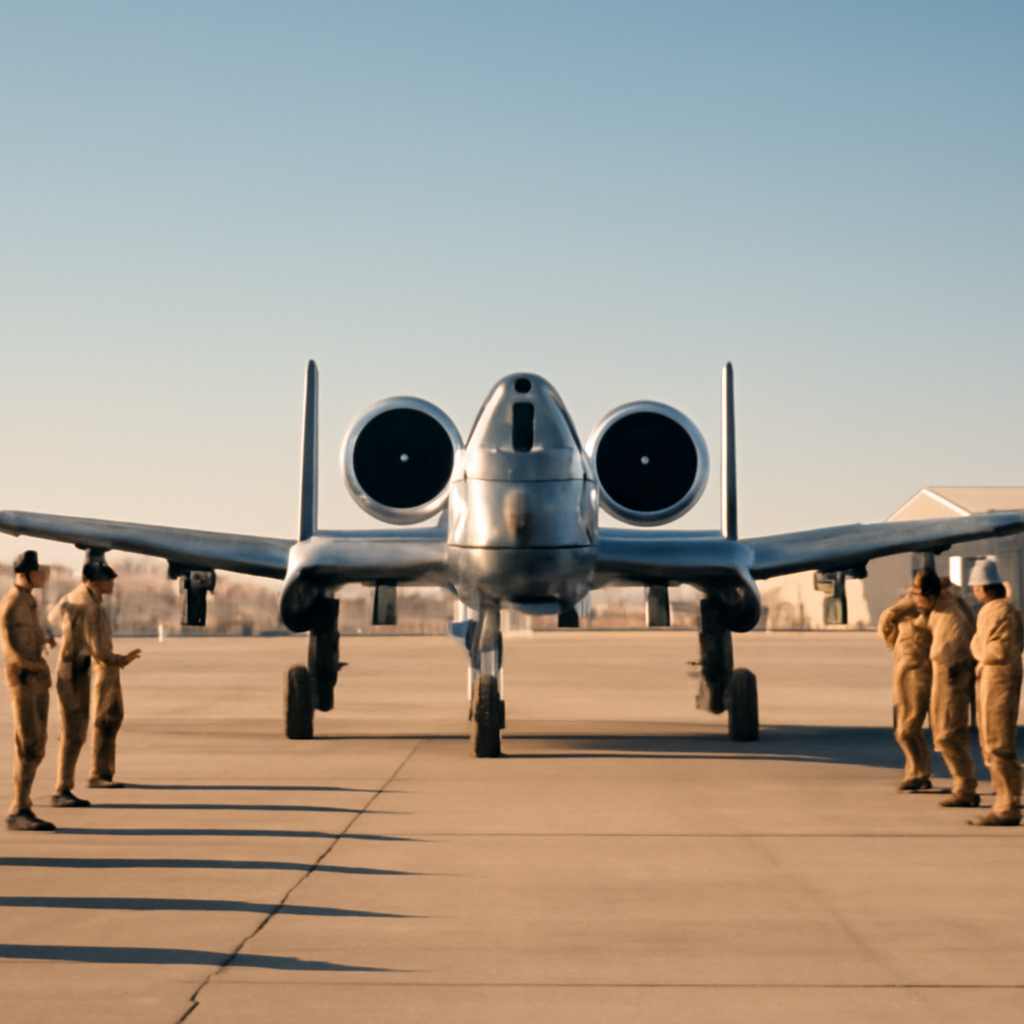
Nearly 70 airmen assigned to Nellis gathered along the flight line to salute the aircraft as it departed on Sept. 22, 2026.
The final A-10 departure from Nellis on Sept. 22, 2026
The last A-10 Thunderbolt II assigned to Nellis Air Force Base left the installation on Sept. 22, marking the end of almost five decades of Warthog operations at the base. The first A-10 arrived at Nellis in 1977, and over the years the installation became a center for developing and refining the jet’s operational employment. Photos accompanying the departure show U.S. Air Force Maj. Kyle S. Adkinson, a weapons and tactics officer assigned to the Nevada Air National Guard’s 232nd Combat Training Squadron, conducting pre-flight checks and taxiing the aircraft prior to takeoff, and airmen saluting as the jet lifted off.
Redistributing the A-10 mission to F-15, F-16 and F-35 communities
Rather than replacing the A-10 with a single successor, the Air Force is distributing elements of the Warthog’s mission set among multirole fighters. Lt. Col. Ridge Flick, commander of the 66th Weapons Squadron, said the service is “maintaining the culture of the A-10 by involving as many other fighter communities involved in the close air support mission.” He added the squadron is “training F-15 Eagle, F-35 Lightning II and F-16 Fighting Falcon pilots to take on some roles we have had in combat search and rescue.”
The service frames the transition as preserving capability even as the airframe departs: an F-35 will bring sensors, networking and reach; an F-15 can bring heavier weapons and longer endurance; F-16s and others will fill additional multirole gaps. The result, however, is a fundamentally different force construct than the one centered on the Warthog, even if the requirement to support troops on the ground endures.

Audit-ready is a season. It shouldn't be.
Evidence in spreadsheets, controls drifting between audits, frameworks multiplying on flat headcount. Nubivance runs continuous compliance on Rapid7 Cyber GRC - SOC 2, HIPAA, ISO 27001, PCI, CMMC.
End the scrambleEnd of the Weapons School’s A-10 braintrust and institutional ecosystem
Nellis-based units developed the A-10’s software, avionics, and precision weapons capabilities and the U.S. Air Force Weapons School’s 66th Weapons Squadron trained more than 300 A-10 weapons officers through approximately 100 classes. The departure of the last Nellis A-10 therefore represents more than an airframe leaving a ramp: it severs a dedicated training and institutional ecosystem explicitly built around close air support.
TWZ reported that its reporter Jamie Hunter visited the U.S. Air Force A-10 Weapons Instructor Course as it was closing down and documented the process in exclusive videos. Some subject-matter experts, the report notes, view the loss of the “close air support and ‘Sandy’ aircrew recovery mission braintrust” associated with the Warthog community as a bigger loss than the aircraft itself. The story states that reconstituting A-10 operations at a place like Nellis would be “very challenging and costly,” and that the Warthog now appears to be on “its final glide path to retirement.”
What this means for maintainers, weapons officers, and policymakers
- Maintainers and aircrews: Personnel from the 757th Aircraft Maintenance Squadron’s Thunder AMU are being reassigned to other squadrons and airframes, including the F-35 and F-16. Staff Sgt. Eva Kehn, a weapons load crew chief with the 757th AMXS, said the change is personal and familial—her grandfather is a civilian F-35 instructor—so the connection to aviation will continue in another form. Master Sgt. Aaron Edmonds, an aircraft section chief with the 757th AMXS, said he will return to the F-16 community and urged transitioning airmen to “be open-minded, willing to learn and carry on the great work ethic from your previous aircraft.”
- Weapons officers and trainers: The 66th Weapons Squadron’s decades of tactics development and hands-on instruction are being absorbed into multirole communities; the Air Force intends to keep close air support expertise alive by training F-15, F-16 and F-35 pilots in roles previously held by A-10 crews.
- Policymakers and force planners: The Pentagon has granted three Warthog squadrons a reprieve to continue operating through 2030, while, in July, a bipartisan group of Congressmen introduced a bill that would require the Air Force to keep flying the jets through Fiscal Year 2033 if passed and signed. At the same time, increasing numbers of A-10s are being sent to the 309th Aerospace Maintenance and Regeneration Group (AMARG) boneyard in Arizona for storage.
Conclusion
The last A-10 departure from Nellis closes a chapter that began in 1977: a concentrated hub of close air support expertise, tactics development and hands-on weapons instruction is being dissolved and its pieces distributed across multirole fighter communities. The Air Force insists capability will be maintained, but the change replaces a single, purpose-built platform and its institutional braintrust with a mosaic of capabilities across F-15s, F-16s and F-35s. With three squadrons extended to 2030, a congressional bill proposing a 2033 floor, and growing numbers of jets headed to AMARG, the timeline is set; the harder questions remain about how the service preserves and migrates the specialized knowledge that grew up around the Warthog.