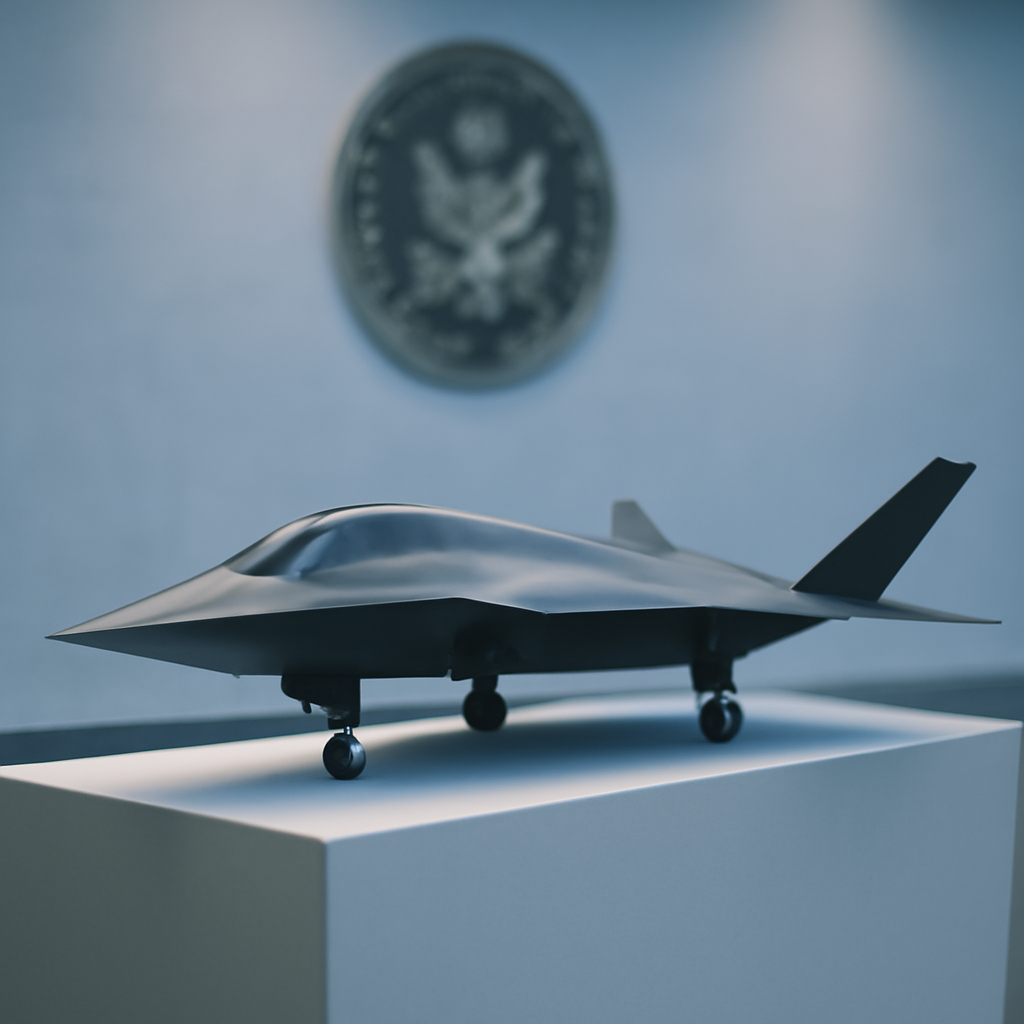
"We're shooting for roughly six, but we'll see what we end up with," Col. Timothy Helfridge said of how many designs the Air Force may advance into prototyping for the next round of its Collaborative Combat Aircraft effort.
Col. Timothy Helfridge on Increment 2 timeline and targets
Speaking at the Life Cycle Industry Days conference in Dayton, Ohio, Col. Timothy Helfridge, the fighter portfolio acquisition executive, said the concept-refinement phase for CCA Increment 2 has "another approximately 10 months left" on its contract and could produce "several closed conceptual designs." That schedule places the end of concept refinement at roughly mid‑2027 — a date Helfridge and his office have used as a planning target — and he reiterated the Air Force's aspiration to move as many as six designs into a prototyping phase next year.
Nine companies contracted, 11 more remain eligible
The Air Force announced in December that nine companies had received contracts to refine concepts for Increment 2 CCAs, and that 11 additional companies remain eligible to compete in later phases. The service has signaled that Increment 2 will be structured similarly to Increment 1, allowing more than one awardee to be selected for prototyping so the Air Force can "evaluate various solutions before selecting the final designs to move into production," an Air Force official told Defense One late last year.

This site is the portfolio.
OSINTSights runs on Cloudflare Workers, D1, R2, and Vectorize, with an AI pipeline on Hetzner ARM. Nubivance designed, built, and operates it. We do the same for clients.
See what we buildHow Increment 1 set the precedent: production and prototypes named
Increment 1 provided a practical blueprint for the path Increment 2 may follow. In 2024, the Air Force funded initial Increment 1 work by Boeing, Lockheed Martin, Northrop Grumman, Anduril, and General Atomics, but ultimately only Anduril and General Atomics were chosen to build prototypes and then to begin production. Northrop Grumman’s largely self‑financed CCA earned a prototype an Air Force designation and made it eligible for the first increment, but it did not win a production contract.
Prototypes in service: Fury, Dark Merlin, and the Creech exercise
This week, Anduril unveiled the first Fury CCA produced at its facility near Rickenbacker Airport in central Ohio. Service officials also confirmed the Air Force has been experimenting with a prototype Fury and with General Atomics’ Dark Merlin CCA. The service used those CCAs as part of a recent multi‑day Agile Combat Employment exercise at Creech Air Force Base in Nevada. "This exercise was about getting the systems into the hands of the warfighter," Lt. Col. Matthew Jensen, the Experimental Operations Unit commander, said in a press release. "We are focused on operating CCA outside of a traditional test environment so we can continue to learn, inform and rapidly iterate."
What this means for Anduril, General Atomics, and other eligible contractors
- Anduril: The company has moved a production‑line Fury out of its Rickenbacker Airport facility and into Air Force experiments, positioning the design to be evaluated as part of Increment 2’s competition.
- General Atomics: Dark Merlin prototypes already in service with Air Force experimentation place the company among known contenders whose designs are being exercised in operational settings.
- Other eligible contractors and new entrants: With nine firms already under concept‑refinement contracts and 11 more eligible to compete later, the Air Force is explicitly leaving room for entrants that did not take part in concept refinement to join in subsequent phases, a point Helfridge emphasized as the service seeks to "maximize the learning as soon as we can."
The Increment 2 structure — multiple prototyping awards, operational experiments outside classic test environments, and an open door to later entrants — makes mid‑2027 a hinge point. By then, the Air Force expects to move the most promising concept designs forward, refine tradeoffs, and continue exercises that place CCAs in the hands of operators rather than keeping them confined to laboratory testing.
The immediate question the facts leave: which of the designs refined through the next 10 months will be among the "up to" six chosen for prototyping, and how those prototypes will perform in further Agile Combat Employment experiments at bases like Creech. The service’s stated emphasis on competition and rapid iteration suggests the answers will unfold through the prototyping phase and the operational experimentation that follows.