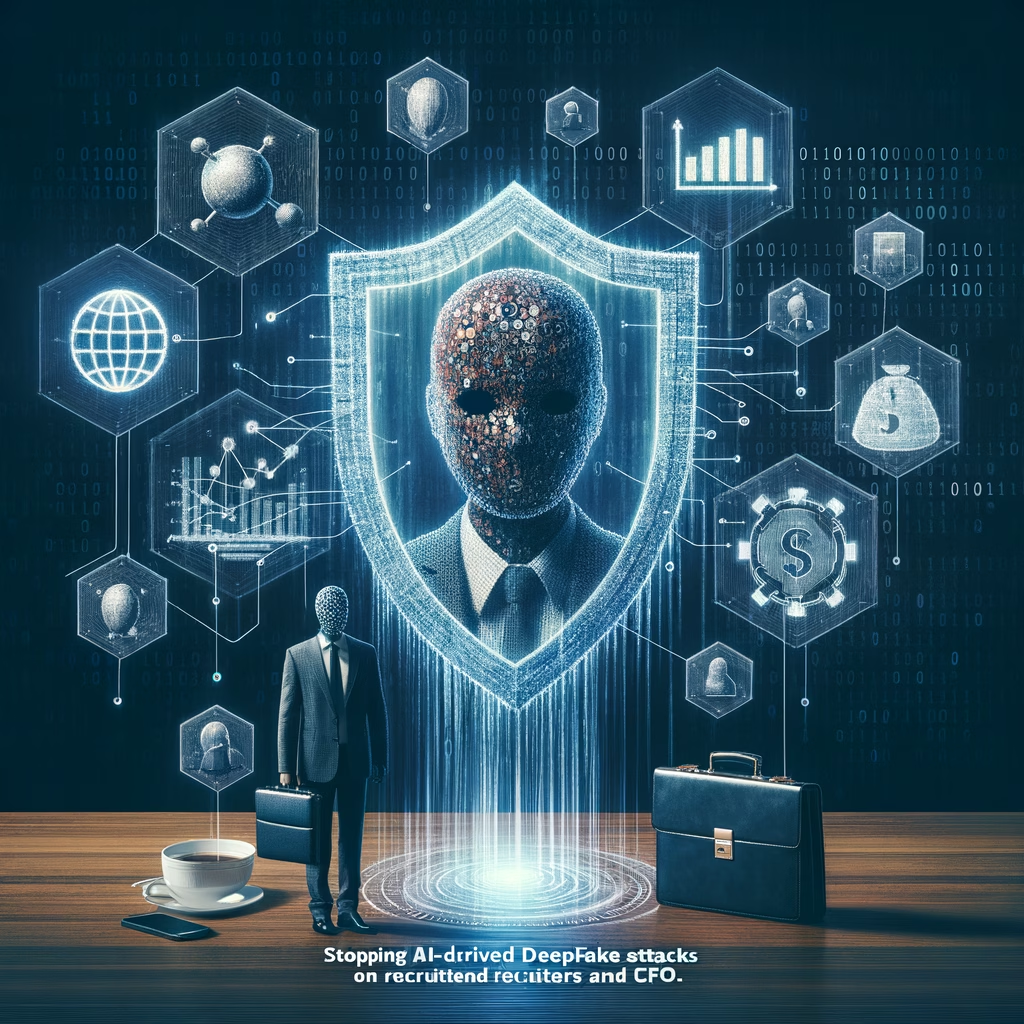
“Are you really speaking to your CFO, or is it a synthetic voice engineered by a hacker halfway across the globe?” This question, once confined to the realm of science fiction, now echoes through boardrooms and HR departments with unsettling frequency. The rise of AI-driven deepfake technology has transformed social engineering from a blunt, often obvious tactic into a sophisticated assault that targets the very gatekeepers of corporate trust: recruiters and chief financial officers.
Social engineering attacks have evolved dramatically. What was once limited to poorly spelled phishing emails now includes highly personalized and believable deceptions. According to a recent report by cybersecurity firm Proofpoint, attackers leverage generative AI, stolen branding assets, and deepfake tools to mimic executives’ voices and appearances, hijack social media accounts, and create counterfeit websites and emails that can fool even the most cautious professionals.

At the core of these attacks lies the ability to exploit human trust. Recruiters and CFOs are uniquely vulnerable due to their roles. Recruiters often handle sensitive personal data and authorize access for new hires, while CFOs manage financial transactions and strategic communications. The attackers’ use of AI-generated voices and visuals, combined with stolen corporate identity elements, creates a convincing illusion that can prompt an unsuspecting employee to transfer funds, disclose confidential information, or grant system access.
“The AI component is a force multiplier,” says Dr. Elizabeth Renner, Director of Cyber Threat Intelligence at SecureWorks. “It enables fraudsters to craft tailored communications at scale, reducing the guesswork and increasing the success rate of these schemes. It’s no longer about casting a wide net but about precision targeting.”
The current landscape is worrying not only for businesses but for policymakers and security technologists as well. While traditional cybersecurity measures focus on malware detection and network defense, AI-driven impersonations demand new approaches. Multi-factor authentication (MFA), behavioral analytics, and employee training focused specifically on AI-based threats are critical tools in the defense arsenal.
However, these solutions come with challenges. MFA, while effective, can be bypassed if attackers manipulate internal actors with convincing deepfake audio or video. Behavioral analytics require significant data and contextual understanding to differentiate between legitimate and fraudulent communications without generating false positives that hinder operations. Meanwhile, employee training must evolve constantly to keep pace with rapid advancements in generative AI.
From a policy perspective, lawmakers face the difficult task of balancing innovation and security. Overregulation risks stifling AI’s beneficial applications, yet inaction could leave businesses exposed to ever-more convincing deepfakes. The European Union’s proposed Artificial Intelligence Act attempts to set guidelines for transparency and risk assessment, but enforcement and global coordination remain complex hurdles.
Adversaries, too, are evolving their tactics. Beyond direct impersonation, they employ hybrid attacks that combine deepfake-generated content with traditional social engineering. An email might be accompanied by a video call from a synthetic CEO urging immediate action, creating a sense of urgency that lowers defenses. The financial and reputational costs of such breaches can be devastating, as seen in recent cases where millions were siphoned from corporations through fraudulent wire transfers.
In practice, companies are adopting layered security strategies. These include:
/ Robust identity verification processes for high-risk transactions
/ Continuous monitoring of social media and external communications for brand impersonation
/ Deployment of AI detection tools capable of flagging deepfake media
/ Cultivating a culture of skepticism and verification among employees, especially those in recruiting and finance roles
Recruiters and CFOs must also remain vigilant in their own digital habits. “Regularly verifying requests via independent channels and maintaining awareness of emerging threats can mitigate risks,” advises Michael Chen, Chief Information Security Officer at FinSecure. “It’s about creating a human firewall in an era of synthetic deception.”
As AI continues to advance, so too will the sophistication of deepfake attacks. This raises a pivotal question: in an environment where seeing and hearing is no longer sufficient proof of authenticity, how do organizations safeguard their most critical human interactions? The answer may lie in a combination of technological innovation, thoughtful policy, and relentless human vigilance. Without it, the lines between reality and fabrication blur—and the consequences could be profound.
Source: https://thehackernews.com/2025/07/deepfakes-fake-recruiters-cloned-cfos.html



