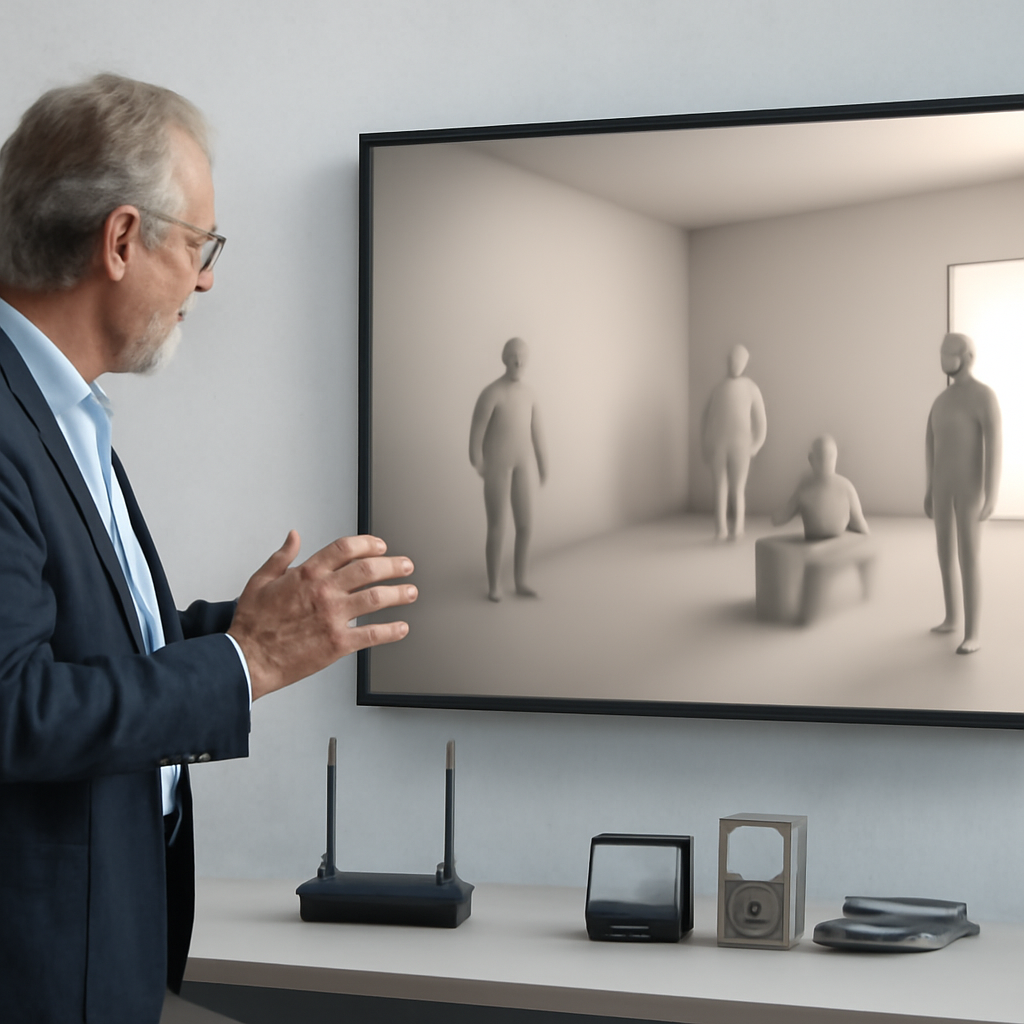
“By observing the propagation of radio waves, we can create an image of the surroundings and of persons who are present,” said Thorsten Strufe, a KIT professor and study co‑author, in a press release.
Thorsten Strufe and the KIT study
The observation above comes from Thorsten Strufe, identified in the source as a Karlsruhe Institute of Technology (KIT) professor and co‑author on a study. The researchers behind that study frame their work as an application of what is commonly called WiFi sensing: using radio-frequency signals, such as those produced by Wi‑Fi equipment, to infer information about a physical environment.
WiFi sensing: how radio waves reveal a room
The technical core described in the study is straightforward in concept and deliberate in wording: radio waves travelling through a space interact with objects and people by being reflected, scattered, or absorbed. By comparing how a signal is expected to behave with how it is actually received, researchers can draw inferences about the surrounding environment. The source puts the mechanism in analytical terms — observe propagation, note deviations, infer structure.

Audit-ready is a season. It shouldn't be.
Evidence in spreadsheets, controls drifting between audits, frameworks multiplying on flat headcount. Nubivance runs continuous compliance on Rapid7 Cyber GRC - SOC 2, HIPAA, ISO 27001, PCI, CMMC.
End the scrambleFrom signals to images: radio waves as a camera
The research team explicitly likens their method to optical imaging. “This works similar to a normal camera, the difference being that in our case, radio waves instead of light waves are used for the recognition,” Strufe said. The study frames the outcome not merely as a set of measurements but as a constructed representation — an image of surroundings and of persons who are present — produced from radio‑wave propagation data.
Not tied to router usage — identifying people using Wi‑Fi signals
The source makes a crucial distinction in language: the work is not about identifying people based on their use of Wi‑Fi routers, but about identifying people using Wi‑Fi signals. That is, the method operates by interrogating the behaviour of radio waves in space rather than by linking network authentication, logins, or device identifiers to individuals. The phrasing in the study separates signal‑based imaging from network‑use attribution.
What this means for technologists, end users, and policymakers
- Technologists and security teams: The study demonstrates a technique that turns radio‑propagation measurements into images of physical spaces and people. Engineers designing wireless systems or intrusion‑detection tools will encounter a documented mapping from signal behaviour (reflection, scattering, absorption) to environmental inference.
- End users and the general public: The researchers assert that radio waves — not light — can be processed to create images of rooms and persons present. For individuals, that technical claim reframes how presence in a space might be detected independent of device logins or visible cameras.
- Policymakers and regulators: The work, as presented, distinguishes between surveillance based on network use and sensing based on radio‑wave propagation. That distinction may affect how rules or guidelines are drawn around the permitted uses of Wi‑Fi infrastructure and signal‑based sensing technologies.
The study lays out a concise technical proposition: radio waves traversing a space carry information about the things they encounter, and by measuring deviations between expected and received signals researchers can reconstruct an image of that space — including persons who are present. The source anchors that claim in direct language from a named researcher and in careful descriptions of signal behaviour, leaving a clear, concrete assertion at the center of this work: WiFi signals can be used to infer and image physical environments and the people in them.
https://www.schneier.com/blog/archives/2026/05/identifying-people-using-wi-fi-routers.html