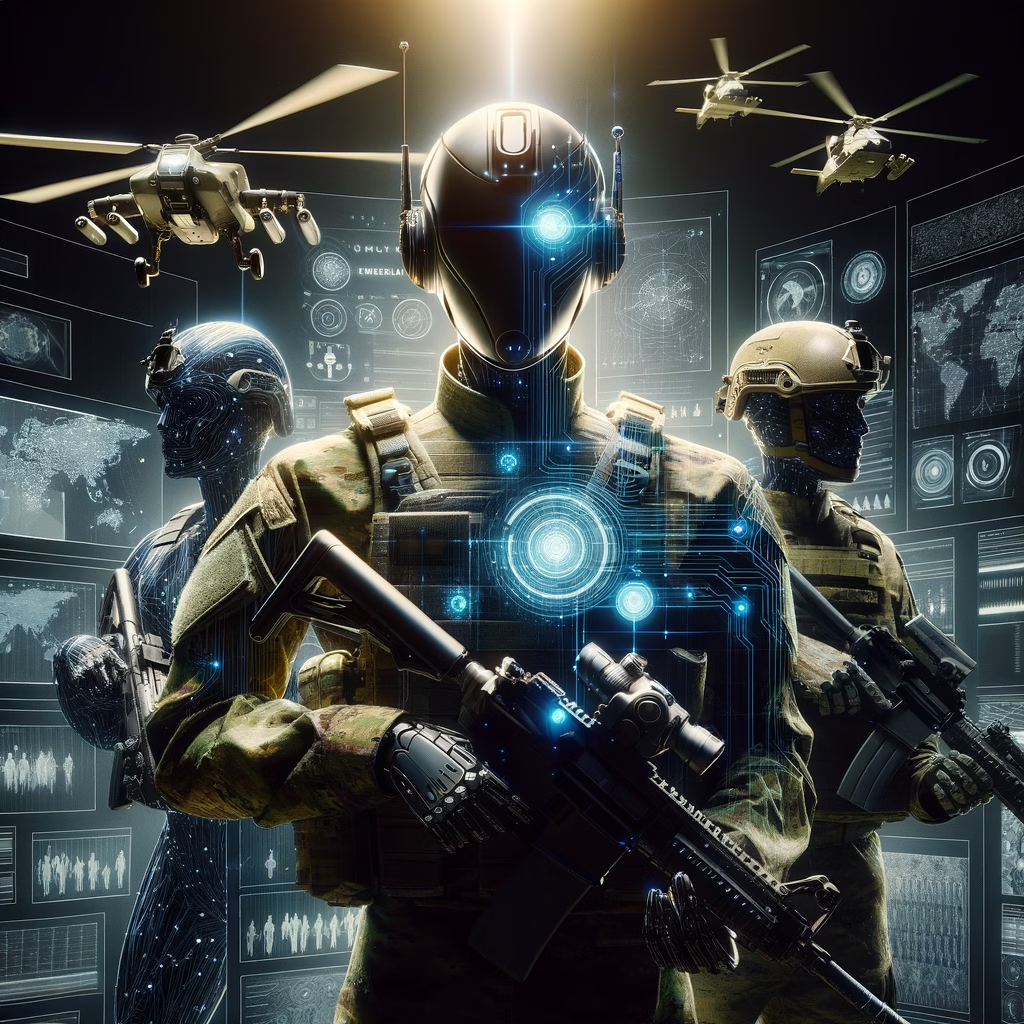
AI Strengthens Warfighter Readiness and Safety
The question echoes across training grounds, field hospitals and command centers: how do you trust a machine with a soldier’s life? That concern, part practical and part philosophical, drives an urgent debate about integrating artificial intelligence into defense operations. At the 4th Annual AI for Defense Summit in National Harbor, Maryland, defense leaders, technologists and ethicists will move beyond rhetoric to present protocols, pilots and measurable results that aim to answer that question. The central promise is tangible: AI can improve medical diagnostics at the front, predict maintenance needs to keep equipment mission-ready, and automate logistics to reduce human error — all of which bolster warfighter readiness.
Why AI matters now
The potential of AI in defense is not hypothetical. Faster triage in combat casualty care can save lives. Predictive maintenance reduces downtime and the logistical burden of spare parts. Automated analysis of sensor feeds helps intelligence teams get from data to decisions far more quickly. These capabilities translate directly into preserved readiness, reduced risk for deployed personnel and more time for commanders to make strategic choices.
This push is occurring against a shifting institutional backdrop. Over the last decade the Pentagon has moved from scattered experiments to coordinated efforts: the Joint Artificial Intelligence Center (JAIC), DARPA projects and Department of Defense strategies and ethical guidelines have established a framework for responsible adoption. Centralized standards aim to reduce duplication, share best practices and accelerate safe deployment. The aim is not rapid fielding at any cost, but measured, auditable progress that keeps humans meaningfully in control.
Warfighter readiness: technical enablers and vulnerabilities
Three technical pillars support operational AI: quality data, validated models and resilient delivery systems. High-quality labeled data from both training and live operations fuels models. Those models must be robust and validated so their outputs are trustworthy. Finally, secure delivery mechanisms ensure that AI-derived insights reach troops operating in contested, low-bandwidth or disconnected environments.
Each pillar has weak points. Data bias can skew outcomes; models can break when faced with novel scenarios; and delivering AI in austere conditions — where communications are intermittent and cyber threats abound — is a hard engineering challenge. Addressing these vulnerabilities requires rigorous testing, continuous monitoring, and deliberate design choices that prioritize reliability and explainability.
Examples from the field
Concrete pilots already demonstrate benefits. Medical teams are testing AI triage tools that analyze vitals and imaging to surface traumatic injuries faster than conventional workflows. Maintenance units use predictive algorithms to forecast part failures, shortening repair times and reducing the spare-part footprint. Analysts leverage machine-assisted search and synthesis to reduce intelligence processing from days to hours. These are not incremental conveniences; they affect survival, mission tempo and operational endurance.
Human-machine teaming, not delegation
A prevailing principle across U.S. military policy is human-centered automation: AI should augment decision-making, not replace it. While AI can compress the sensor-to-shooter loop or recommend medical interventions, the final, accountable decision remains with trained humans. This approach recognizes both technical limits — AI brittleness in unpredictable contexts — and ethical and legal constraints around delegating life-and-death decisions to algorithms.
Governance, ethics and accountability
Policymakers, ethicists and safety advocates stress meaningful human control, transparency and rigorous testing. The DoD requires evaluations for bias, robustness and traceability before systems are fielded, and acquisition practices increasingly demand auditable artifacts — model cards, validation logs and documented datasets. Implementing these standards at scale, especially within classified systems, remains complex but essential for accountability.
Cybersecurity and supply-chain integrity are non-negotiable. A compromised model or corrupted dataset could transform an advantage into a catastrophic vulnerability. To mitigate that risk, the DoD and industry partners invest in secure development practices, red-team testing and continuous monitoring of deployed models.
Workforce and cost realities
Deploying AI is not just a technical challenge; it is a people and resource problem. Effective AI requires investment in hardware and software and a workforce trained to operate, interpret and maintain systems. The military is adapting training pipelines to emphasize data literacy and systems engineering, while partnerships with industry and academia aim to accelerate knowledge transfer and enlarge the talent pool.
Strategic implications and international cooperation
AI alters competitive dynamics. As adversaries invest in similar capabilities, AI becomes a strategic force multiplier with the potential to change escalation thresholds and operational calculus. Allies can enhance effectiveness by sharing tools and data, but interoperability depends on harmonized standards and legal frameworks. Debates over autonomous weapons, export controls and the application of international humanitarian law to automated systems remain central to multinational discussions.
Conclusion: strengthening warfighter readiness with care
AI is not a magic fix; it amplifies both strengths and weaknesses. When designed and governed correctly, AI can extend the reach of medics, sharpen logistics and give commanders better situational awareness — materially improving warfighter readiness. When rushed or poorly resourced, it can introduce new vulnerabilities and ethical dilemmas. The summit in National Harbor will test whether the defense community can accelerate responsible deployments that perform reliably under stress and preserve the human judgment that must remain central to combat operations. The goal is clear: harness AI to make warfighters safer and more prepared, not to replace the human accountability that anchors every mission.