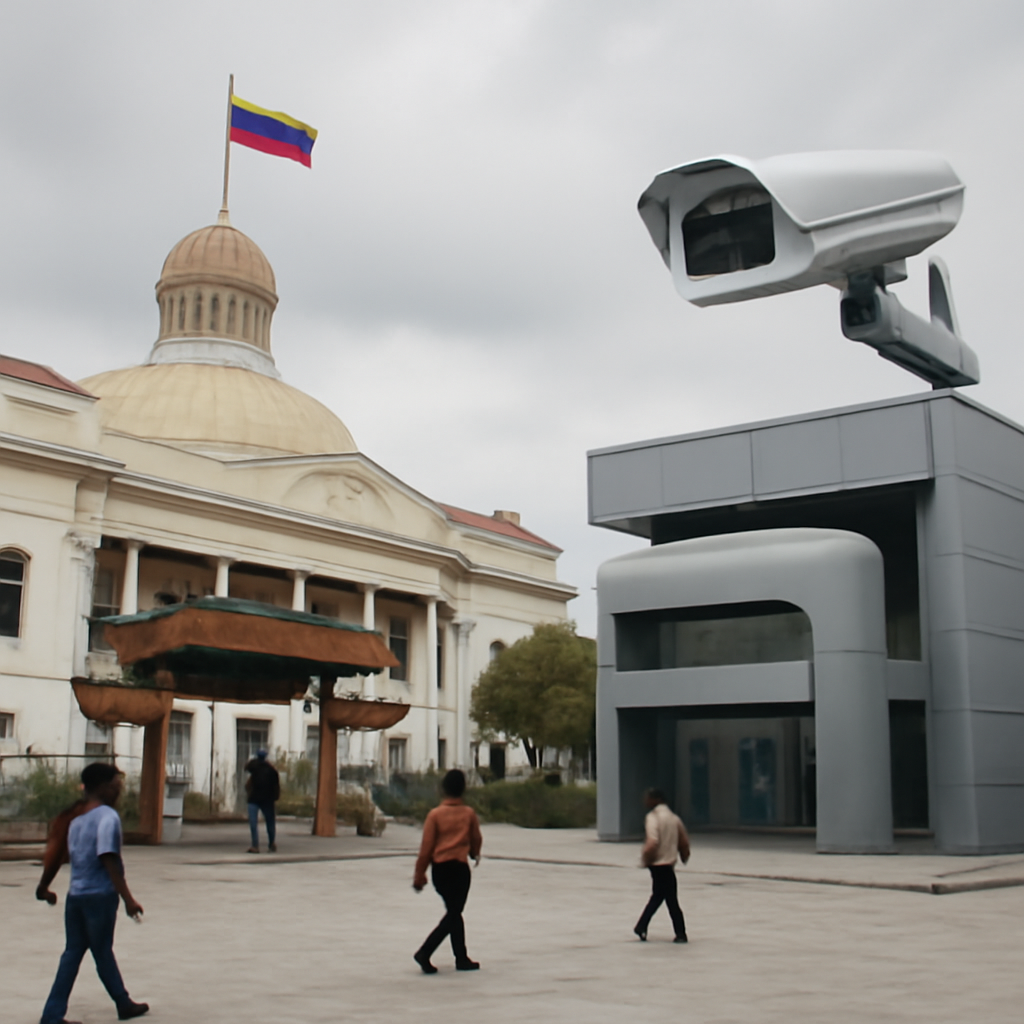
‘Only China’ could ensure countries in the Global South obtained AI ‘for development and not for domination,’ Delcy Rodriguez declared after visiting iFlytek in April 2025.
What remains of Venezuela’s surveillance infrastructure
Two decades of purchases left Venezuela with much of the plumbing of a digital surveillance and control system: telecommunications equipment, identity systems, cameras, command centres and internet-control technology. The largest single component is the Carnet de la Patria, or Homeland Card, a digital identity and welfare system built with significant assistance from ZTE. Chinese firms including CEIEC, Huawei, Hikvision and Dahua have also supplied elements of public-security cameras, command centres, telecommunications networks and internet-control infrastructure.
The iFlytek deal: timing, scope, and current status
In July 2025 Venezuela signed an agreement with Chinese AI company iFlytek to develop what the government described as “sovereign” AI technologies. The agreement followed an April 2025 visit by acting president Delcy Rodriguez to iFlytek’s Beijing facilities. The report that documents these facts stresses that the AI layer contracted for has not yet been built: “There is no public evidence that iFlytek, or any other Chinese company, is currently operating an AI surveillance system inside Venezuela.”
Even so, the paperwork matters because the infrastructure onto which AI could be layered — the cameras, identity databases and command rooms — already exists in many places across the country.

Audit-ready is a season. It shouldn't be.
Evidence in spreadsheets, controls drifting between audits, frameworks multiplying on flat headcount. Nubivance runs continuous compliance on Rapid7 Cyber GRC - SOC 2, HIPAA, ISO 27001, PCI, CMMC.
End the scrambleDelcy Rodriguez’s role and U.S. leverage
Rodriguez is a central figure in the network of relationships connecting Venezuela and China. Before becoming acting president, she chaired the China–Venezuela High-Level Joint Commission and, as executive vice president, held the highest civilian authority with formal oversight of Venezuela’s domestic intelligence agency. The report notes that the person the United States is relying on to run post-Maduro Venezuela therefore helped oversee both the old surveillance apparatus and the relationship that produced the iFlytek agreement.
The United States has publicly asserted leverage over post-removal Venezuela: Donald Trump said the United States was “in charge” of Venezuela and “we’re going to run everything,” and Secretary of State Marco Rubio said Washington had “tremendous control and leverage over what those interim authorities are doing and are able to do.” The report argues Washington should use that leverage to require Rodriguez to cancel the iFlytek agreement and to begin dismantling, rather than merely inheriting, Maduro’s machinery of digital repression.
Why adding AI would change the calculus
The existing policy toolkit for countering digital authoritarianism has focused on hardware that can be identified, sanctioned, inspected or removed. AI alters the equation because what matters may be an intangible model whose training data, filtering rules and threat assumptions are largely invisible to the importing government and external observers. AI could connect citizen records, automate censorship, analyse camera feeds and combine data that today sits in separate databases — making repression cheaper, faster, more scalable and harder to detect.
The selected supplier amplifies those risks: the report states iFlytek’s technology is embedded in China’s policing, judicial and censorship systems and that the company markets tools capable of detecting political and other sensitive content. The United States placed iFlytek on an export-control blacklist in 2019 over its role in surveillance and repression of Muslim minorities in Xinjiang.
What this means for technologists, policymakers, and Venezuelan citizens
- Technologists and security teams: Watch for attempts to integrate models with existing identity databases, camera feeds and command-centre software; the report highlights that the national command room Maduro ordered in January 2025 would operate “with artificial intelligence” and rely on 5,334 local data rooms embedded in Venezuela’s communal governance system.
- Policymakers and regulators: The report calls for standards governing foreign AI used in sensitive state functions, including disclosure of training data sources, filtering methods, update pathways and control of fine-tuning — and urges Washington to use its leverage to cancel the iFlytek agreement.
- Venezuelan citizens and human-rights monitors: The UN investigators’ March 2026 report that dozens of politically motivated detentions followed Maduro’s removal, together with independent researchers’ findings that surveillance infrastructure remained “fully operational,” suggest immediate human-rights and privacy risks even before AI is deployed.
The core paradox the report leaves on the table is stark: the supplier is known, the agreement is signed and the physical infrastructure is in place — yet the most consequential element, the AI surveillance capability itself, is not publicly documented as operational. Venezuela therefore represents a rare chance to act before an intelligence layer transforms fragmented tools into a far more powerful system of control.