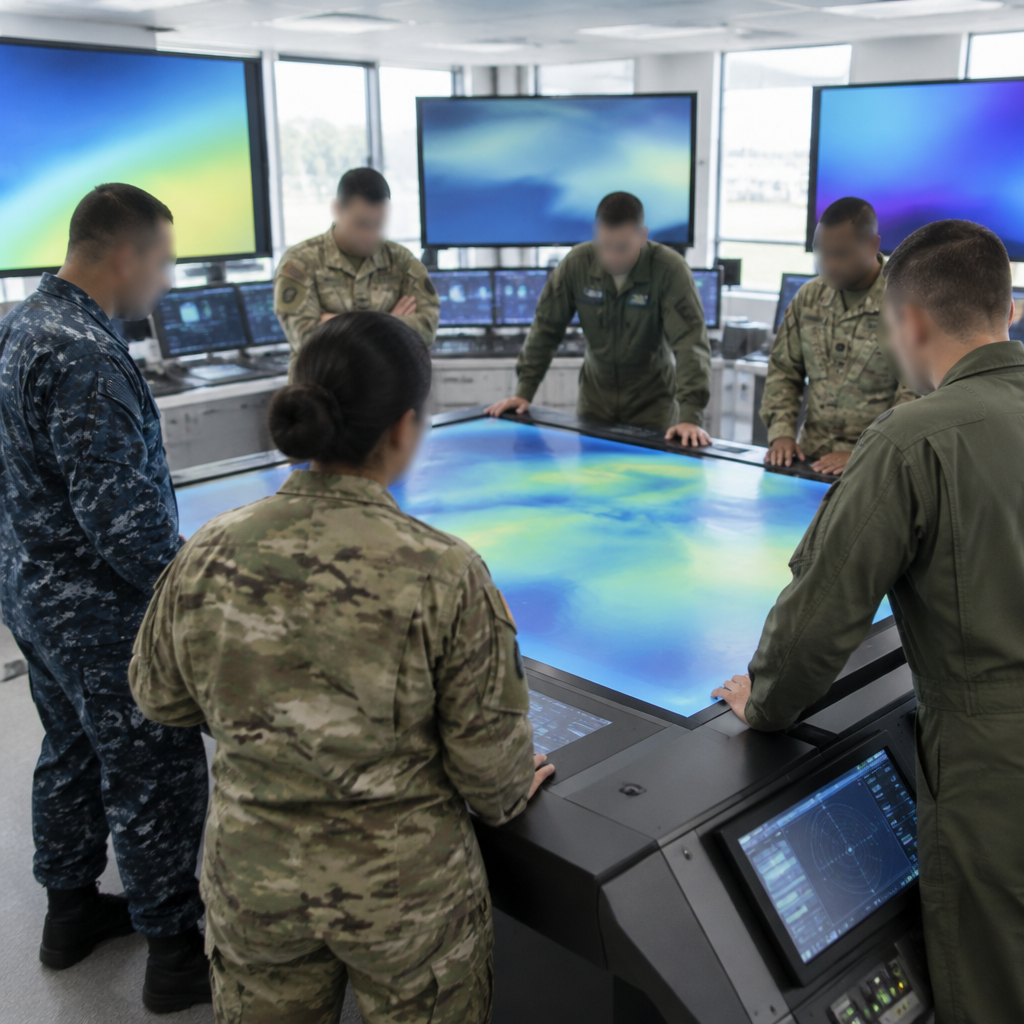
“The lower you go, the more important it is that you're looking out obliquely…you need to have a 3D reference in order to be able to compare to, to determine your position,” Paul Millhouse, Vantor’s senior director who leads the Raptor program, told Defense One.
Vantor’s Raptor: three-dimensional imagery as a GPS alternative
Vantor has built Raptor to be a navigation fallback for camera-equipped drones when GPS is unavailable or jammed. Rather than relying on overhead, two-dimensional maps, Raptor uses Vantor’s three-dimensional satellite imagery together with a drone’s onboard video feed and the navigation system’s initial estimate of camera position and altitude. That combination produces a visual, 3D reference so a drone can determine its position even while flying low through built-up terrain, where rooftops and façades no longer look like simple tops-down map features.
Flight testing in real GPS-jammed environments and 40-minute runs
The product debuted last year; since then Vantor says it has conducted flight testing and integration in “live, real GPS-jammed environments,” including long-range operations that lasted 40 minutes. The company designed Raptor to run on “pretty much any drone with a camera,” with the caveat that cameras of poor quality or drones with weak processors may not be suitable. The firm cast the capability as one component of the ongoing “cat-and-mouse game of drone warfare,” where flying low is a common tactic to avoid detection and radar.

This site is the portfolio.
OSINTSights runs on Cloudflare Workers, D1, R2, and Vectorize, with an AI pipeline on Hetzner ARM. Nubivance designed, built, and operates it. We do the same for clients.
See what we buildPlanned integrations: from Pentagon programs to non-aerial and soldier systems
Over the next year Vantor plans to integrate Raptor with more platforms. The company named the Pentagon’s Drone Dominance program as a target for integration and also listed swarms, counterdrone efforts, and collaborative combat aircraft. Vantor is extending operational testing and exploring Raptor-like use on non-aerial drones, ground vehicles, and soldier-mounted cameras, according to Millhouse: “We are exploring other technologies to bring Raptor-like capability to ground vehicles,” and soldier-mounted cameras. “GPS is fantastic when it's available, and the problem is it's just not going to always be available.”
Hadrian’s acquisition of Kutztown Foundry & Machine and a $300 million expansion
Hadrian has acquired Kutztown Foundry & Machine — a foundry the company describes as more than 150 years old — to produce naval-grade steel castings and forgings for submarines. Hadrian plans a roughly $300 million expansion that will include a mix of greenfield construction and upgrades. Chris Power, Hadrian’s CEO, said the expansion will be tied to the company’s AI-for-factories software, Opus, and that the firm intends to “fully plug” Opus across Kutztown operations.
Power cautioned that integrating AI into an existing factory is difficult: “Integrating AI into an existing factory is 10 times harder than setting it up once from scratch. So we'll be focusing on what are the key areas and rolling that out as fast as possible between now and January.” While new build areas will be designed with automation and AI in mind, Hadrian does not expect the foundry to be “fully robotic,” in part because legacy equipment dating back roughly 50 years will need upgrading and integration with new systems. Hadrian is also planning greenfield parts that surround the existing Kutztown building so it remains integrated with the company’s other factories and suppliers.
Supply-chain strain and wider defense industrial notes
During the confirmation hearing for Acting Navy Secretary Hung Cao, Sen. Tommy Tuberville, R-Ala., warned that a steel shortage is driving up prices and affecting weapons makers in his state, which produce Tomahawks and Patriots. Tuberville told the hearing that defense contractors in Alabama are struggling to obtain steel to upgrade and build more systems.
Other brief developments in the defense-manufacturing and autonomy space reported alongside these stories include: Valkryn emerging from stealth with a $15 million seed round led by a16z to build test labs for autonomous systems; Raytheon contracting Ursa Major and Avio USA to build solid rocket motors for the Navy’s Tomahawk program; Seasats placing one of Anduril’s loitering munitions on a fast-response drone boat; and the U.S.-China Economic Security Review Commission issuing 30 recommendations for Congress, among them treating data as “an asset recognized on the balance sheet” and urging the SEC to require set standards for doing so.
What this means for technologists, procurement leaders, and naval suppliers
- Technologists and security teams: Visual, 3D-referenced navigation shifts effort from GPS-resilience to sensor quality and on-board processing — Raptor requires camera feeds of sufficient fidelity and enough processor capacity to run imagery comparisons during GPS outages.
- Procurement and program managers: Vantor’s stated plan to pursue integrations with major programs like Drone Dominance and with swarms or counterdrone architectures suggests upcoming interfaces, certifications, and operational testing cycles that programs will need to budget for and schedule over the next year.
- Naval and defense suppliers: Hadrian’s $300 million plan and the short-term steel concerns flagged in a Senate confirmation hearing underscore material and modernization pressures — new factory automation and AI platforms will need to be reconciled with decades-old equipment and current steel market dynamics.
Both stories land on a common hinge: the U.S. defense enterprise is investing in new sensor- and software-driven capabilities while wrestling with legacy infrastructure and supply constraints. Vantor aims to replace — or at least backstop — GPS with image-based 3D positioning as drones fly lower and more contested missions; Hadrian aims to fold AI into a 150-year-old foundry while accepting that full robotics may not fit legacy assets. The near-term timetable is explicit: Vantor’s continued operational testing and platform integrations over the next year, and Hadrian’s phased Opus rollout through January and its greenfield construction around Kutztown. Whether those timelines resolve the technical and material frictions described in these briefings is the next practical test.