"A common execution error seen in the occasional joint exercises is the duplication of targeting across services. The difficulty of doing multiple exercises means these lessons get relearned as units and personnel rotate out before being able to train again in a complex scenario," said Matthew Martin, CAE’s lead for LVC.
Matthew Martin on joint training and the Guam problem
Martin framed the core challenge plainly: defending the U.S. territory of Guam against a peer air-and-missile (AMD) attack requires the Joint Force to operate as a single force in a battlespace where weapons, sensors, and command-and-control systems were never designed to work together. He argues the old habit—each service training largely within its own responsibility—produces avoidable errors, including duplicated targeting, and that those errors are repeatedly relearned as units rotate.
Valiant Shield: inserting simulations into operational networks at Andersen AFB
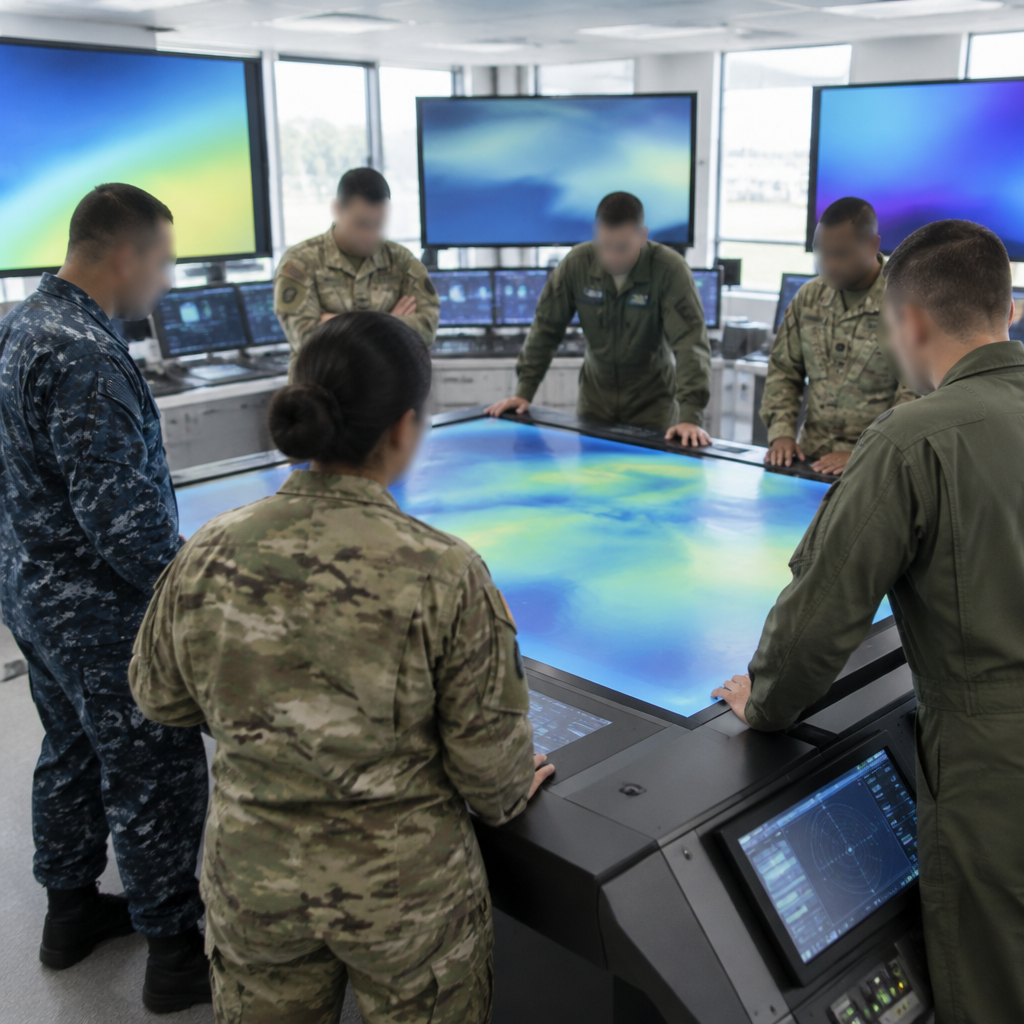
During Valiant Shield, CAE established a simulation cell at Andersen Air Force Base on Guam and connected it to the mission network supporting the island’s regional air-defense operations. The exercise generated simulated ballistic and cruise missiles, red aircraft, and friendly forces and fed that information into the command-and-control systems used by Army, Navy, and Air Force operators. The result, the company reports, was a common threat picture enabling cross-service coordination against a sophisticated adversary while personnel worked through the exact systems and procedures they would use in combat.

The cyber insurance questionnaire just landed. Now what?
SOC 2, HIPAA, insurance renewals - someone has to own security strategy. Nubivance provides fractional CISO leadership without the full-time salary.
Get a security leadF-35 simulators, MQ-28, and early CCA tactics
CAE linked geographically dispersed participants: F-35 simulators at Misawa Air Base in Japan were connected to the Guam exercise so pilots could conduct defensive operations guided by Air Force controllers thousands of miles away. The exercise also integrated collaborative combat aircraft (CCA) elements that are still being tested and fielded. CAE injected autonomy software associated with the Air Force’s Autonomy Government Reference Architecture and control interfaces from its CCA Academy in Texas into the environment, and a live MQ-28 operating near Guam participated to enable interaction between live and virtual CCA capabilities.
Dr. Brian Stensrud, CAE’s Technical Fellow for Artificial Intelligence, said, "CCAs will undoubtedly be a permanent fixture in future representative LVC mission exercises," emphasizing the need to learn how those aircraft will be employed, what tasks they should perform, and how much human control should be retained. To probe the human side of autonomy, CAE equipped F-35 pilots and air-battle managers with biometric monitoring devices and used cognitive classifiers to assess workload, situational awareness, and trust in autonomous systems.
AI and automation to reduce exercise complexity
CAE is investing in an integrated mission environment that uses artificial intelligence to automate much of the work required to assemble, execute, and repeat large live-virtual-constructive (LVC) exercises. "We’re trying to close that loop with AI and automation, rather than relying on dozens of people involved in making it all happen," Stensrud said. The stated objective is for AI to translate a commander’s training objectives into an executable exercise: selecting simulation tools, configuring data sources, connecting systems, and generating forces and conditions.
AI-generated adversary behavior is being used to make opposing forces more dynamic and less scripted, and to produce more representative sensor outputs for intelligence, surveillance, and reconnaissance training. The reported benefit is twofold: a wider range of threats in exercises, and reduced time and manpower required to prepare them, making complex joint training more practical and repeatable.
SCARS, allied links, and Resolute Forces Pacific 2027
Connecting LVC across the Pacific depends on secure, reliable infrastructure. The U.S. Air Force’s Simulator Common Architecture Requirements and Standards (SCARS) program provides a cloud-based architecture for cybersecurity, software updates, and distribution of authoritative simulation data. CAE is leveraging SCARS to host simulation tools within a cybersecure environment and connect them to classified mission networks so simulated threats and friendly forces can appear in operational command-and-control systems without building separate networks for training.
CAE expanded allied participation during the U.S.–Japan bilateral exercise Keen Sword by including Japanese air controllers, U.S. and Japanese F-35 simulators, and live aircraft with Link 16 and operational communications. The company plans further expansion for Resolute Forces Pacific 2027, which will connect locations in Japan, Guam, and Hawaii into a common air-defense environment and allow warfighters to practice distributed command and control, including transferring responsibilities between command centers if an installation is attacked, damaged, or unable to communicate.
What this means for joint operators, AI developers, and US–Japan planners
- Joint operators (Army, Navy, Air Force): the approach gives them a common threat picture and a chance to work through Tactics, Techniques, and Procedures together—Army air-defense personnel took part in Air Force-style tactical debriefings during Valiant Shield, and Air Force battle managers worked alongside Army operators to coordinate airspace.
- AI and autonomy developers (CAE, CCA Academy, autonomy toolchains): they will evaluate not just system performance but human factors—biometric monitoring and cognitive classifiers were used to measure workload, situational awareness, and trust, informing the balance between operator control and machine independence.
- US–Japan planners and allied commanders: Link 16 connectivity and the planned Resolute Forces Pacific 2027 expansion create a way to rehearse distributed command-and-control and mission rehearsal across national boundaries, testing transfers of responsibility between command centers in degraded or damaged communications scenarios.
CAE and its partners frame this work as more than training: Martin said the same connected, automated environment could "become a true operational capability by enabling opportunities like mission rehearsal." The next concrete milestone is Resolute Forces Pacific 2027 in the coming spring — a test of whether the integration and AI-driven automation demonstrated in recent Pacific exercises can scale into a routinely usable tool for joint and allied commanders.