"This arrest sends a clear message that anyone who intentionally damages public safety equipment will be identified, arrested, and held accountable," said Monterey County Sheriff Tina Nieto.
The Monterey County arrest
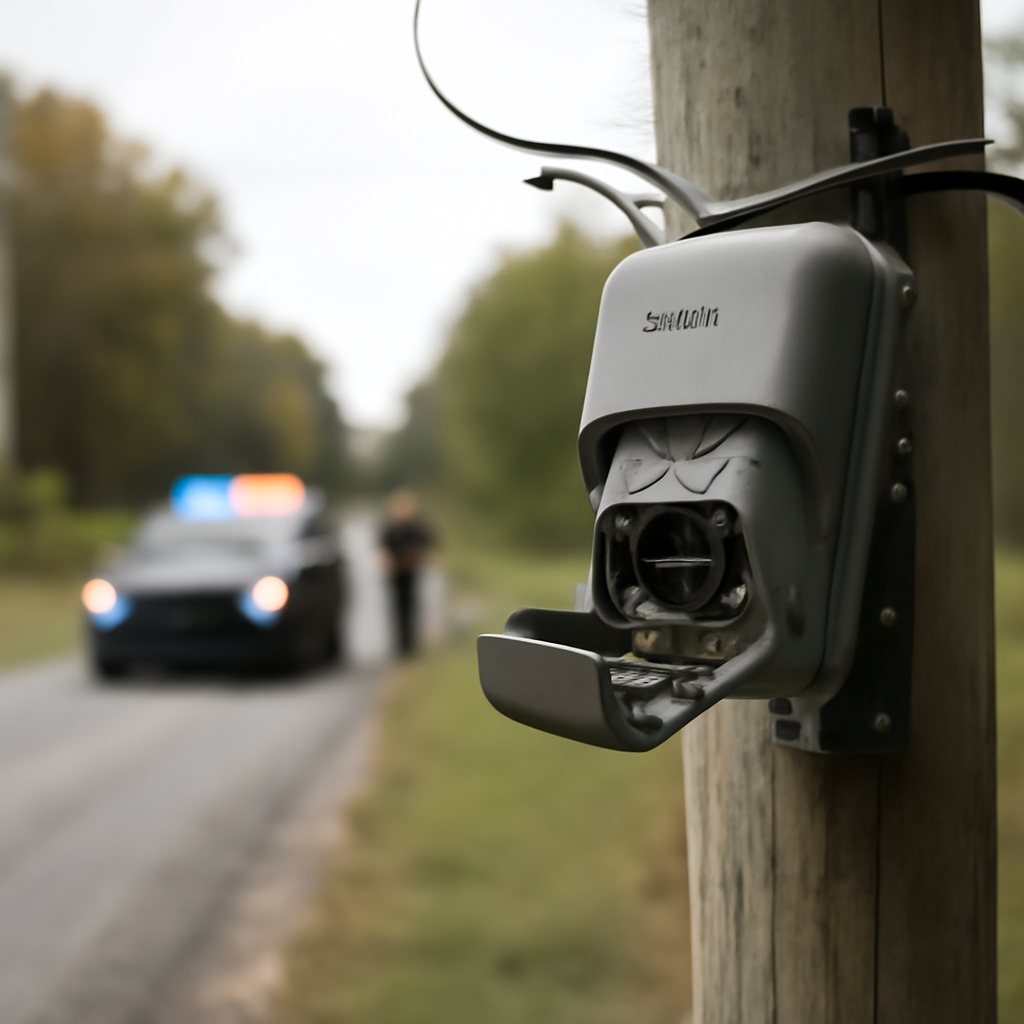
Marcus Bee, 40, of Pismo Beach was arrested by the Monterey County Sheriff’s Office on Tuesday after police allege he attacked at least three Flock automated license plate readers (ALPRs) in the communities of Lockwood and Bradley. According to a police report cited by the sheriff’s office, Bee caused "thousands of dollars’ worth of damage to 'public safety infrastructure.'" Deflock.org, which maps Flock deployments, lists three ALPRs across the two communities—one in Lockwood and two in Bradley—roughly 25 miles apart. Bee was jailed with bail set at $30,000.
How the arrest unfolded
Monterey County officials said Bee’s actions were captured by other surveillance cameras located nearby, and that those recordings, along with other investigative leads, contributed directly to his arrest. The sheriff’s office framed the arrest as part of an ongoing effort: "These cameras have become an invaluable investigative resource that helps us solve crimes, recover stolen vehicles and ag equipment, locate missing persons, and protect our communities," Sheriff Tina Nieto said. "Any attempts to disable these systems will not prevent us from doing our job."

Audit-ready is a season. It shouldn't be.
Evidence in spreadsheets, controls drifting between audits, frameworks multiplying on flat headcount. Nubivance runs continuous compliance on Rapid7 Cyber GRC - SOC 2, HIPAA, ISO 27001, PCI, CMMC.
End the scrambleFlock’s stated role and company claims
Flock has been explicit in condemning vandalism of its cameras and in stressing the investigative value of its systems. Flock CEO Garrett Langley told The Drive that the company’s cameras were used to "solve around 1 million crimes across the US last year." Langley also rejected constitutional concerns raised by critics, saying there are no legal issues and he does not foresee any arising in the future.
Pattern of vandalism and the wider landscape
The Monterey County arrest follows a string of attacks on ALPRs nationwide. Local police in Georgia reported two attacks last week in which two ALPRs were set on fire; those incidents were timed close together, but authorities there were unable to identify the suspect(s). In North Suffolk, Virginia, authorities have tied a spate of ALPR attacks between April and October 2025 to Jeffrey Scott Sovern, 41. At a hearing in June, Sovern said he believed the technology was unconstitutional.
Privacy, legal questions, and documented misuse
Debate over ALPRs is not limited to vandalism. The Monterey County Sheriff’s Office countered common criticisms by saying the cameras “are used exclusively to support legitimate criminal investigations,” and it specifically refuted the notion that they are used to further the US government’s anti-immigration efforts. Nonetheless, reporting has alleged that police sometimes carried out searches on behalf of Immigration and Customs Enforcement, and that Customs and Border Protection has "also allegedly used Flock data in its own immigration investigations."
Privacy and civil-liberties groups point to broader concerns. The American Civil Liberties Union (ACLU) asserts that less than 1 percent of the cars scanned are connected to crime, yet information such as vehicle manufacturer, model, color, license plate number, bumper stickers, and scratches is still added to a database. The Institute for Justice reported it is aware of at least 26 cases in which officers used ALPR data to stalk romantic interests, with the majority of those incidents occurring since 2024.
How law enforcement, privacy advocates, and Flock are responding
- Law enforcement: Monterey County’s message is direct—aggressive investigation and prosecution. The sheriff’s office said it will "continue to aggressively investigate these crimes and seek prosecution against anyone who targets public safety infrastructure." Other local forces have likewise pursued suspects in recent months.
- Privacy advocates and litigants: Individuals like Jeffrey Scott Sovern and organizations such as the ACLU and Institute for Justice are advancing constitutional and civil-liberty critiques, pointing to the scale of data collection and documented abuses as grounds for legal and public challenges.
- Flock and vendors: Flock’s public comments emphasize crime-solving value and condemn vandalism as a loss of potential evidence. Company spokespeople have repeatedly framed camera damage as a direct threat to ongoing criminal investigations.
The arrest of Marcus Bee is the latest collision between two persistent trends: law-enforcement emphasis on ALPRs as investigative tools and persistent public resistance rooted in privacy and constitutional concerns. With Bee jailed on $30,000 bail and other cases—both solved and unsolved—continuing to surface, the dispute will likely play out simultaneously in criminal courts, public debate, and the court of policy. Whether prosecutions will deter future attacks, or whether legal and public pressure will reshape how and where ALPRs are deployed, remains for the parties involved to determine.