"CHAOS closes this capability gap, by delivering a highly capable, adaptable, and exportable maritime strike solution," Captain Sarah Abbott said, framing a set of August contract awards that moved several U.S. “affordable strike” concepts from slideware toward production and large-scale procurement.
Zone 5 Technologies wins $65 million CHAOS agreement for maritime Rusty Dagger
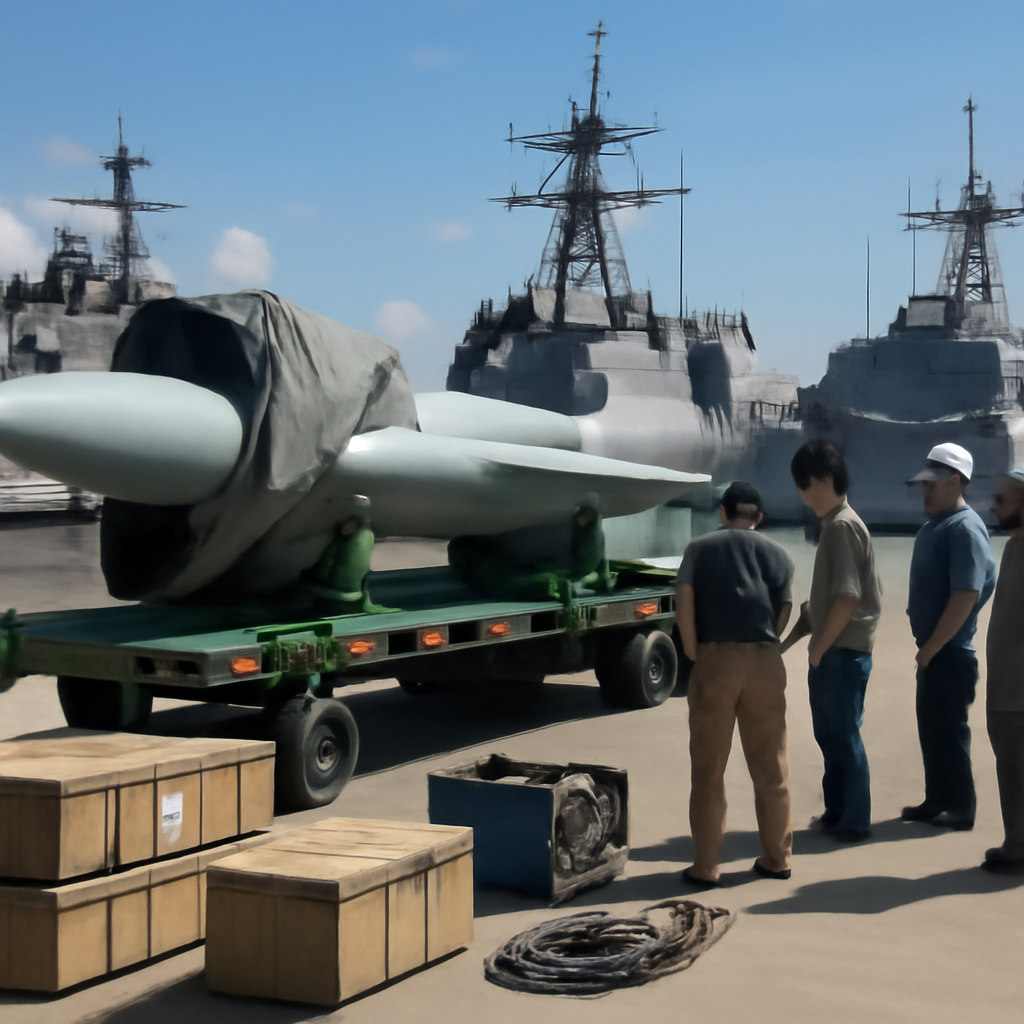
In late August 2026 the U.S. Navy awarded Zone 5 Technologies an Other Transaction Agreement worth USD $65 million to design, build and deliver a maritime-strike variant of the Rusty Dagger cruise missile under the Coalition Heterogeneous Affordable Offensive Strike (CHAOS) program. Zone 5 is 90% owned by Kongsberg, and the Rusty Dagger — designated AGM-188A — is already in series production for the Ukrainian Air Force, a point the vendor is using to emphasize provenance.
CoAspire’s July award and CHAOS’ open-architecture approach
CoAspire received the program’s first CHAOS award in July — a USD $70 million agreement for an extended-range Rapid Affordable Air-launched Cruise Missile. Both CHAOS missiles trace back to the Air Force’s Extended Range Attack Munition effort, and the program is explicitly built around a Modular Open Systems Approach and a Weapons Open Systems Architecture to allow partner nations to participate in assembly and integrate their own subsystems.

Audit-ready is a season. It shouldn't be.
Evidence in spreadsheets, controls drifting between audits, frameworks multiplying on flat headcount. Nubivance runs continuous compliance on Rapid7 Cyber GRC - SOC 2, HIPAA, ISO 27001, PCI, CMMC.
End the scrambleWhite Sands live launch of a "Low-Cost Containerized Missile" and the contested Barracuda-500M identification
On 19 August the Department of War staged a live ground launch of its Low-Cost Containerized Missile at White Sands Missile Range during Joint Readiness Experimentation 26.3. Under Secretary of War for Research and Engineering Emil Michael attended the demonstration, which the service described as an effort to evaluate affordable precision munitions and assess how the weapons perform against maritime and ground targets in operational scenarios. The official release named neither the vendor nor the missile. One account identified the test item as Anduril’s surface-launched Barracuda-500M, quoting a 100 lb payload, range beyond 500 nautical miles, and a launch from a standard twenty-foot container holding up to 16 rounds.
Scale: procurement planning, competing contractors, and the "magazine" argument
The same account that identified the White Sands launch lists four competing contractors — Anduril, CoAspire, Leidos and Zone 5 — and states the test phase will inform procurement of roughly 10,000 lower-cost cruise missiles from 2027, at fixed unit prices for deliveries between 2027 and 2029. The reporting frames ten thousand rounds at a fixed price as a magazine rather than a technology demonstration, and marks the first time the affordable-mass concept has been attached to that order-of-magnitude in a procurement context.
Castelion’s Blackbeard contract and industrial expansion for exportable hypersonics
The Navy issued Castelion a firm-fixed-price contract of USD $89,997,162 for 50 Blackbeard Early Operational Capability weapons, with completion in August 2028. The scope includes Defense Exportability Features design work for allied partners. Blackbeard is described as a Mach 5 class weapon with roughly 500 nautical miles of reach, targeted at F/A-18E/F integration at a stated unit cost under USD $500,000 — placing a hypersonic round inside the same cost bracket the subsonic programs are chasing. Two days before the award Castelion closed roughly USD $800 million in equity plus a USD $250 million revolving credit facility at a USD $13 billion valuation, with much of that funding earmarked for a 1,000‑acre manufacturing campus in Sandoval County, New Mexico.
How allied buyers, competing vendors, and the Department of War are positioned
- Allied buyers: The CHAOS contracts and Castelion’s exportability work explicitly tie exportable design and Defense Exportability Features to these programs, offering partner nations the ability to participate in assembly and integrate sovereign subsystems.
- Competing vendors and integrators (Anduril, CoAspire, Leidos, Zone 5, Castelion): August’s awards and demonstrations move several designs from concept toward production and present a procurement path that pairs fixed unit prices with potential high-volume buys (the reported roughly 10,000 rounds), changing the commercial calculus toward mass-manufacturing and export engineering.
- The Department of War and the Navy: The service staged the White Sands launch, hosted Under Secretary Emil Michael, issued multiple contracts and expects the first CHAOS capability — an expeditionary ground-launched variant — to be in production by 2028, with surface-launched platforms to follow.
August’s deals and demonstrations stitched together several threads: proven provenance (the AGM-188A Rusty Dagger already in series production), open-architecture requirements for partner integration, production timelines with a 2028 target for initial CHAOS production, and procurement language that contemplates fixed-price, mass-quantity buys. The combined effect is a shift from concept briefings toward concrete contracts, exportability engineering, and industrial expansion — and it leaves a single concrete near-term benchmark to watch: the Navy’s expectation that the first CHAOS capability enter production by 2028.