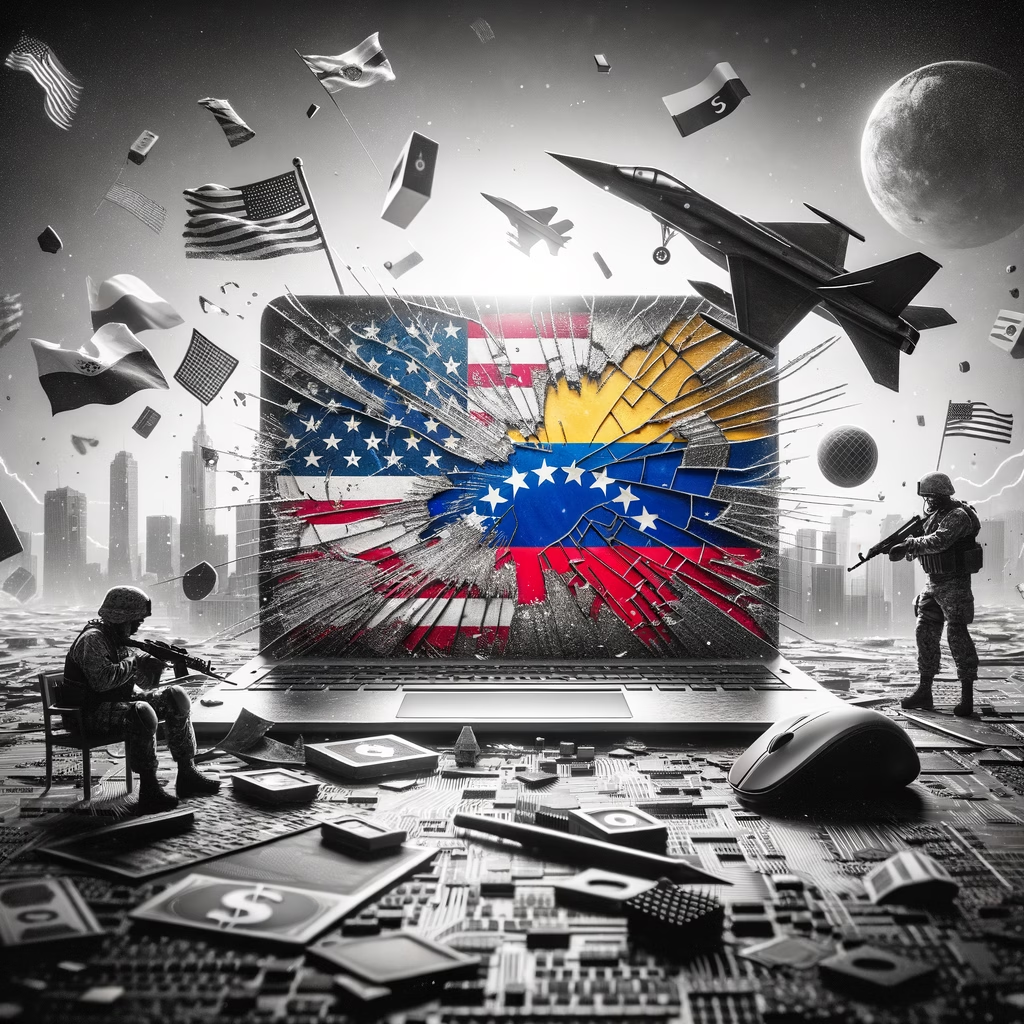
Could a single keystroke have helped topple a government? President Donald Trump suggested that U.S. cyber capabilities or other technical measures were used to cut power in Caracas during strikes that culminated in the capture of President Nicolás Maduro — a claim that, if accurate, would mark a rare, public use of American cyber power against another nation.
The United States rarely confirms offensive cyber operations. Such activities are typically classified, tightly controlled by military and intelligence agencies, and cloaked in legal and diplomatic caveats. Still, the president’s suggestion has forced a public reckoning: what it means when kinetic force and code intersect on the same battlefield, and how democratic societies should weigh secrecy, effectiveness, and the risk of escalation.
Background: the mechanics and the moment
Modern statecraft increasingly blends cyber and conventional tools. Cyber operations can disrupt communications, blind air defenses, or silence utilities — all without firing a single conventional round. The U.S. is widely regarded as one of the most capable cyber powers globally, and officials have long developed doctrine for integrating cyber effects with military campaigns. But public confirmation of such actions remains rare, precisely because the details — access vectors, exploited vulnerabilities, forensic traces — are sensitive and could reveal sources, methods and legal rationales.
The immediate allegation is straightforward: during strikes on Caracas that led to Maduro’s capture, American cyber or technical operations helped cut power to parts of the city. This sort of disruption can produce tactical advantages in a raid or a coup-like operation by limiting coordination and sowing confusion. Yet the operational realities are messy: outages can be caused by physical strikes, sabotage, poor infrastructure, or cascading system failures. Attribution — proving who did what and how — often takes days, weeks or longer, and sometimes never reaches a conclusive public judgment.
Why this matters
First, the strategic implications are profound. Using cyber effects overtly against another sovereign capital crosses a threshold. It signals willingness to apply digital instruments of power in ways conventionally reserved for military force. That carries both deterrent value and destabilizing risk: adversaries may feel compelled to respond in kind, set dangerous precedents, or escalate through asymmetric channels such as information operations, economic coercion, or cyber reprisals.
Second, the normative and legal questions are unsettled. International law lags behind technology. Policymakers and legal scholars debate when a cyber operation constitutes a use of force, when it is an act of war, and what rules of engagement should govern nonkinetic effects. There are no universally accepted standards for proportionality or attribution in cyber operations, which makes diplomatic fallout more likely when actions become public.
Third, the operational and humanitarian consequences are immediate. Power outages affect hospitals, water systems, communications, and civilian safety. Technologists warn that while cyber tools enhance capabilities, they also open pathways for attack and collateral harm. Investigations of recent incidents have underscored the need for robust, adaptive security measures and cross-sector resilience to limit civilian impact and reduce strategic friction .
Perspectives to consider
- Technologists: Security experts emphasize resilience. Public takedowns or disruptions can expose fragile infrastructure; defenders urge redundancy, improved architecture, and public–private partnerships to harden critical services. As one prominent cybersecurity voice noted in the context of recent breaches, “While it enhances capabilities, it also opens pathways for attack,” underscoring the double-edged nature of digital power .
- Policymakers and legal scholars: They face the challenge of balancing secrecy and accountability. Some argue that strategic advantage sometimes requires classified operations; others insist on stronger oversight, clearer legal standards, and international norms to prevent miscalculation.
- Users and civilians: For the people living through outages, the cause is often secondary to consequence. Loss of power and communications threatens life-saving services and erodes trust in institutions — a human cost that can outlast any tactical gain.
- Adversaries and allies: States watching this precedent will learn lessons. Some may harden their networks; others may develop asymmetric responses. International cooperation on attribution and deterrence could either deepen or fracture depending on how nations react.
What we know and what we do not
At present there are few verifiable public details beyond the president’s suggestion that technical capabilities were used. That opacity is unsurprising; cyber operations are designed to be deniable and compartmented. Still, the lack of transparent explanation intensifies the debate over democratic oversight: who authorizes such operations, how are risks assessed, and when — if ever — should elected representatives and the public be informed?
Policy lessons and risks
There are several practical lessons policymakers should weigh:
- Invest in resilience: redundant power, secure control systems, and emergency protocols reduce civilian harm when critical infrastructure is targeted or affected.
- Clarify legal frameworks: domestic oversight and international norms can help manage escalation risks and set expectations for state behavior in cyberspace.
- Strengthen attribution and transparency mechanisms: credible forensic methods and international investigative cooperation can reduce misattribution and lower the chance of inadvertent conflict.
- Prepare for retaliation: offensive cyber operations can provoke asymmetric responses and information campaigns; contingency planning should be integral to strategy.
Conclusion
If the United States did employ cyber measures in Caracas, it would illustrate how modern conflicts blur the line between the digital and the kinetic. The benefits of such tools — speed, precision, deniability — are matched by legal ambiguity, human risk and the potential for strategic escalation. As Michael Chertoff and other experts have argued in related contexts, laws and protections must evolve to keep pace with rapidly changing threats; the real challenge is anticipation as much as reaction . In the end, democratic societies must decide whether secrecy and advantage outweigh the long-term costs to norms, civilian safety, and global stability — a question whose answer will shape the future of warfare in the digital age.
Source: https://www.schneier.com/blog/archives/2026/01/a-cyberattack-was-part-of-the-us-assault-on-venezuela.html



