"Close battle is not a relic of an earlier age," Gen. Christopher LaNeve warned, framing the Army's shift toward a multi-domain fight where maneuver still matters but the battlespace has fundamentally changed.
Gen. LaNeve’s framework: convergence, strike, close battle, endurance
Last month the Army published "How the Army Fights," laying out four pillars it says win in a multi-domain operations (MDO) fight: convergence, strike, close battle and endurance. The guidance emphasizes an enemy equipped with advanced reconnaissance, drones and precision munitions, and insists ground maneuver remains essential. That doctrinal baseline is the yardstick used in Retired Lt. Gen. Eric J. Wesley’s assessment of what a modern main battle tank must be able to do.
The limits of a 45‑year‑old Abrams chassis
Wesley frames the current Armored Brigade Combat Team fleet as "analog machines with digital parts bolted on after the fact." He highlights the Abrams as a symbol: a 45‑year‑old design that has reached the limit of incremental upgrades. The Army cancelled the M1A2 SEPv4 in 2023 and accelerated development of the M1E3 because, according to the piece, the layered approach of retrofit digital architectures, thermal sights, reactive armor and auxiliary systems is “slipping under its own weight.”

Audit-ready is a season. It shouldn't be.
Evidence in spreadsheets, controls drifting between audits, frameworks multiplying on flat headcount. Nubivance runs continuous compliance on Rapid7 Cyber GRC - SOC 2, HIPAA, ISO 27001, PCI, CMMC.
End the scrambleHow the M1E3 is described to address survivability and strike
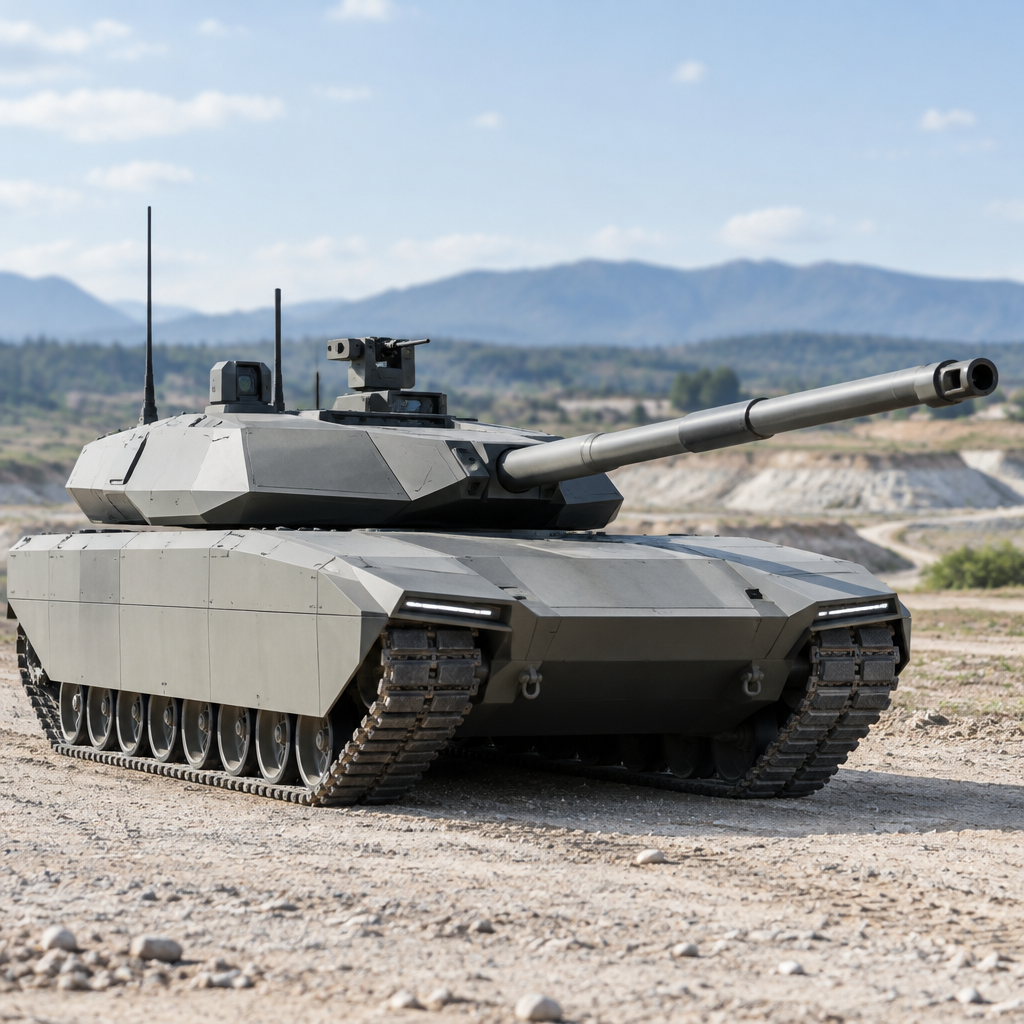
Wesley lays out three design shifts embodied in the M1E3 that respond directly to the guidance. First, survivability: moving an unmanned turret and an ammunition handling system lets the three‑person crew be lowered into a better‑protected hull, eliminating the current vulnerability of crewmembers who sit in the turret under relatively thin roof armor. Second, hard‑kill active protection is designed as an integrated system with 360‑degree coverage plus protection against high‑angle top‑attack threats, replacing add‑on applique systems. Third, strike and mobility: the M1E3 targets a combat weight of roughly 60 tons—about a 14‑ to 16‑ton reduction from fielded configurations—intended to restore strategic, operational and tactical mobility that heavy retrofit packages have eroded.
Convergence, power and sustainment: MOSA and hybrid propulsion
On networking and upgrades, Wesley emphasizes Modular Open Systems Architecture (MOSA) in the M1E3: designing the platform from the start to allow software‑defined upgrades that can arrive in weeks rather than through depot cycles. That architecture is coupled to an “integrated battle management and automated targeting aids” suite, enabling a three‑person crew to fuse feeds from unmanned aerial systems and robotic ground vehicles without being overwhelmed.
On endurance, the piece contrasts the fielded M1A2’s AGT1500 turbine—criticized for fuel consumption even at idle and for tying brigades to divisional fuel convoys—with the M1E3’s hybrid diesel‑electric powertrain. Wesley writes the hybrid would cut fuel consumption by 50 percent, let batteries run sensors, communications and counter‑UAS systems with the engine off, and enable short‑distance, near‑silent movement on battery power. He also notes the M1E3’s high‑voltage electrical architecture is sized to absorb future power demands that current SEPv3 configurations already run near the limit of.
Practical constraints: weight, bridges, transport and sustainment costs
Wesley flags concrete operational constraints caused by added survivability packages: with the Trophy Active Protection System, he says the fielded M1A2 SEPv3 weighs over 76 tons—he argues that exceeds the load-bearing capacity of most European and Indo‑Pacific bridges, and outstrips organic recovery assets and the margins of tactical bridging and Heavy Equipment Transporters. The consequence, he contends, is that commanders are often constrained to a few viable avenues of approach, funneling armor into predictable chokepoints.
On cost, Wesley argues sustaining the M1A2 requires a growing stack of custom engineering patches, depot overhauls and rising sustainment costs that will soon exceed the amortized development and procurement cost of the M1E3, and that the sunk‑cost fallacy should not set requirements for the next war. He also notes industrial‑base considerations: fielding the M1E3 would preserve a predictable workload at the Joint Systems Manufacturing Center in Lima, Ohio, and sustain the national supply chain rather than letting that manufacturing footprint atrophy.
What this means for Congress, Army leaders, and the Joint Systems Manufacturing Center
- Congress: Faces a choice, Wesley says, between continuing to fund increasingly costly sustainment of an aging Abrams fleet or investing in a generational design that the Army’s own guidance requires.
- Army leaders: Must reconcile doctrinal demands for MDO‑compatible platforms—convergence, mobility, survivability and reduced sustainment tails—with procurement and fielding timelines, Wesley argues.
- The Joint Systems Manufacturing Center (Lima, Ohio) and suppliers: Wesley contends that an M1E3 program would convert a 20th‑century overhaul depot into an advanced manufacturing hub and preserve a national industrial capability.
Wesley closes with a clear prescription: the Army has described how it intends to fight; he argues Congress and Pentagon leadership now need to provide a tank designed to fight that way and to develop and field the M1E3. He discloses in the piece that he serves on the Sapa Transmission board and had advocated for the program prior to that business interest.