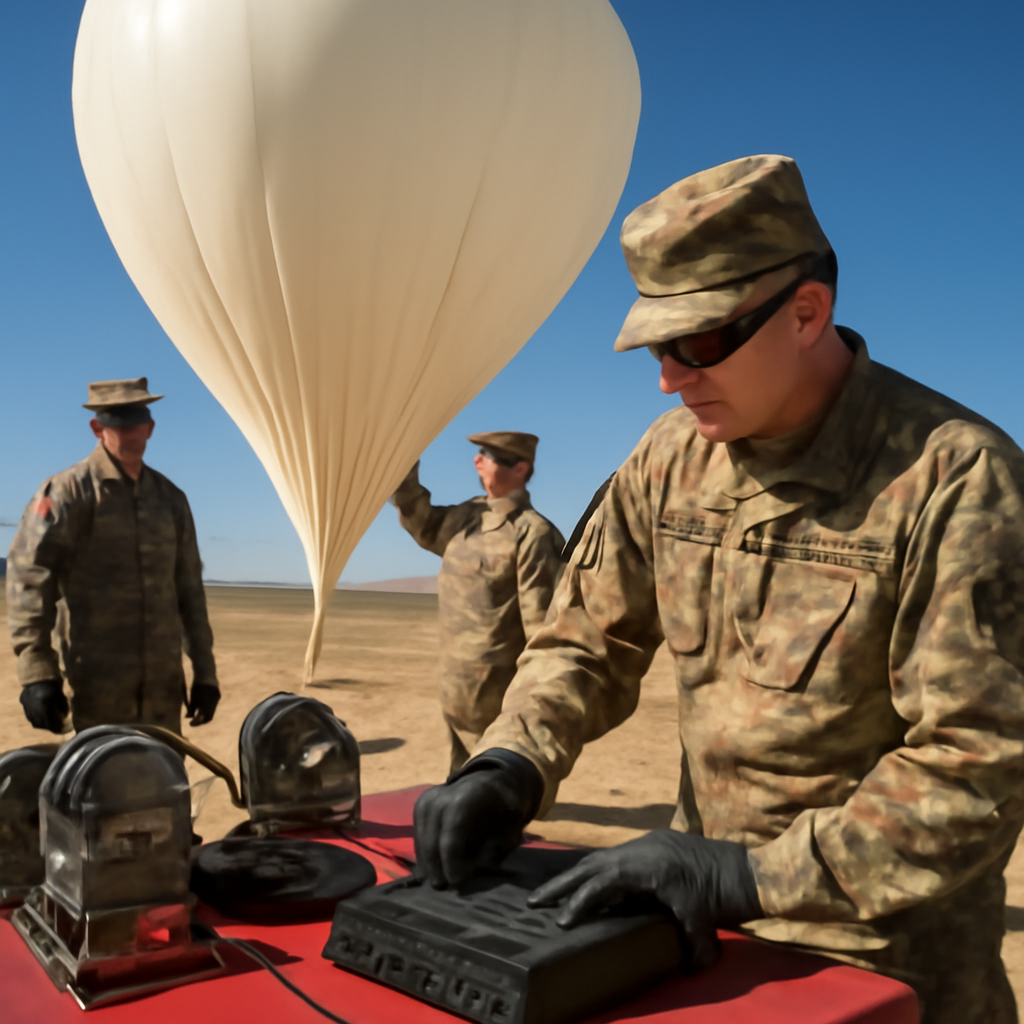
“It was game-changing for me,” Lt. Gen. John Rafferty said, describing how high‑altitude balloons went from a skeptical idea to a capability he now champions.
Lt. Gen. John Rafferty on high‑altitude balloons
Lt. Gen. John Rafferty, head of the U.S. Army Space and Missile Defense Command (SMDC), told reporters at an Association of the U.S. Army (AUSA) media roundtable that his view of high‑altitude balloons changed after seeing them in operational experimentation. Rafferty said he first heard balloon concepts while at Army Futures Command and found them “crazy,” but exposure to training with the 2nd Multi‑Domain Task Force in Morocco convinced him of their value, citing their ability to station‑keep, sense from altitude, and “deliver effects from high altitude.”
Col. Joseph Mroszczyk and SMDC’s TID‑Space Superiority plans
Army Col. Joseph Mroszczyk, head of SMDC’s Transformation Integration Directorate for Space Superiority (TID‑Space Superiority), described the service’s push for a “family of stratospheric systems” that ranges from smaller to larger platforms. He framed the stratosphere — roughly 60,000 to 100,000 feet — as an operational layer that can provide “space‑like capabilities” with persistence and broad coverage, enabling sensing, communications, and the extension of “launched effects.”

Audit-ready is a season. It shouldn't be.
Evidence in spreadsheets, controls drifting between audits, frameworks multiplying on flat headcount. Nubivance runs continuous compliance on Rapid7 Cyber GRC - SOC 2, HIPAA, ISO 27001, PCI, CMMC.
End the scrambleThe Pacific‑to‑CENTCOM pivot and operational use
Breaking Defense first reported that the Army canceled a planned balloon swarm test in the Pacific last year and instead redirected those systems to support operations in the Middle East (CENTCOM). Andrew Evans, Director of Strategy and Transformation in the Office of the Deputy Chief of Staff of the Army (G‑2), told Breaking Defense the assets “were effective for the mission that they were assigned,” but declined to provide further detail. Evans also noted practical limits: “Balloons can be a little finicky in terms of temperature, and you have to contend with environmental characteristics,” and the service learned where the friction points are between what it must own and what vendors provide when shifting theaters.
Technical capabilities: persistence, sensing, comms, and launched effects
The Army and industry describe modern high‑altitude balloons as platforms that can station‑keep for days, weeks, or months, moderate altitude to maintain position, and offer wide fields of view for radars, cameras, and other sensors from 60,000 feet or higher. The service has discussed balloons as not only intelligence, surveillance, and reconnaissance (ISR) platforms but also as communications relays and launch platforms for swarms of uncrewed aerial systems. The reporting includes concrete examples: a sensor element called Wallabee designed for balloon carriage (Urban Sky), a demonstration showing an Apollo‑R drone suspended beneath a balloon during Exercise Orient Shield 26 in Japan, and tests of balloon‑assisted launch for Hornet middle‑range strike UAVs. The Army plans “multiple experiments over the course of the coming year” to demonstrate command, control, networking, and autonomous swarm behaviors for balloon systems.
What this means for the Army, vendors, and U.S. CENTCOM
- The Army: Senior leaders are committed to fielding balloon capabilities and have begun operationalizing experimental systems, including establishing a new high‑altitude balloon schoolhouse earlier this year, but the service still describes much of the effort as in its infancy and dependent on continued testing and experimentation.
- Vendors: The Army acknowledged heavy reliance on vendors during deployments and experiments, and leaders flagged the need to sort which capabilities the military must own versus what industry will provide as balloons move between theaters with different environmental profiles.
- U.S. CENTCOM operations: The unpublicized deployment to CENTCOM demonstrates that balloon systems have been applied to real operations; timing and duration of that deployment were not disclosed, but Army officials said the redirected assets supported ongoing missions in the Middle East.
Conclusion
SMDC leaders framed high‑altitude balloons as a potentially transformative, stratosphere‑level capability — persistent, broad‑area, and multifunctional — while acknowledging operational limits and a continued need for experimentation. The Army’s pivot of experimental swarm assets from the Pacific to CENTCOM, the creation of a schoolhouse, and plans for multiple experiments over the coming year show an active effort to move from proof‑of‑concept toward operational use. At the same time, senior leaders concede there is still work to do to make balloons a mature, reliably deployable element of multi‑domain sensing and launched‑effects architectures. The original TWZ reporting is here: https://www.twz.com/air/high-altitude-balloons-are-a-game-changing-capability-army-space-command-boss