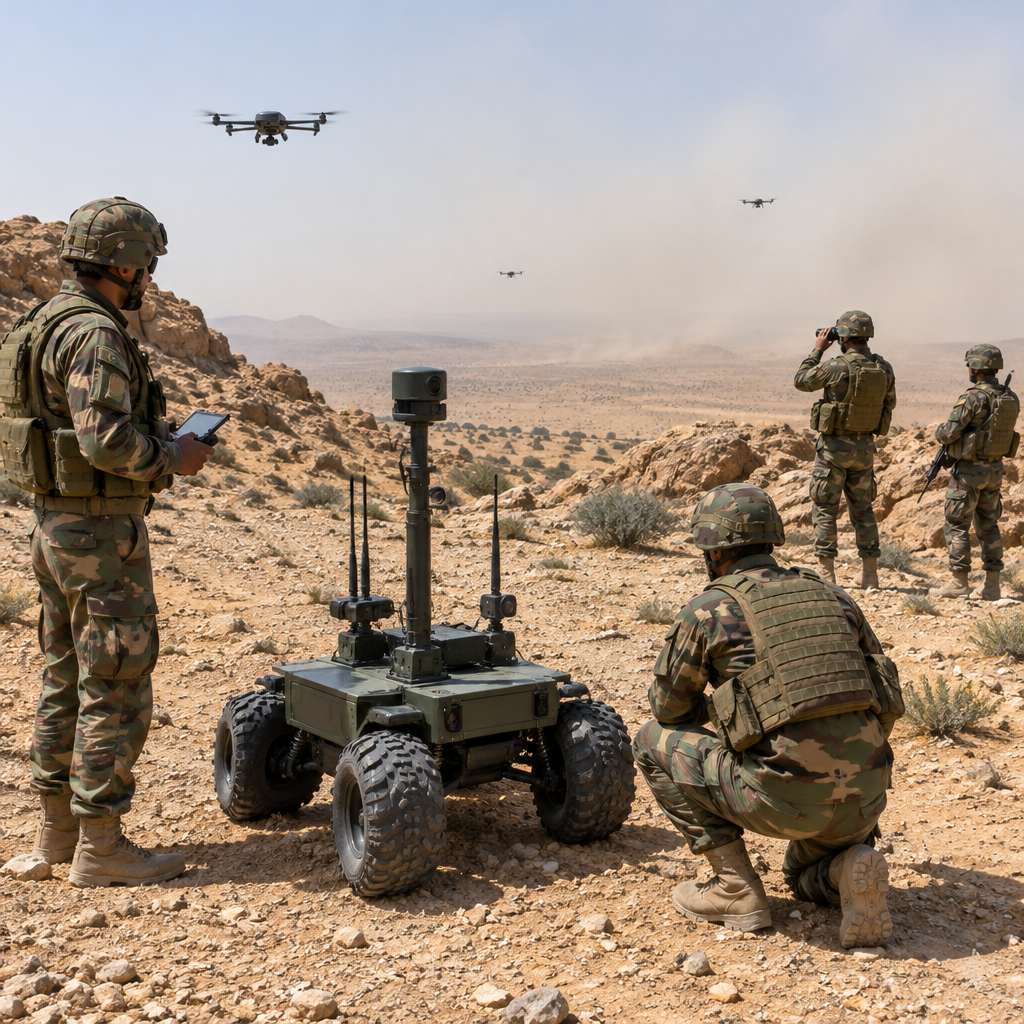
"NANO ACE tested prototype systems that combine autonomous platforms with different payloads, mission management software and robust communications," according to an Army release.
NANO ACE II at Morocco’s Multidomain Training Area
The U.S. Army disclosed that a recent test event, Needs-Driven Acquisition for Near-Term Operations Accelerated Capability II (NANO ACE II), took place in October at the Multidomain Training Area (MDTA) in Tan‑Tan, Morocco. The exercise was conducted in cooperation with Moroccan armed forces and ran under the broader Operation Jailbreak effort, which the Army says has focused on developing networking capabilities to link disparate systems.
Participants included the Army’s Africa Multi‑Domain Training and Experimentation Center (AMTEC), the Global Tactical Edge Acquisition Directorate, Army Test and Evaluation Command (ATEC), U.S. Army Central (ARCENT), U.S. Africa Command (AFRICOM), the Southern European Task Force‑Africa (SETAF‑AF), and an unnamed “tactical U.S. Army division.” The Army framed Morocco’s MDTA as providing “open electromagnetic spectrum, uncongested airspace and contested terrain” to evaluate systems under realistic conditions.
FireAnt UGVs carried and emplaced small drone‑detection sensors
Images released by the Army show a Swarmbotics AI FireAnt uncrewed ground vehicle (UGV) configured to carry six small ground sensors, arranged as three sensors on two rails angled to either side. The sensors are depicted sliding off the rails and settling on three small legs; each sensor has a spherical central body and a slender antenna mast.
Swarmbotics AI describes FireAnt as a small 4×4 UGV that can be reconfigured for missions including electronic warfare, surveillance and reconnaissance, and even one‑way attack munitions. The platform is described in reporting as able to operate in semi‑autonomous swarms and was earlier observed being carried on the side racks of an M2A4 Bradley IFV. In one account, FireAnt is noted as weighing around 27 kg.

This site is the portfolio.
OSINTSights runs on Cloudflare Workers, D1, R2, and Vectorize, with an AI pipeline on Hetzner ARM. Nubivance designed, built, and operates it. We do the same for clients.
See what we buildSensors shown, and sibling systems tested or under development
The Army release and accompanying imagery do not specify the sensor make or model used in the six‑pack shown on the FireAnt, and the release states only that the test “aimed to evaluate semi‑autonomous capability sets that extend C‑UAS coverage.” The article notes possible detection modes for sensors of that size and form—passive radiofrequency signal capture or acoustic signature detection—but attributes those as plausible functions rather than confirmed descriptions of the exact devices used.
Separately, the reporting identifies other sensor systems tied to FireAnt demonstrations. MaXentric Technologies’ Mapleseeds (also written “Maple Seeds”) are described by the manufacturer as “low‑power, lightweight, disposable RF” sensors that “can locate, differentiate, and track targets in deep fires areas in contested A2/AD environments.” The article says Mapleseeds are funded by the U.S. Army and designed as a low‑cost, mass‑deployable, expendable unattended ground sensor system.
Another configuration mentioned pairs FireAnt with the FireFLY passive acoustic sensor system supplied by Invariant Corporation and Hyperion Technology Group; a fixed acoustic array version has been developed for NANO ACE, although it is not clear from the material whether that variant was demonstrated during the Morocco event.
Networking, data fusion, and operational intent
The Army characterized NANO ACE II as testing combinations of autonomous platforms, payloads, mission management software and communications to meet an “emergent U.S. joint force requirement to field integrated, autonomous sensing and effector capabilities on an accelerated acquisition timeline.” The release added that industry developers were evaluated on whether their platforms “could operate independently on unimproved terrain while surviving a contested electronic warfare environment.”
The reporting highlights the operational intent: ground‑deployed sensors and UGVs—whether carrying sensors or acting as sensor nodes themselves—could create distributed data streams for operators to fuse, cue higher‑end sensors and feed effectors. The Army has stressed the potential utility of unattended ground sensors as a lower‑cost way to expand coverage, and noted that passive sensors can be difficult for adversaries to detect and neutralize once emplaced.
That technical promise comes with acknowledged challenges. Now‑retired Lt. Gen. Scott McKean is quoted saying expanding distributed coverage risks producing “too much data” and that efforts are needed to correlate it into usable formats. Then‑Secretary of the Army Christine Wormuth is quoted urging standardization of data and commander discipline about critical information requirements, while noting improvements in turning volume of information into “more actionable knowledge.” The article points to artificial intelligence and machine learning as areas that could help sift expanding data flows.
What this means for technologists, procurement leaders, and commanders
- Technologists and system integrators: will need to show not only sensor performance but also how sensors and UGVs interoperate with mission management software and communications to survive contested electromagnetic environments, per the Army test criteria.
- Procurement and acquisition leaders: face an emphasis on accelerated fielding of “integrated, autonomous sensing and effector capabilities”—a requirement that privileges low‑cost, mass‑deployable options like expendable unattended ground sensors while forcing attention to tests that validate survivability and interoperability.
- Commanders and unit leaders: gain options to seed forward areas with sensors without direct personnel risk, but must plan for data correlation, prioritization and command decision workflows if distributed coverage is to be operationally useful.
FireAnt and the sensor demonstrations at NANO ACE II underscore a focused Army effort to pair small, attritable robotic platforms with unattended ground sensors to extend counter‑drone awareness at tactical ranges. The exercise highlighted both technological possibilities—reconfigurable UGVs, deployable RF and acoustic sensors, swarming—and enduring hurdles: networking disparate nodes, surviving contested electronic environments, and turning raw sensor volume into actionable knowledge, a problem the Army has already signaled it must solve.