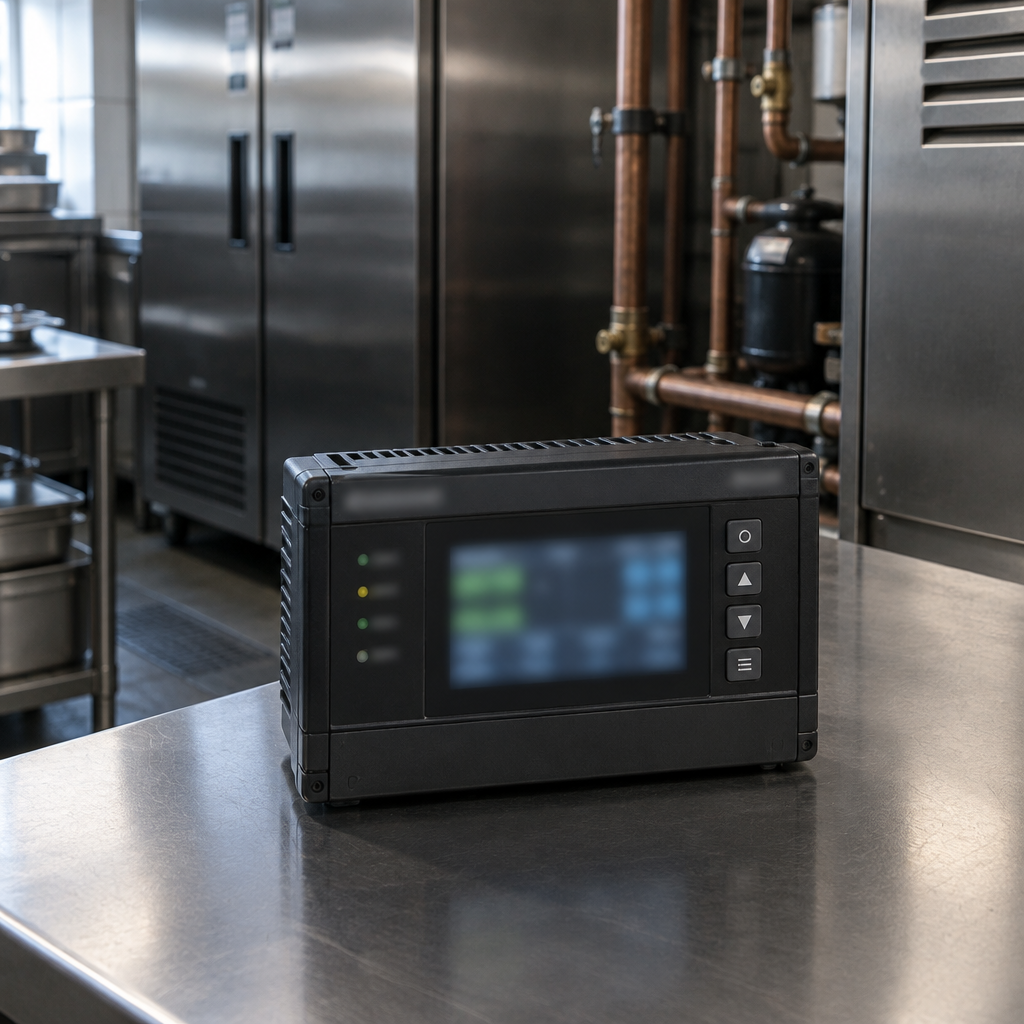
“The AK-SM800A should not be directly reachable from the public internet,” Danfoss’s update guide warns. “This recommendation applies to all software versions, including those with Strict Mode enabled.”
Midnight Blue's discovery and disclosure posture
Dutch security consultancy Midnight Blue reported six flaws in Danfoss AK-SM800A refrigeration controllers earlier this week. Researcher Carlo Meijer found the issues in less than an hour of manual review using firmware the vendor provides for download, and documented them in a technical write-up. The researchers say every firmware version examined up to and including 5.3.2 is affected. They have not published technical exploit details or requested CVE identifiers; instead they are keeping details private while working with Danfoss on coordinated disclosure.
How the flaws work: web handlers, a gateway bug, and root access
Five of the six flaws live in web request handlers that do not require login and run inside a program that operates as root. The researchers demonstrated code execution as root on older firmware, version 3.3.0, and found the same bugs present in 5.3.2. The sixth flaw is in the gateway that enforces the controller’s Strict mode — the feature designed to require encrypted connections and session tokens before allowing management requests.
When Midnight Blue ran firmware 5.3.2 in an emulator with Strict mode enabled, the gateway flaw crashed the gateway; the researchers say that crash could be escalated into code execution with further work. They also reported the gateway lacks basic exploit mitigations such as stack canaries. Because the device does not use secure boot, malicious code an attacker installs could survive a factory reset and a firmware update, according to the researchers.

This site is the portfolio.
OSINTSights runs on Cloudflare Workers, D1, R2, and Vectorize, with an AI pipeline on Hetzner ARM. Nubivance designed, built, and operates it. We do the same for clients.
See what we buildGovernment advisories: Belgium, Ireland and Germany
National cybersecurity agencies in Belgium, Ireland and Germany have issued public guidance to operators. All three told operators to remove the AK-SM800A management interface from the internet. Belgium and Ireland warned that updating firmware, changing default passwords or enabling Strict mode alone are not sufficient protections because one of the six flaws is in the gateway that enforces Strict mode.
The Belgian Centre for Cybersecurity and Ireland’s National Cyber Security Centre recommended concrete steps: locate any controller management interfaces reachable from the internet — including those exposed via 4G or 5G modems — and remove that exposure; provide remote access only through a secure VPN or protected internal network; and, as a short-term measure, restrict access at the firewall to a service company’s IP addresses. They also advised operators to check temperature setpoints, defrost schedules, alarm settings, user accounts and remote-access settings for unauthorized changes.
Germany’s federal IT security agency, the BSI, said in a security notice that the AK-SM800A was involved in earlier incidents where refrigeration units in several countries were tampered with. The BSI initially said firmware 5.4.0 was not affected; later that same day it corrected that statement, saying it cannot rule out that 5.4.0 is affected. The German agency told operators who suspect compromise to change all credentials and to verify that connected equipment functions properly.
Operational impact: past attacks and current risk
The AK-SM800A controls store refrigeration systems and is commonly managed remotely by maintenance firms. The source material notes that controllers of this family were targeted in attacks beginning October 11 in France, with a second wave across Europe the following week. Those incidents caused unwanted defrost cycles and destroyed stock. The agencies and Midnight Blue say there is no public linkage between the newly reported six flaws and the earlier tampering incidents; the BSI has no information that the six new flaws have been exploited.
Danfoss told Cooling Post on October 12 that most units struck in France were either older models no longer receiving updates or AK-SM800A units running outdated firmware. The vendor lists software package 5.4.0, dated November, as the newest release for the AK-SM800A; the 5.4.0 readme and November update guide add a stricter password rule but do not mention fixes for the six flaws.
What this means for operators, national CSIRTs, and service providers
- Operators and maintenance firms: Remove any AK-SM800A management interfaces from direct internet exposure immediately, including those reachable over cellular modems; restrict remote access to secure VPNs or protected internal networks; and inspect setpoints, defrost schedules and logs for unauthorized changes, per the Belgian and Irish advisories and Danfoss guidance.
- National CSIRTs and regulators: Agencies have already issued advisories and, in Germany’s case, a corrected position on firmware 5.4.0’s status. The researchers are withholding exploit details while coordinating with Danfoss and no CVEs have been assigned yet.
- Danfoss and service vendors: Danfoss’s public materials list 5.4.0 as the latest firmware and add password-hardening guidance but do not list a patch or publish an advisory for the six flaws; the vendor previously fixed other AK-SM800A vulnerabilities in 2023 and 2025.
No patch for these six flaws is available today, and the vendor’s advisory page lists no advisory or date for a fix. Agencies and the researchers uniformly advise that removing internet exposure cannot wait for a patch — a practical constraint made starker by the researchers’ findings that Strict mode can be bypassed through a gateway bug and that the device lacks secure boot. The next concrete milestones to watch are Danfoss publishing an advisory and a fix, and any CVE assignments or confirmed exploit reports from the national agencies.
Original reporting: https://thehackernews.com/2026/11/six-unpatched-danfoss-refrigeration.html