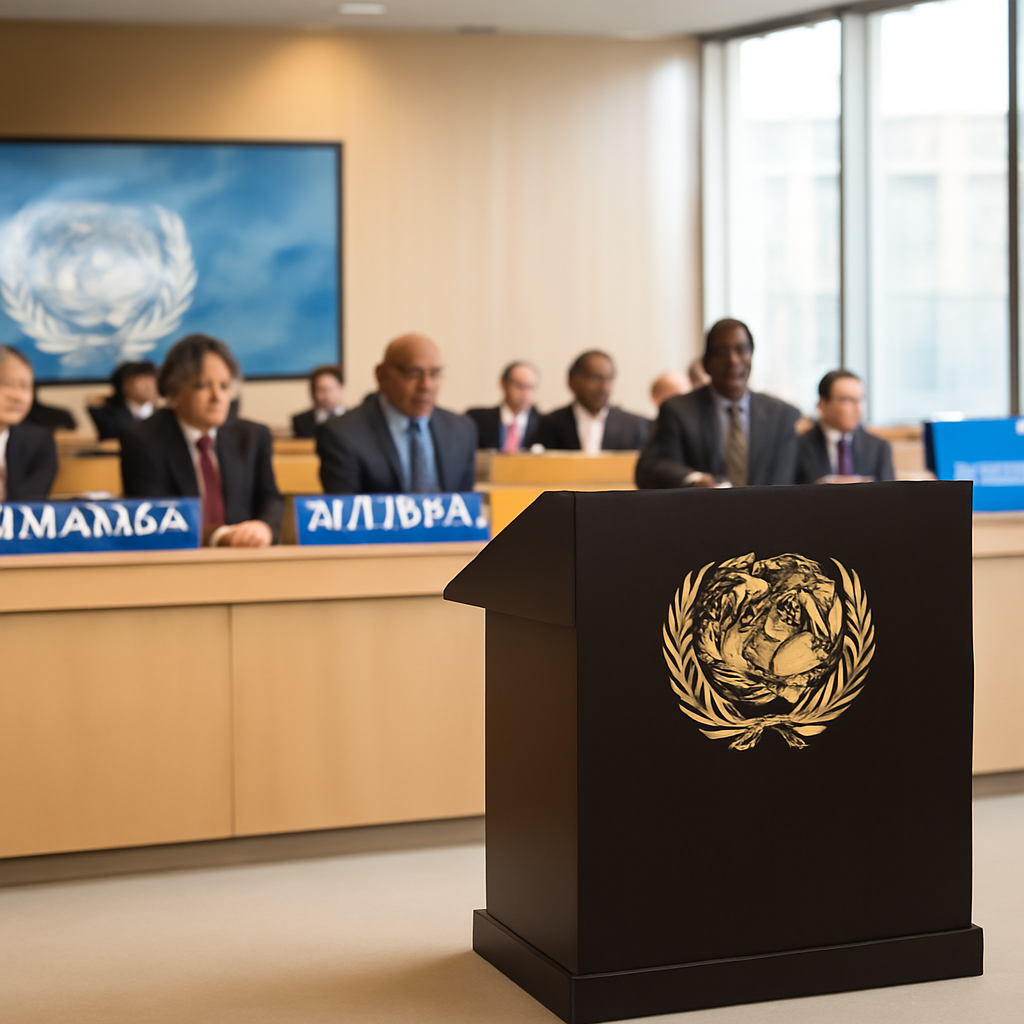
“The Pacific Islands Forum determines what happens here, not any other country,” Australian Prime Minister Anthony Albanese told delegates in Palau, underscoring a narrower principle at stake in New York: institutions must control how their own rules are applied.
UN General Assembly: Resolution 2758 and the test before delegates
The 81st session of the United Nations General Assembly opens on 8 September under the theme of restoring trust and managing transformation. One institutional question that delegates will inevitably face is how Resolution 2758, adopted in 1971, is read and operationalised. Resolution 2758 restored the rights of the People’s Republic of China (PRC) at the UN, recognised its representatives as the only lawful representatives of China, and expelled the representatives of Chiang Kai-shek. The resolution settled a representation question but, the record shows, did not mention Taiwan.
Beijing’s broader interpretation and the risk of administrative normalisation
Beijing has long promoted a broader reading of Resolution 2758 — a reading described in the public record as unfounded — that the text declares Taiwan to be part of China. The concern expressed in the source material is not only diplomatic: repetition and political pressure can harden an interpretation into administrative assumption. When that happens, the argument goes, political interpretation migrates into the mechanics of institutions and begins to determine who is invited to meetings, whose information flows into official channels and how mandates are defined.

Your town's IT department is one person. Maybe.
Ransomware crews target small municipalities because nobody's watching. Nubivance gives Maine and New Hampshire towns a security program sized to a town budget.
Protect the town officeICAO, WHO and the operational consequences of interpretation
The source highlights civil aviation and public health as concrete domains where interpretive drift can have consequences beyond rhetoric. At the International Civil Aviation Organization (ICAO), Taiwan has not returned to a triennial ICAO assembly since attending as a guest in 2013, despite renewed diplomatic support ahead of last September’s 42nd Assembly in Montreal. Yet Taiwan’s civil aviation authority continues to manage the Taipei Flight Information Region while operating in accordance with ICAO standards. The World Health Organization (WHO) similarly depends on timely information and cross-jurisdictional coordination — areas where political decisions about participation can affect the institution’s ability to carry out its technical work.
Australia’s position and the distinction it draws
Canberra’s stance, as recorded here, emphasises precision in institutional interpretation rather than a change in diplomatic recognition. In August 2024 the Australian Senate passed a bipartisan motion stating that Resolution 2758 did not establish PRC sovereignty over Taiwan, did not determine Taiwan’s future status in the UN, and did not determine Taiwan’s participation in UN agencies or other international organisations. Australia has also made clear that its one-China policy is distinct from Beijing’s one-China principle, while maintaining a strong unofficial relationship with Taiwan and supporting its meaningful participation in international organisations; that, the record notes, does not alter Australia’s diplomatic recognition of the PRC.
What this means for Australia, ICAO, and WHO
- Australia: Canberra is being urged to apply the same interpretive precision to international institutions that it applies to its own policy — treating institutional procedure as a form of strategic risk management rather than only a matter of diplomatic posture.
- ICAO: The organisation faces a tension between technical continuity (Taiwan managing the Taipei Flight Information Region in accordance with ICAO standards) and political limits on formal participation (no return to a triennial assembly since 2013), which can shape how routine contacts are formalised or restricted.
- WHO: Because the WHO relies on timely cross-border information and coordination, political assumptions about participation could affect the flow of health-related data and professional coordination across jurisdictions.
The underlying point in play as diplomats gather in New York is institutional integrity: rules survive not just by their text but by disciplined application. If political interpretation is permitted to substitute for textual authority, institutions risk a drift between what they were mandated to do and the assumptions they come to operate under. As the source material concludes, that quieter shift — who is invited, whose information is shared first, which assumptions become defaults — deserves attention if the broader goal of restoring trust in the UN is to be more than a slogan.