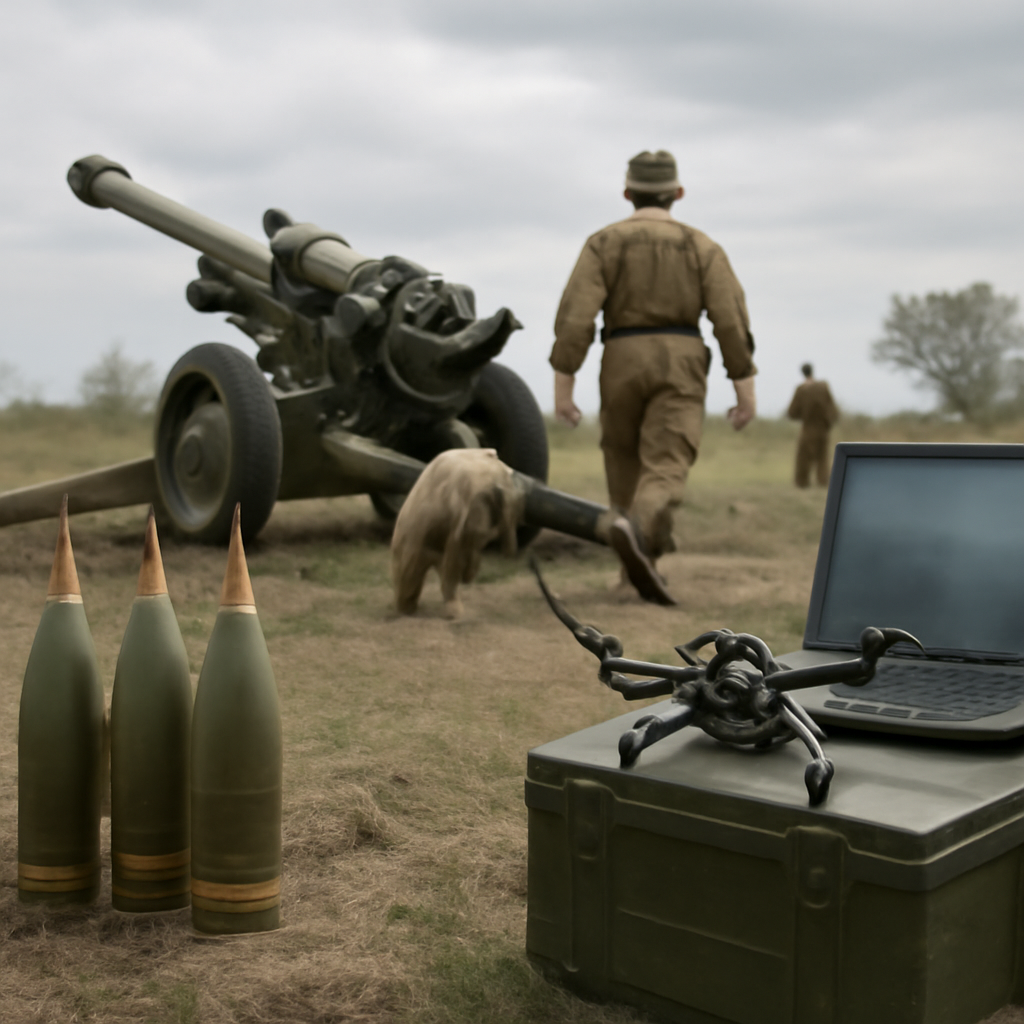
Ukraine’s artillery brigades are choosing unguided 155 mm artillery shells over guided rounds such as the M982 Excalibur, and shifting the accuracy work onto the gun itself.
Why the 7th Artillery Brigade retooled its approach
In an interview with Oboronka, the commander of Ukraine’s 7th Artillery Brigade — known as “Gregit,” Lt. Colonel Vitaliy Kornienko (call sign “Hephaestus”) — described the unit’s operational preference for unguided 155 mm shells paired with changes to gunnery practice. Kornienko laid out a concept in which the brigade accepts unguided shells as the projectile while using other tools and techniques to achieve the desired effect on target.
FPV drones plus tube artillery: moving the accuracy burden
Kornienko explained how his unit combines first-person-view (FPV) drones with tube artillery. The observable pattern is a deliberate choice to shift the “accuracy work” away from expensive guided rounds and onto how the gun is employed and supported by real-time aerial observation from FPV drones, according to the interview.

Audit-ready is a season. It shouldn't be.
Evidence in spreadsheets, controls drifting between audits, frameworks multiplying on flat headcount. Nubivance runs continuous compliance on Rapid7 Cyber GRC - SOC 2, HIPAA, ISO 27001, PCI, CMMC.
End the scrambleWhat the Russia-Ukraine War has demonstrated about drones and artillery
The Russia-Ukraine War — which began in 2022 — is cited in the reporting as the defining reference case for studying how drones, artillery, countermeasures, and counter-countermeasures evolve over sustained, months‑long combat. The conflict’s duration, the piece argues, has allowed truisms and theories about those systems to be tested in ways shorter conflicts do not permit. The article also notes other state-on-state conflicts since 2022 — including the ongoing war between the United States and Iran and the India-Pakistan conflict of May 2025 — but identifies the Russia-Ukraine War as thus far unique in providing a long-term operational record for these dynamics.
Pakistan’s procurement response: platforms and an ammunition base
The reporting identifies a direct carryover from Ukraine’s experience into Pakistan Army procurement choices. Pakistan is fielding comparable 155 mm/52-calibre platforms and is “building out its own artillery ammunition base.” In other words, the pattern seen in Ukraine — favoring adjustments in delivery and observation over exclusive reliance on guided munitions — is influencing procurement and industrial posture in another nation-state’s armed forces.
How Ukrainian brigades, Pakistan’s procurement planners, and ammunition producers are responding
- Ukrainian artillery brigades and front-line gunners: Practically, units are adopting combinations of unguided 155 mm shells plus FPV drones and altered gunnery techniques so that the gun and its associated sensors carry more of the burden for accuracy.
- Pakistan Army procurement planners: The procurement pattern reflects an emphasis on fielding 155 mm/52-calibre platforms compatible with this approach and on developing a domestic ammunition base, indicating a decision to invest in systems and supply chains that support unguided-round employment.
- Ammunition producers and industrial planners: The decision by Pakistan to build out an artillery ammunition base signals demand for industrial capacity aligned with unguided 155 mm production and sustainment rather than a sole focus on guided rounds.
The reporting frames a tactical and industrial shift: rather than rely primarily on costly guided rounds such as the M982 Excalibur to guarantee accuracy, some units are reallocating precision to observation, gunnery, and platform performance. That shift, evidenced in the practices Kornienko described and mirrored in Pakistan’s procurement choices, is one of the concrete lessons emerging from the Russia-Ukraine War’s extended operational record.
Source: Quwa — Why Ukraine Now Prefers Unguided 155 mm Artillery Shells Over Guided Ones