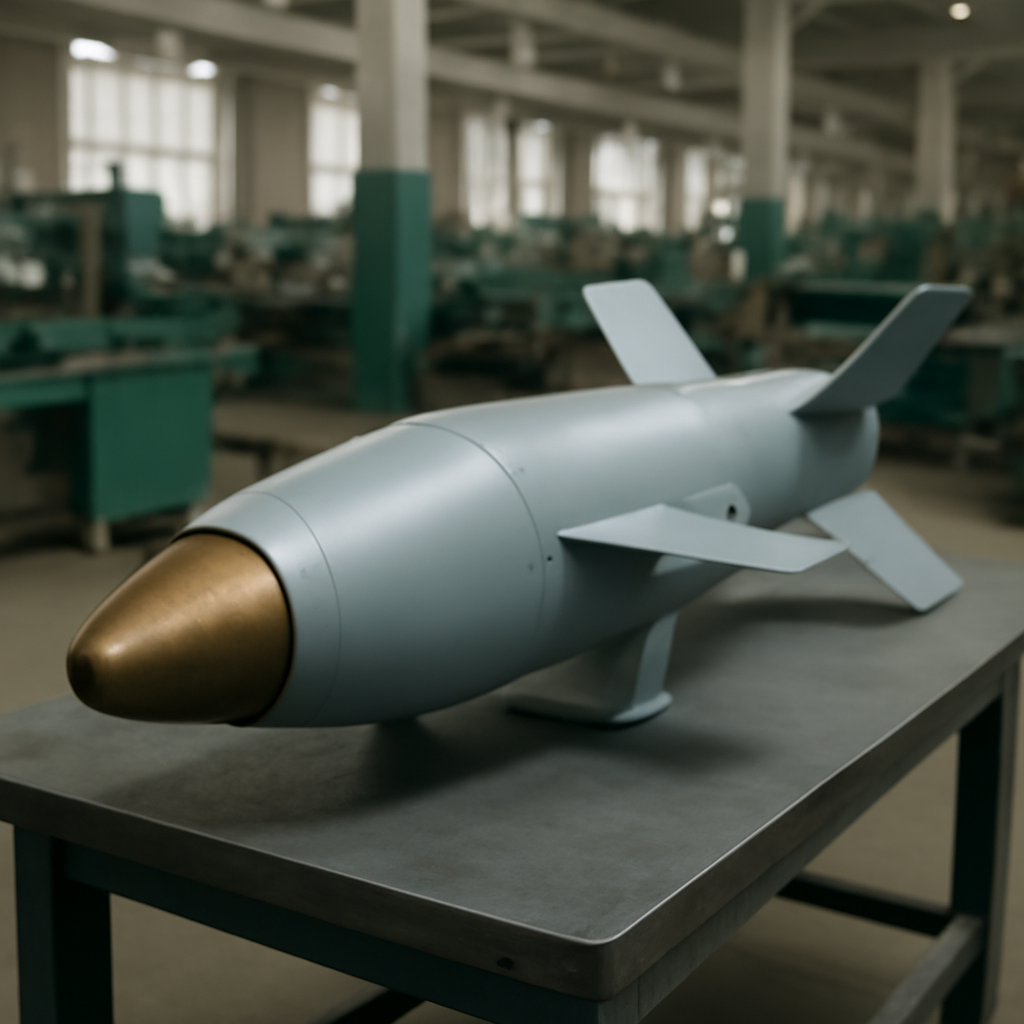
The bomb carries a 250 kg warhead and, Brave1 says, can hit targets “dozens of kilometers” behind enemy lines — while the weapon itself “has no motor,” Brave1 spokesman Yurii Voronkov told TWZ.
Who built the Equalizer and how it was developed
The Equalizer (Ukrainian name “Vyrivniuvach”) was developed by DG Industry with support from the Ukrainian defense technology incubator Brave1. DG Industry completed all required trials and declared the weapon ready for combat after 17 months of development, the organizations said. Brave1 says it backed the project from its inception in 2024 and helped transition the team from concept to the first working prototype.
Brave1’s statements emphasize that the glide kit — including pop-out wings and the flight controller software — was designed in Ukraine. Voronkov said roughly 90% of the component base consists of Ukrainian, European, and American parts, with only chips and microcircuits procured from abroad. Yaroslav Vinnytskyi, Head of Defense Technologies at Brave1, framed the weapon as a broader technology milestone: “The guided aerial bomb itself isn’t just a single product—it represents a technology that has now emerged in our country.”
Design, guidance, and aircraft integration
The Equalizer is a guidance kit that converts so-called dumb bombs into glide weapons through pop-out wings and modern guidance algorithms. Brave1 told TWZ the weapon “has no motor,” so navigation and control “rely entirely on the bomb’s own inertia and aerodynamics,” a design choice that demanded “precise calculations, structural balancing, and extensive testing,” Voronkov said. He added: “The main difficulty lay in combining several critical factors: speed, high g-forces, and aircraft integration.”
Brave1 says the system was designed for Ukrainian Su-24, Su-27, and MiG-29 jets. It “can also be used with donated F-16 and Mirage fighters,” but “has to receive additional certification for usage on F-16s and Mirages,” according to the incubator. The company also highlighted that the product “differs from both Russian and foreign counterparts,” without providing further technical specifics.

This site is the portfolio.
OSINTSights runs on Cloudflare Workers, D1, R2, and Vectorize, with an AI pipeline on Hetzner ARM. Nubivance designed, built, and operates it. We do the same for clients.
See what we buildRange, propulsion ambitions, and how Equalizer compares to other glide munitions
Brave1 describes the Equalizer’s reach in the present configuration as “dozens of kilometers.” The team explicitly avoided adding a motor for the initial design; that omission poses range limits but reduced development complexity. TWZ’s reporting notes that other glide munitions have incorporated propulsion: the U.S.-made JDAM-ER has a stated range of about 45 miles, and Russia introduced a small turbojet last year with claims of extending range to at least 60 miles. Brave1 told TWZ Ukraine is developing propulsion capability too, with a stated goal of reaching targets as far as 125 miles.
The reporting also points out that the French-supplied AASM-250 Hammer includes a rocket booster, a feature that can be useful for the Ukrainian operating profile in which jets perform low-level, pop-up releases to reduce exposure to heavy air defenses near the front lines.
Industrial scale and the domestic supply rationale
Brave1 says DG Industry is one of “at least eight manufacturers working on glide bombs altogether.” The incubator framed the Equalizer not only as a single weapon but as the emergence of a capability that can be scaled across sizes and types. Voronkov described the program’s impetus in starkly practical terms: “In 2024, a team of developers asked themselves a practical question: what happens if foreign arms supplies stop?”
The program’s timing, according to Brave1, reflects concerns about the future flow of foreign assistance: TWZ reported that the U.S. has stopped donating weapons to Ukraine and that “other nations, like the Netherlands, have as well.” Brave1 and DG Industry have therefore emphasized supply independence and the ability to avoid donor-imposed restrictions on the employment of foreign-provided weapons.
What this means for the Ukrainian Air Force, foreign donors, and Russian forces
- Ukrainian Air Force: The armed forces are already purchasing the Equalizer for operational use, Colonel Vladyslav Voloshyn, head of the Central Department of Innovation Activities of the Armed Forces of Ukraine, told Ukrinform. If production and certification progress, domestically produced glide kits would give Ukrainian jets another standoff option compatible with existing platforms — with additional certification required before use on some donated fighters.
- Foreign donors: Domestic production reduces Kyiv’s dependence on externally supplied glide munitions and on donor rules that have at times limited how donated weapons can be employed, a cited motivation for the program.
- Russian forces: The context is intensifying. Voloshyn noted Russia increased daily glide-bomb use from about 180 last year to more than 300 this year. When — and at what scale — the Equalizer will reach frontline units therefore matters to Ukraine’s ability to respond to that growing threat.
DG Industry and Brave1 say the Equalizer has cleared trials and is being procured; what remains uncertain is the timetable for mass delivery and how quickly propulsion upgrades — the stated route to much longer ranges — can be fielded. Given the reported rise in Russian glide-bomb launches, Kyiv’s push to indigenize standoff munitions is framed by developers as both a tactical necessity and a strategic hedge: “Ukraine needed its own capabilities to help its military carry out combat missions independently,” Voronkov said. For Kyiv, the testing and procurement milestones are real. For the battlefield, the weapon’s arrival at scale — and whether future variants include engines — is the next measurable step.