"The heart, so to speak, of the vehicle is the main computer," one of the soldiers said in a brigade video, describing how the Lynx KF41 will time airburst rounds to intercept incoming targets.
First deliveries and who is getting them
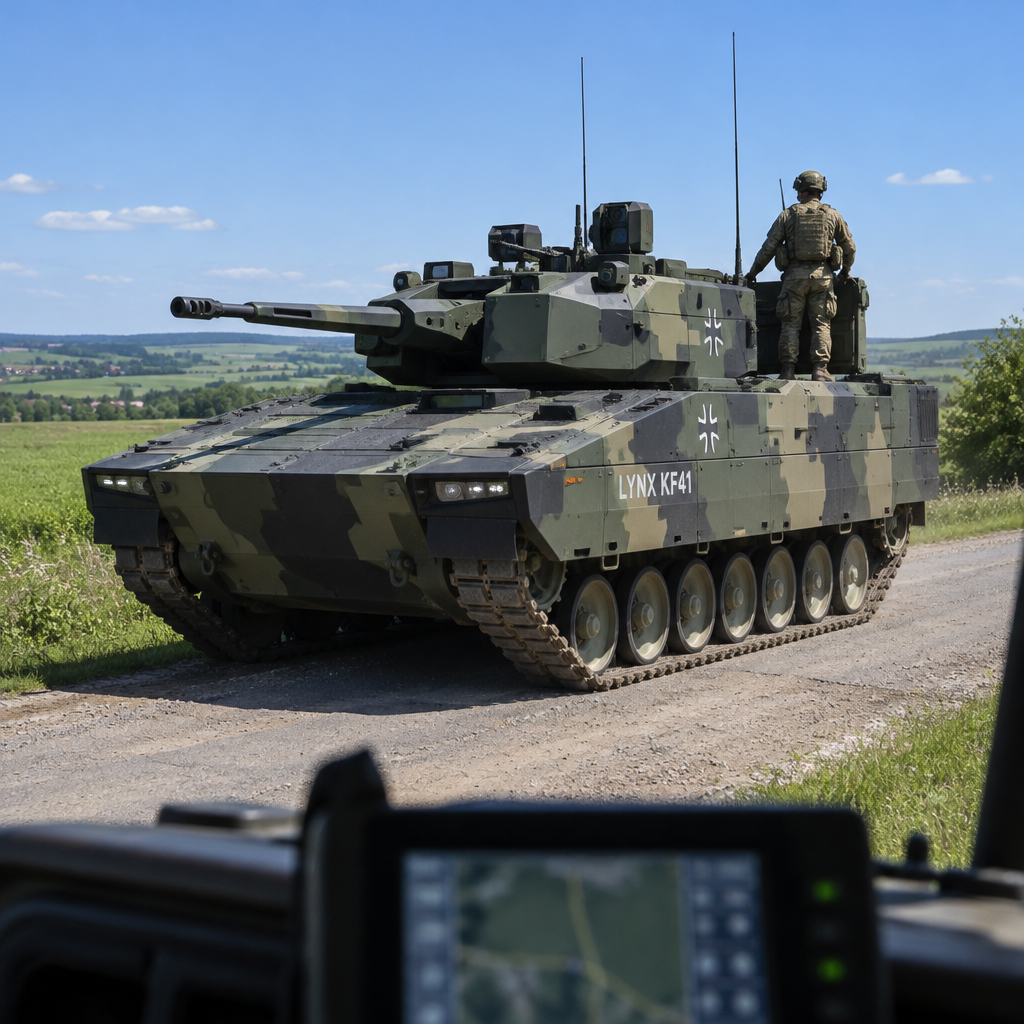
Ukraine's 21st Separate Mechanized Brigade has received its first batch of Lynx KF41 Infantry Fighting Vehicles from Germany, the brigade announced on Telegram. The delivery follows a Rheinmetall deal confirmed in January. The initial tranche for the brigade totals five IFVs, a package described in the source as financed by the German government and worth a "mid double-digit million euro" sum. The vehicles came new from the factory, with one soldier noting some had only 10 kilometers on the odometer.
How the brigade intends to use the Lynx — including counter-drone duties
The brigade released video in which troops explained planned missions. In addition to transporting infantry and engaging ground targets, soldiers said they will "also use this vehicle to combat enemy UAVs." The Lance 2 turret fitted to the Ukrainian KF41 carries a 30mm autocannon and a 12.7mm machine gun in a remote weapon station. The 30mm fires Rheinmetall’s AHEAD programmable airburst round, which the source describes as releasing a cloud of shrapnel "just ahead of a target," increasing kill probability against low-flying aerial threats. One soldier described the firing technique: "And we fire a five-round salvo at the target. The shells explode in front of the target, creating a cloud of shrapnel."

Audit-ready is a season. It shouldn't be.
Evidence in spreadsheets, controls drifting between audits, frameworks multiplying on flat headcount. Nubivance runs continuous compliance on Rapid7 Cyber GRC - SOC 2, HIPAA, ISO 27001, PCI, CMMC.
End the scrambleCapabilities and limits of the KF41 as an anti-drone asset
The source notes several operational constraints that shape how effective a Lance-equipped KF41 can be against aerial threats. The AHEAD rounds can engage small drones, and the 30mm cannon has a typical effective range around 1.8 miles. However, engaging rockets and mortar projectiles with airburst ammunition requires special sensors. The vehicle as fielded to Ukraine has no visible radar system; Rheinmetall describes the Lance as a multi-role system with a counter-drone upgrade, but the KF41 would likely need to rely on passive sensors, external cueing, and visual acquisition through its optics to detect and lock onto small, fast aerial targets. That mix of capabilities means the Lynx can be effective in certain circumstances, the source says, but it is "not an optimized air defense system for that purpose with its own active sensors."
Protection, transport, and other mission uses
Beyond anti-drone tasks, the 21st Brigade will use the KF41 to move troops and engage Russian infantry and light armored vehicles. The Lynx has a standard crew of three and can transport a squad of up to eight infantry. Its protection suite is designed to defend against certain anti-armor weapons, medium-caliber ammunition, artillery shrapnel, and bomb blasts; customers can also specify active protection systems. The design emphasizes mobility (a top speed of up to 50 miles per hour) and a spacious turret and troop compartment. The AHEAD rounds also offer the ability to detonate behind cover, increasing utility against concealed targets while reducing collateral damage when used correctly.
Rheinmetall's export strategy, variants, and broader procurement context
Rheinmetall developed the Lynx with an export market in mind, the source says, using more commercial off-the-shelf automotive parts to lower cost and ease logistics. The KF41 is larger and heavier—about 44 tons—than the KF31. Rheinmetall has offered multiple mission-specialist Lynx variants: mortar carrier; heavy fire support vehicle; a self-propelled anti-aircraft Skyranger 30 with its own radar and short-range missiles; command-and-control, reconnaissance, recovery, and ambulance versions. The Skyranger 30 is described as fully optimized for air defense, with radar and short-range missile systems, but it “lacks the flexibility of the Lance 30 equipped variant” that Ukraine received. The KF41 is also on a shortlist to replace the Bradley in the U.S. Army’s XM-30 program: American Rheinmetall Vehicles and General Dynamics Land Systems are each building prototypes for that program, the source reports.
What this means for the 21st Brigade, Rheinmetall, and Ukrainian air defenses
- 21st Separate Mechanized Brigade — Will employ the KF41 for troop transport, direct fire against infantry and light armor, and as an ad hoc counter-drone platform; soldiers completed six weeks of intensive training in Germany with daily driver/mechanic sessions and separate commander/gunner training, including night firing and live exercises.
- Rheinmetall — Gains a live operational testbed for the KF41 in Ukraine, where battlefield conditions and ubiquitous aerial threats can demonstrate variant strengths and weaknesses for export customers.
- Ukrainian air defenses and combined-arms commanders — May need to continue integrating external sensors and cueing systems to help Lance-equipped Lynx acquire swarms and small unmanned systems effectively, given the vehicle’s lack of an onboard radar in the fielded configuration.
Ukraine’s Lynx KF41s arrive into an environment where Russian uncrewed aerial threats range from small FPV and fiber-optic reconnaissance drones to jet-powered one-way attack drones and Geran 4 systems described as increasingly problematic. The vehicles’ factory-fresh condition and the brigade’s recent intensive training create favorable conditions for an initial operational assessment; whether a Lance 30 without its own active sensors can consistently counter the spectrum of threats remains the central, observable question moving forward.