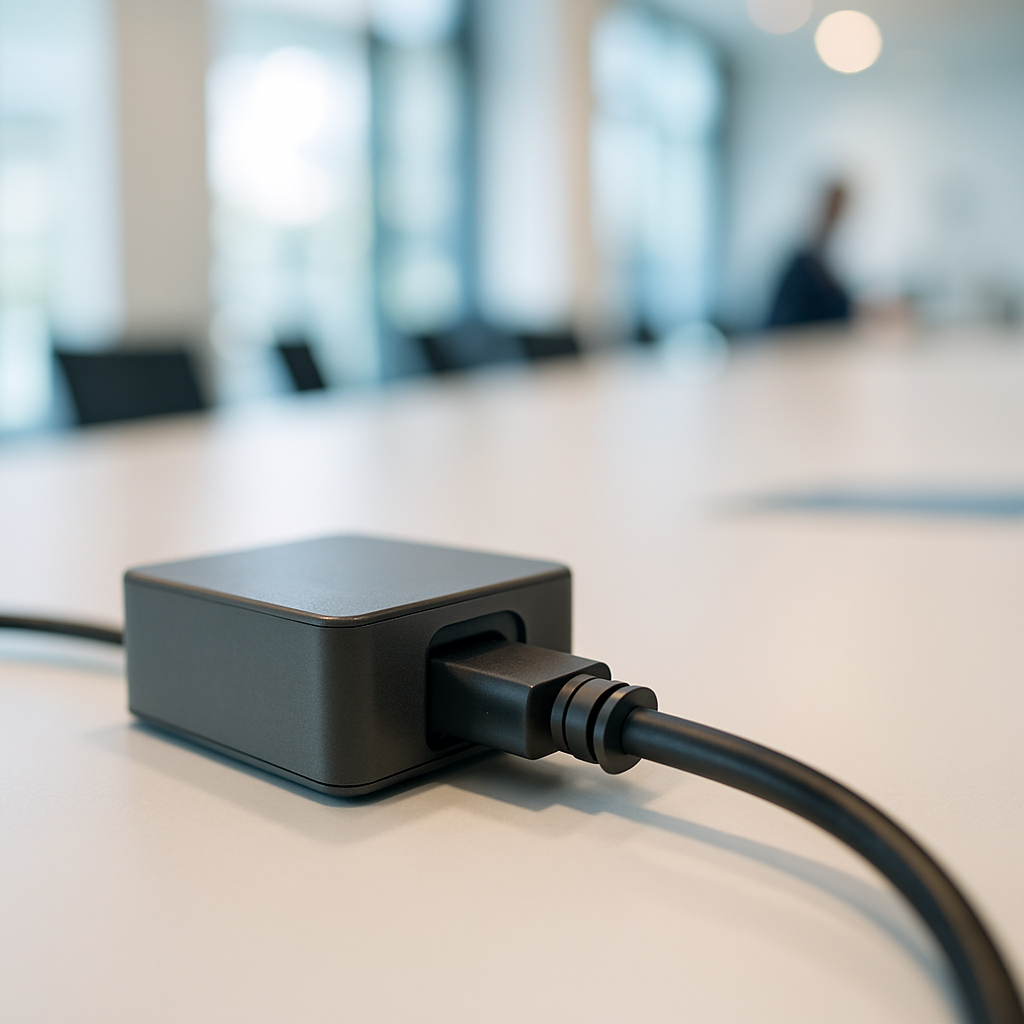
NCSC unveils SilentGlass at CyberUK in Glasgow
The United Kingdom's National Cyber Security Centre (NCSC), part of intelligence agency GCHQ, unveiled a plug‑and‑play gadget called SilentGlass during its annual CyberUK conference in Glasgow, Scotland. The device is designed to protect desktop monitors by having users run monitor cables through a small hardware unit. The NCSC designed SilentGlass and licensed the design to British secure‑hardware maker Goldilock Labs.
Product details: HDMI and DisplayPort versions, USB‑C left out
SilentGlass is being released in two variants: one for HDMI connections and another for DisplayPort. Officials noted that users relying on USB‑C will not be covered by the current device—"Anyone using USB‑C apparently will just have to risk it," the reporting says. The NCSC also indicated additional devices could follow to protect other common peripheral connections such as keyboards and mice.

Audit-ready is a season. It shouldn't be.
Evidence in spreadsheets, controls drifting between audits, frameworks multiplying on flat headcount. Nubivance runs continuous compliance on Rapid7 Cyber GRC - SOC 2, HIPAA, ISO 27001, PCI, CMMC.
End the scrambleGoldilock Labs' pitch: governments and critical national infrastructure
Goldilock Labs is marketing SilentGlass to "governments and risk‑conscious organizations." The company expects demand particularly from organizations operating in critical national infrastructure environments, including those that need to secure operational technology systems. The NCSC framed the device as a tool to protect an often‑overlooked piece of office equipment that nonetheless contains digital components attackers could exploit.
Why monitors are a concern: processors, supply chains, and past research
The NCSC's announcement stressed that monitors, which may appear simple, often include processors that could be abused to steal data or manipulate on‑screen content. The agency warned about supply‑chain attack vectors that could introduce malicious functionality at manufacturing, during fulfillment, or after deployment—either at the hardware or software level.
There is some public data suggesting the risk isn't entirely hypothetical. Market researcher Omdia reported last year that Chinese manufacturers control 80% of the display glass market in North America, a statistic the NCSC cited as part of the broader context for supply‑chain concern. Academic and industry researchers have also demonstrated monitor‑related techniques: a 2024 paper detailed the use of artificial intelligence to decode electromagnetic emissions from an HDMI cable, and a 2020 paper showed malware could imperceptibly vary monitor brightness levels to exfiltrate data to a video camera.
At the conference, government officials declined to comment on whether they have observed backdoored monitors being used to compromise systems in either the public or private sectors.
Skepticism, advocacy, and the debate over scope
The device has prompted an immediate debate. Scottish hacking personality Scott McGready tweeted: "Can anyone genuinely tell me what risk this is addressing or is it a solution in search of a problem?" NCSC proponents, by contrast, argue SilentGlass fills a gap by protecting an overlooked peripheral with a simple, deployable gadget. The tension comes down to demonstrable incidents versus plausible attack vectors and the balance organizations will strike between mitigation cost and perceived risk.
How governments, critical national infrastructure, and enterprise IT are likely to respond
- Governments: May consider SilentGlass for sensitive environments and procurement lists because the NCSC designed and endorsed the device and licensed it for British manufacture.
- Critical national infrastructure operators: Are a named target market; organizations running operational technology systems may pilot or evaluate the device where monitors interface with OT networks.
- Enterprise IT and procurement leaders: Will note the device's limited scope (HDMI and DisplayPort only) and the stated possibility of follow‑on devices for other peripherals; they will have to weigh whether to deploy SilentGlass now or await broader coverage, including USB‑C solutions.
SilentGlass concentrates attention on a peripheral most security programs rarely treat as an active risk. The NCSC has laid down a concrete mitigation and licensed it to industry; whether the device becomes standard kit for high‑risk environments will depend on how organizations judge the plausibility of supply‑chain and in‑field monitor compromise—and whether future devices expand protection beyond HDMI and DisplayPort. Read the original announcement at the source below.



