"Display screens and monitors are everywhere in modern business environments, and the SilentGlass device will help protect previously vulnerable IT infrastructure with unprecedented ease," said Ollie Whitehouse, the NCSC's chief technology officer.
GCHQ's cyber arm, the NCSC, pushes hardware into the marketplace
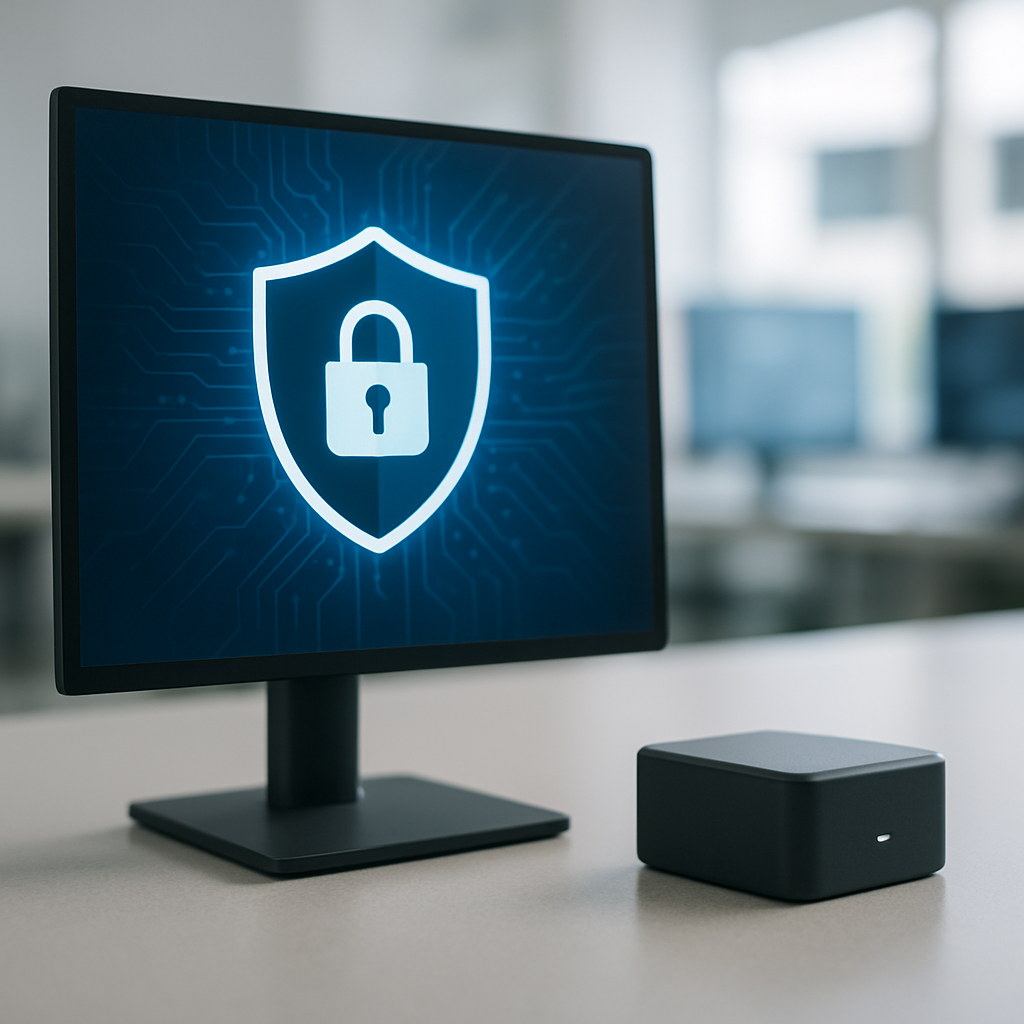
The UK's National Cyber Security Centre (NCSC) — described in the source as GCHQ's cyber arm — has for the first time released a branded hardware device designed to stop attacks on external displays. Called SilentGlass, the gadget's intellectual property is credited to the NCSC, and the signals-intelligence agency licensed it to UK-based Goldilock Labs for commercial sale. The NCSC said SilentGlass has already been deployed across "government estates" for several years and is capable of protecting "most high-threat environments."
What the SilentGlass gadget is and how it is sold
SilentGlass comes in two separate models: one compatible with HDMI and another for DisplayPort. Each unit protects a single cable. According to reporting in The Register, the devices are equipped with hardware that identifies malicious traffic in the video data channel and blocks transfers between a computer and its display; the devices are described as threat-agnostic, meaning they will purportedly detect and block "any kind of nastiness" that could alter or manipulate a monitor's output.

The cyber insurance questionnaire just landed. Now what?
SOC 2, HIPAA, insurance renewals - someone has to own security strategy. Nubivance provides fractional CISO leadership without the full-time salary.
Get a security leadResearch antecedents: electromagnetic eavesdropping and parser flaws
The move follows limited but pointed research into display-related attack vectors. A 2024 team at Universidad de la República in Montevideo published findings called Deep-TEMPEST, showing the potential for technically sophisticated actors to intercept electromagnetic emissions from HDMI cables and reconstruct text intended for a monitor. Earlier work, referenced from conference archives, includes NCC Group presentations — from Black Hat or 44con in 2012 — about exploiting HDMI's EDID and CEC parsers and related CDC and NEC protocols. The source cautions that these are largely fringe cases and that side-channel and parser attacks differ in real-world application from remotely exploitable software flaws.
Goldilock Labs, Sony UK partnership, and the commercialization question
Goldilock Labs, with a stated partnership with Sony UK, holds the license to produce and sell SilentGlass. Stephen Kines, co-founder of Goldilock Labs, said the device addresses a security problem "widely overlooked" because many have not treated HDMI and DisplayPort as serious security boundaries. Kines added SilentGlass is "the first step in a wider effort to enforce behaviour at hardware interfaces before it reaches complex software."
The NCSC declined to answer additional questions from The Register, and the agency would not provide a price. The Register reported it is waiting on Goldilock Labs to disclose pricing and further commercial details.
What this means for technologists, critical national infrastructure operators, and procurement teams
- Technologists and security teams: The device offers a hardware control point for video outputs; teams responsible for air-gapped or high-assurance systems may consider a physical filter for display traffic where parser or side-channel risks are a concern.
- Critical national infrastructure (CNI) operators: The source frames the product as appropriate for "high-threat environments" and notes the NCSC's view that external monitors are "a hugely attractive target" for espionage-focused adversaries, implying selective deployment where the threat model includes sophisticated intercept or manipulation attempts.
- Procurement and commercial buyers: SilentGlass is being positioned as an affordable, easy-to-deploy solution for customers where the same risks seen in national-security contexts exist; however, price and broader product specifications were not disclosed by the NCSC and await confirmation from Goldilock Labs.
The NCSC placed the launch against a backdrop of state-level concerns: the agency's timing coincides with its CEO, Richard Horne, characterising China as "a peer competitor in cyberspace" amid steadily occurring nationally significant cyberattacks against the UK — and the NCSC noted that attackers seeking disruption or financial gain could include other nation-states such as Russia, Iran, and North Korea.
SilentGlass brings a government-developed countermeasure into the open market, packaged for organisations that treat display interfaces as potential attack surfaces. The immediate questions left in plain view are practical: how much will the units cost, how easily will they scale across enterprise deployments if each device protects a single cable, and how defenders will weigh these hardware controls against the rarity of published real-world attacks of the types described. Goldilock Labs and the NCSC are now the named actors to watch as the product moves from government estates into broader commercial availability.