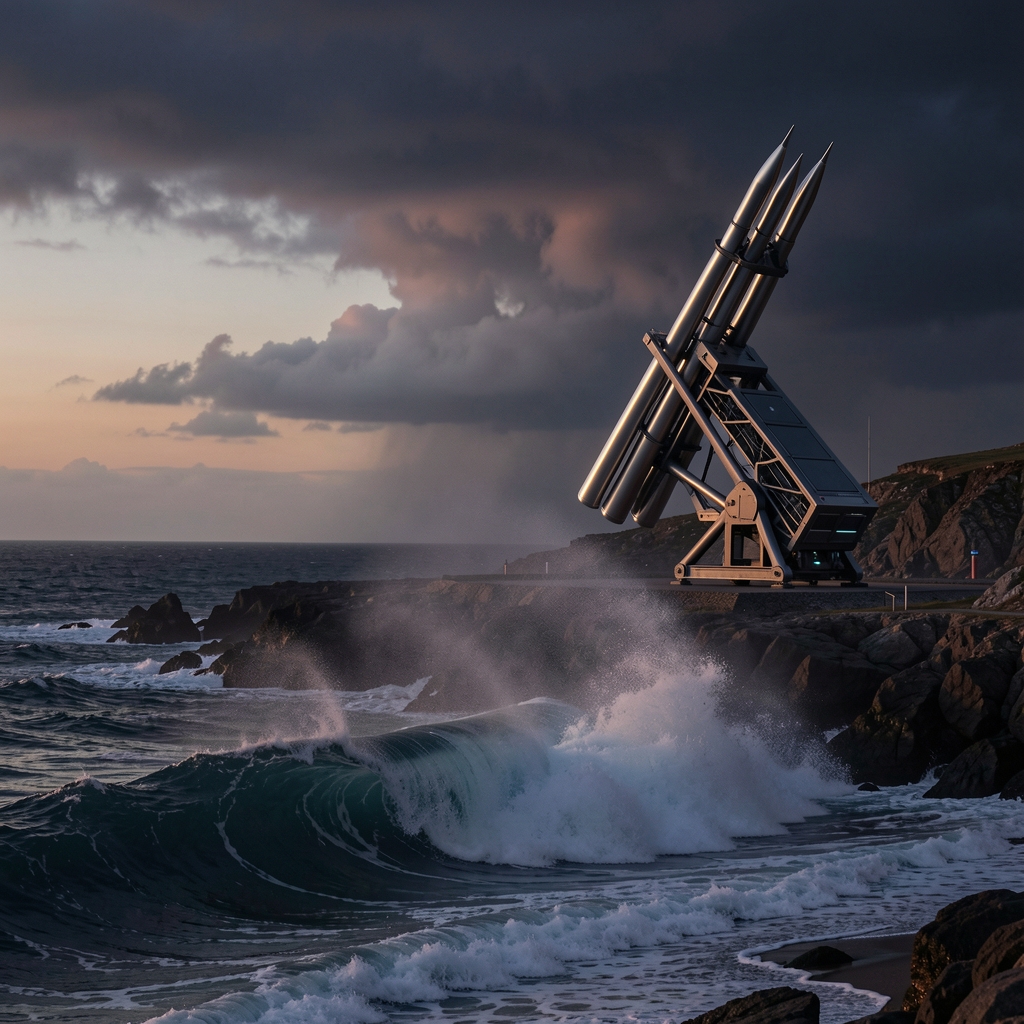
What happens when a land force long synonymous with valleys and deserts turns its attention to the high seas? That question moved decisively from theory to practice this summer when the U.S. Army fired a missile at a maritime target in the Pacific for the first time. The shot, executed during the biennial Talisman Sabre exercise in Australia, used a new system known publicly as the Typhon launcher — a development that signals a growing willingness to blur traditional service boundaries and bring land-based fires to bear on naval problems.
The Typhon shot at Talisman Sabre was not a publicity stunt. Embedded within one of the Indo‑Pacific’s largest multinational rehearsals for high-end joint operations, the demonstration tested more than a missile and a tube: it validated the integration of sensors, targeting networks, and command-and-control links required for an Army unit to prosecute a moving maritime target. That integration — linking satellites, aircraft, shipborne radars and ground sensors into a coherent kill chain — is as consequential as any single projectile.
H2: Typhon launcher — what it means for multi-domain fires
The Typhon launcher represents a modular, road-mobile approach to long-range fires, allowing land forces to threaten maritime targets previously the purview of navies. Its significance is threefold. First, land-based launchers are inherently more dispersed and harder to find and preempt than ships, complicating an adversary’s targeting calculus. Second, they give allies more operational options if naval access to littoral zones is contested. Third, they force a reexamination of escalation dynamics and maritime norms: who can lawfully and credibly fire on ships, from where, and under what authority?
Technologically, the Typhon demonstration synthesizes several trends that have reshaped warfare over the past decade: mobile launch platforms; sensor fusion that mixes space, air and maritime data; and agile software that enables rapid retargeting. These elements shorten the kill chain by collapsing sensor-to-shooter timelines and reducing dependence on any single node. But the same networked architecture introduces vulnerabilities — jamming, cyber intrusion, and spoofing can undermine effectiveness, while complex software stacks pose certification and reliability challenges.
Strategic and operational implications
Strategically, the Army’s maritime shot complicates an adversary’s ability to achieve uncontested sea control. Distributed and land-based lethality increases the cost of aggression by expanding the set of targets that can be held at risk from shore. For coalition forces operating under pressure — for instance, if naval units are pushed back or denied access to forward waters — Army fires can help defend sea lines of communication and create dilemmas for an opponent.
Operationally, however, prosecuting a moving ship from land is hard. Continuous tracking, rapid strike authorization, and meticulous deconfliction are essential in crowded littorals filled with civilian traffic and neutral actors. Exercises like Talisman Sabre are valuable precisely because they expose these frictions under realistic conditions: they test sensor handoffs, timing of engagement authorities, interservice communications, and legal vetting processes. Those practice runs help identify what has to be institutionalized in doctrine and training before such capabilities are used in crisis.
Policy, legal, and alliance considerations
Adding land-based anti-ship fires raises thorny policy and legal questions. Maritime law and peacetime navigation norms intersect with any decision to strike a vessel from shore. Allies will need shared understandings about when and how land-based strikes at sea are escalatory, what thresholds trigger broader responses, and how to avoid collateral harm to neutral parties. Clear doctrine, rules of engagement, and command relationships are prerequisites for responsible use; without them, cross-domain fires risk muddling accountability and complicating coalition decision-making.
From a defense‑planning perspective, investing in systems like Typhon involves tradeoffs. Expanding long-range land-based strike capability enhances redundancy and deterrence, but it draws funding and industrial capacity away from other priorities such as amphibious lift, carrier escorts, logistics, and forward basing. Planners must weigh the benefits of cross-domain flexibility against the realities of budgets and the limited number of resources for force modernization.
Adversary reactions and countermeasures
Adversaries will notice and adapt. A credible land-based anti-ship capability invites countermeasures: direct strikes on launchers and sensor nodes ashore, mines and sea-denial tactics, and sophisticated electronic warfare campaigns aimed at disrupting networks. The Typhon shot is therefore not an isolated experiment; it is a strategic prompt that will shape adversary force posture and targeting priorities as much as it refines U.S. and allied operational concepts.
Toward integrated deterrence
None of this implies the Navy is being supplanted. Rather, the Typhon launcher demonstration underscores a trend toward genuine jointness: the Army offering complementary options to naval power and the services learning to mesh capabilities across domains. When integrated thoughtfully, such approaches multiply dilemmas for an adversary and enhance deterrence. But success depends on clear command relationships, robust interservice training, shared rules of engagement, and resilient sensor and communications networks.
Conclusion: Typhon launcher and the future of maritime conflict
The Typhon launcher’s maritime shot at Talisman Sabre was more than a weapons test; it was a test of doctrine, alliance coordination, and the evolving logic of multi-domain warfare. As anti-ship capabilities diffuse and domains overlap, effective deterrence will hinge on adaptability, integration, and legal-political clarity as much as on any single platform. The more land and sea become interchangeable battlegrounds, the more urgent the questions: can targeting and sensor networks be hardened for contested environments, will allies align on norms for land-based strikes at sea, and how will adversaries ultimately respond? The Typhon demonstration shows the direction of travel — now militaries and policymakers must decide how far to follow.