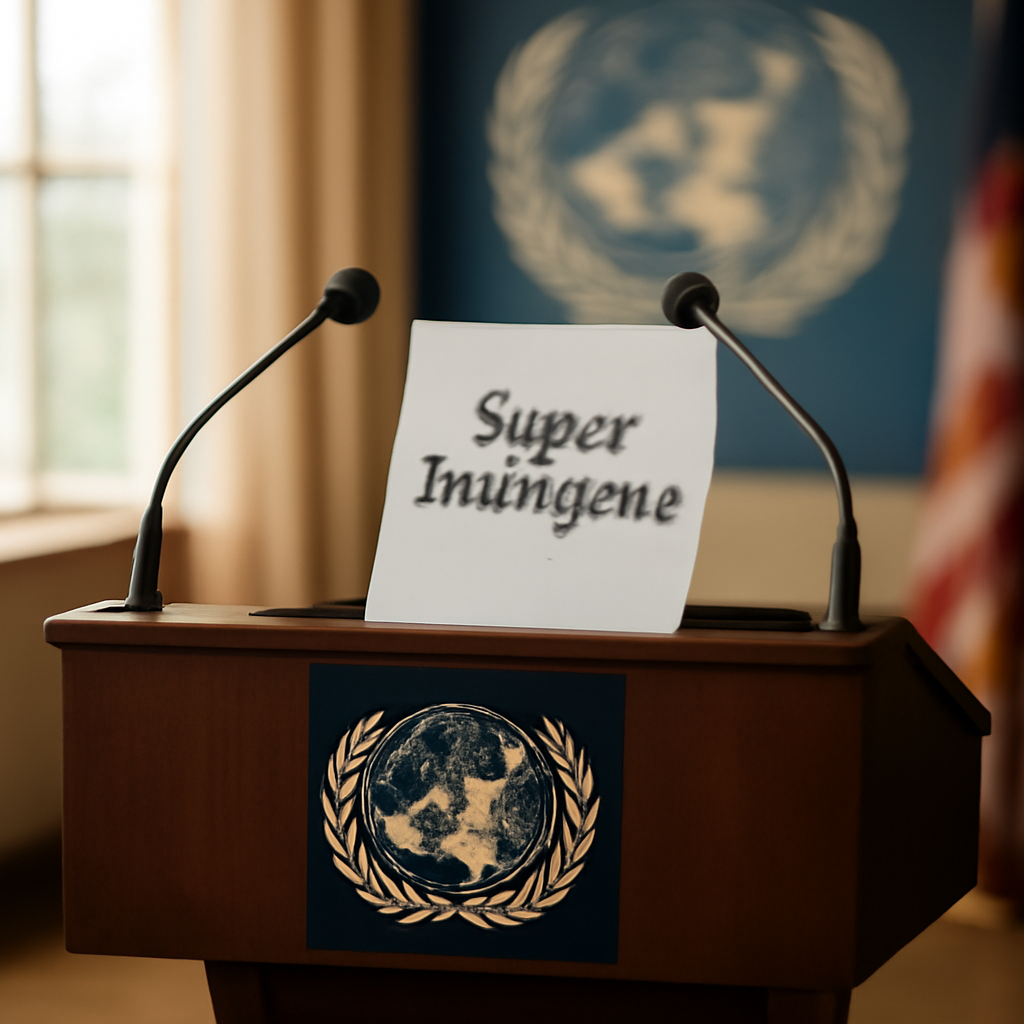
"From this point forward, all of United States’ documents, and hopefully the world’s, will be changed to use the much more accurate term, ‘super,’ as opposed to ‘artificial’," President Donald Trump said on Tuesday at the United Nations General Assembly.
President Donald Trump’s renaming at the United Nations General Assembly
At the U.N. General Assembly, the president announced a formal rebranding of the phrase "artificial intelligence" to "super intelligence." He said the United States’ documents will adopt the new terminology and expressed the hope that other countries will follow. The remark was tied explicitly in his remarks to an economic and geopolitical framing: Trump reportedly worries that an AI slowdown could cause a market crash, and he framed “super intelligence” as a sector the United States must win to remain ahead of China. “Whoever wins AI, you have to remember this, and now I say, whoever wins SI, whoever wins super intelligence, wins. That’s the group that wins,” he said.
What "superintelligence" originally meant in Nick Bostrom’s work
The word "superintelligence" is already established in academic and policy discourse. Philosopher Nick Bostrom popularized it in his 2014 book Superintelligence, where he defined it as “any intellect that greatly exceeds the cognitive performance of humans in virtually all domains of interest.” In that framing, artificial superintelligence (ASI) denotes systems much smarter than humans and stands a step beyond artificial general intelligence (AGI).
OpenAI’s definition of AGI, cited in the record, is “highly autonomous systems that outperform humans at most economically valuable work.” The article notes that by this definition, today’s AI is not yet AGI, and therefore not ASI — “we can’t yet hire AI as a reliable virtual employee,” the piece observes.

Audit-ready is a season. It shouldn't be.
Evidence in spreadsheets, controls drifting between audits, frameworks multiplying on flat headcount. Nubivance runs continuous compliance on Rapid7 Cyber GRC - SOC 2, HIPAA, ISO 27001, PCI, CMMC.
End the scrambleScholarly pushback: Kapoor, Narayanan, and other critics
Not everyone accepts “superintelligence” as a coherent or useful relabel. The 2025 paper “AI as Normal Technology,” by Sayash Kapoor and Arvind Narayanan, is quoted: “We do not think there is a useful sense of the term ‘intelligence’ in which AI is more intelligent than people acting with the help of AI.” That line of critique argues the concept blurs human–machine collaboration rather than describing a singular, superior intellect.
At the same time, other observers see value in emphasizing rising machine capabilities. Caleb Withers, a research associate in the Technology and Security Program at the Center for a New American Security, said “‘Super’ does align well with the fact that AI is exceeding human capabilities in a growing range of tasks and by increasing margins, which can have distinct national security implications beyond simply matching human performance.”
OpenAI’s September announcement and the larger U.S.–China context
The article cites a concrete demonstration of advancing AI capability: in early September, OpenAI announced a solution to the Navier–Stokes Millennium Prize problem, a major open problem in mathematics. That kind of capability jump is offered as part of the rationale for heightened attention to the technology.
The story places the renaming in a diplomatic frame: Trump and Chinese president Xi Jinping were slated to meet this week to discuss trade and AI issues. Bostrom’s warning about an intense AI race is quoted: “If competitors are convinced that coming second [in the AI race] means the total loss of everything they care about, they will take whatever risk necessary to bypass their rivals,” he said. The article connects such warnings to Trump’s public framing of AI — now “super intelligence” — as a national strategic priority.
What this means for policymakers, technologists, and markets
- Policymakers and diplomats: The president’s announcement signals an intention to relabel official documents and to elevate the concept in bilateral talks — notably those with China — where trade and AI are on the agenda.
- Technologists and security researchers: Experts quoted in the piece are split between those who see the term as aligning with measurable capability growth and those who reject it as imprecise; the Navier–Stokes result from OpenAI is offered as evidence of accelerating technical leaps that some argue justify stronger terminology.
- Markets and business leaders: The article reports the president’s explicit concern that an AI slowdown could trigger a market crash, and his framing implies that economic and competitive stakes will inform U.S. strategy going forward.
Renaming matters less as a semantic exercise than as a political and diplomatic signal. By proposing that U.S. documents adopt "super intelligence" and linking the term directly to competition with China and to market stability, the president has shifted the language that will shape forthcoming conversations — at the U.N., in bilateral meetings, and inside agencies that must decide whether and how to change terminology and policy. Whether the phrase alters technical definitions, regulatory approaches, or international cooperation remains to be played out at the negotiating table.